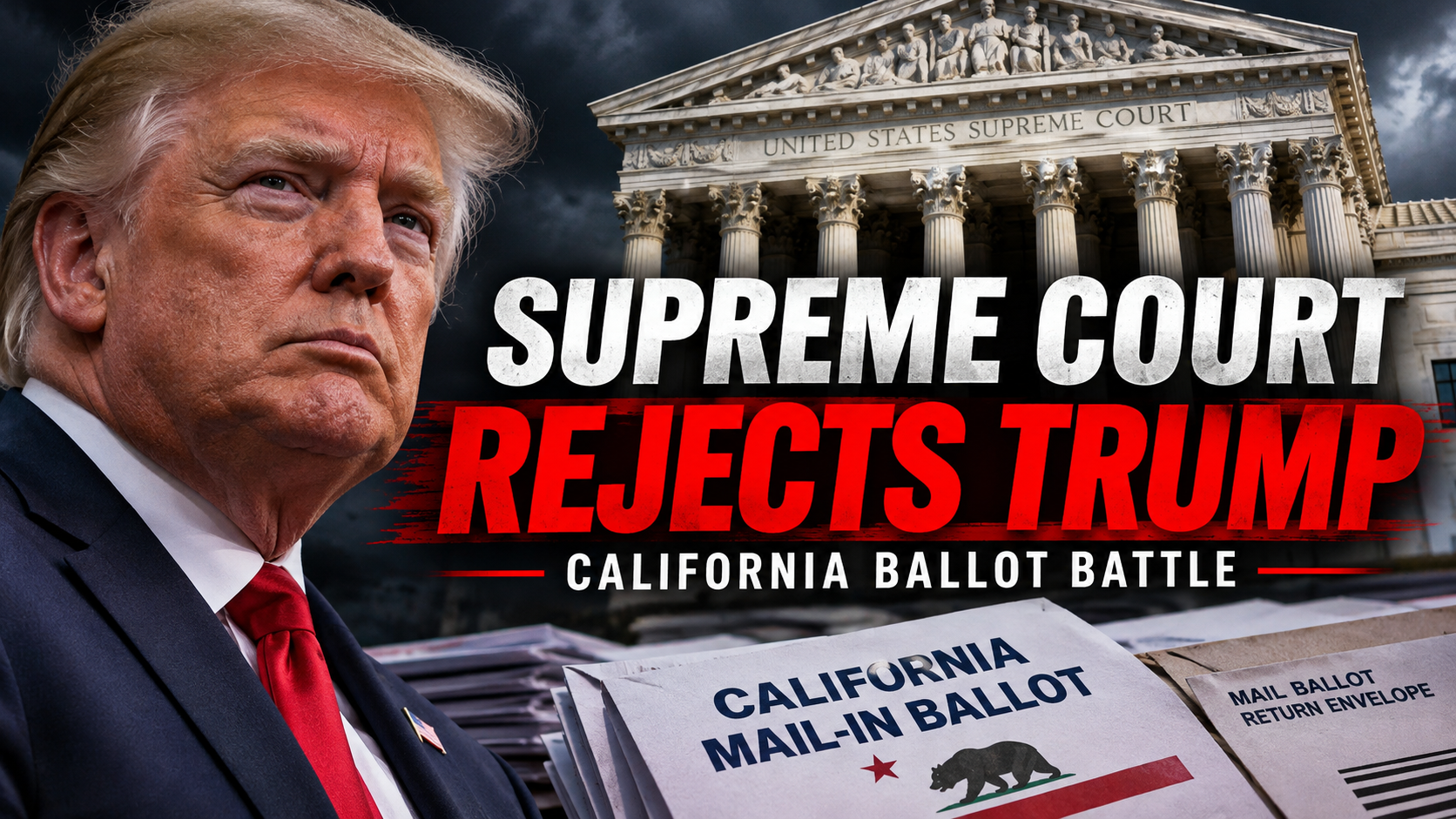
The U.S. Supreme Court rejected the Trump administration's emergency request involving more than 20,000 California registered voters ahead of the November 3 midterm elections.
WASHINGTON, November 3, 2026 — With America’s midterm elections just hours away, a bitter legal confrontation over thousands of California ballots has reached the highest court in the country.
And President Donald Trump’s administration has suffered a significant defeat.
On Monday, November 2, the U.S. Supreme Court rejected an emergency request from the Trump administration to prevent California from counting mail-in ballots associated with more than 20,000 registered voters whom federal officials suspect may not be American citizens.
The ruling came without an explanation or publicly noted dissent.
But behind that brief decision lies a much larger confrontation over election integrity, federal authority, and the increasingly fragile trust Americans place in their electoral system.
The 20,000-Ballot Controversy
The Justice Department argued that federal agencies had identified more than 20,000 registered California voters who were potentially ineligible because they might not be U.S. citizens.
🔴 Help keep this independent voice alive and uncensored.
Support independent journalism and help keep Real Raw News going.
👉 Support Chris Wick on GoFundMe
Federal officials wanted California election authorities to separate ballots associated with those individuals and prevent them from being counted until citizenship could be verified.
The administration maintained that allowing disputed ballots to be mixed with legitimate votes could make subsequent investigations or legal remedies significantly more difficult.
Its argument was straightforward: federal law prohibits noncitizens from voting in federal elections, and election officials should ensure that only eligible voters participate.
But there was a serious problem.
The administration had not established that the thousands of individuals on its list were actually noncitizens.
California officials challenged the accuracy of the federal government’s information, warning that legitimate American voters could lose their voting rights because of unreliable records.
Federal Judges Were Not Convinced
Before the dispute reached the Supreme Court, U.S. District Judge David Carter rejected the administration’s request for emergency intervention.
Carter questioned the reliability of the government’s evidence and warned against allowing unproven allegations to disrupt an ongoing election.
The Ninth Circuit Court of Appeals subsequently declined to grant the administration’s requested relief.
The Supreme Court’s November 2 decision left those refusals intact.
Importantly, the ruling did not establish that every person identified by federal authorities was eligible to vote.
Nor did it determine that noncitizen voting had occurred.
It simply meant that the administration had failed to obtain the emergency judicial intervention it requested.
That distinction matters.
Election Integrity or Federal Overreach?
The confrontation exposes two legitimate concerns that should not be treated as mutually exclusive.
American elections must be protected against illegal voting.
But eligible American citizens must also be protected against losing their votes because government databases contain inaccurate or outdated information.
The Constitution gives states primary responsibility for administering elections, while federal law establishes important protections and requirements.
The Trump administration argues that enforcing federal citizenship requirements is necessary to preserve election integrity.
California counters that federal officials are attempting to interfere with established state election procedures without sufficiently reliable evidence.
Both arguments deserve scrutiny.
What should concern Americans is the possibility that election administration becomes another battlefield where political objectives overshadow transparent, verifiable evidence.
Why California Matters
California holds 52 seats in the U.S. House of Representatives, making it an important state in the battle for congressional control.
Republicans entered the November 3 elections fighting to preserve their majorities in Congress.
Democrats, meanwhile, are attempting to regain control of the House and potentially challenge Republican dominance in Washington.
Against that backdrop, a dispute involving more than 20,000 registered voters has consequences extending beyond the immediate legal proceedings.
However, there is no established evidence that the disputed ballots would determine control of Congress.
The political stakes do not eliminate the need for proof.
Final Thought: The Real Danger Is Losing Public Trust
Here is the uncomfortable question Washington should be asking.
How can Americans trust an election system when federal authorities and state officials cannot even agree on whether thousands of registered voters are eligible?
The answer cannot be to automatically accept every government allegation.
Nor can it be to dismiss legitimate concerns about election integrity without investigation.
The solution requires accurate records, transparent procedures, enforceable laws, and evidence that survives independent judicial scrutiny.
The Supreme Court has rejected Trump’s emergency request.
But it has not resolved the broader conflict over federal election enforcement and state authority.
And as Americans head to the polls, that unresolved confrontation remains another reminder of how deeply political America’s election machinery has become.
The question is no longer simply who wins the election. It is whether Americans will trust the process that produces the winner.
Sources
- Reuters — U.S. Supreme Court Rejects Trump, Lets California Count All Ballots (November 2, 2026)
- CBS News — Supreme Court Rejects Trump’s Effort to Force California to Separate Mail Ballots
- Axios — Trump Administration Turns to Supreme Court in California Ballot Case
About the Author