Political spending in America's 2026 midterm elections is projected to reach $11.9 billion, raising questions about billionaire influence and campaign finance transparency.
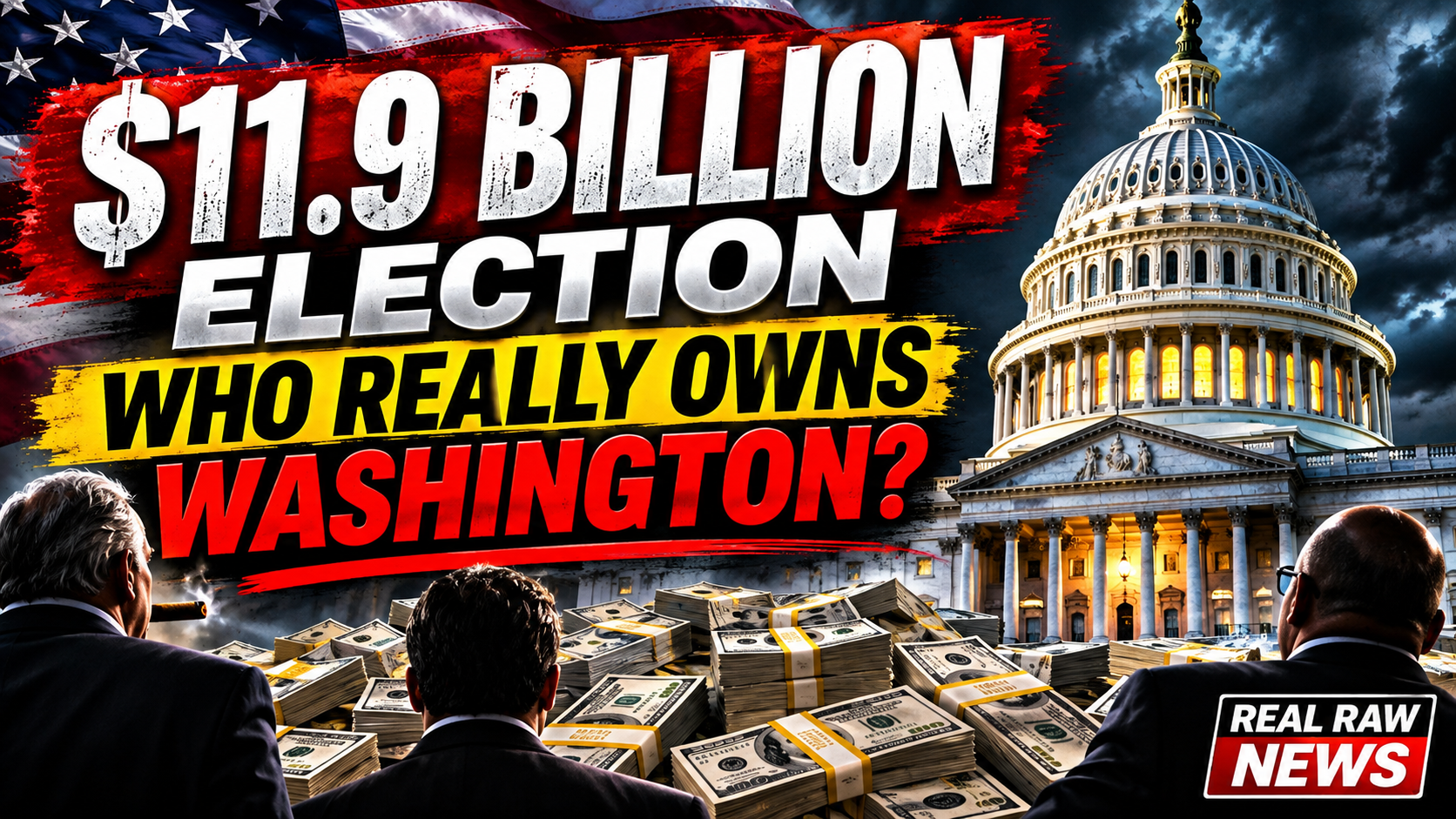
$11.9 BILLION. That’s how much America’s 2026 midterm elections are expected to cost. And while ordinary Americans struggle to pay their bills, the political money machine is operating at full throttle.
Let that number sink in.
Nearly twelve billion dollars flowing through political campaigns, party organizations, and outside spending groups in an election that will determine who controls Congress.
According to the nonpartisan campaign-finance watchdog OpenSecrets, the 2026 election cycle is projected to become the most expensive midterm election in American history.
And the uncomfortable question is impossible to ignore.
When political power costs billions, who really owns Washington?
🔴 Help keep this independent voice alive and uncensored.
Support independent journalism and help keep Real Raw News going.
👉 Support Chris Wick on GoFundMe
The Billion-Dollar Political Machine
The numbers are staggering.
OpenSecrets estimates that total election spending will reach $11.9 billion, compared with approximately $8.9 billion during the 2022 midterms.
Outside political spending alone is projected to reach $3.9 billion, an increase of approximately 85% over 2022.
Much of that money comes through political action committees and super PACs, which can receive enormous contributions from wealthy individuals and organizations.
These groups can spend heavily to influence elections, although super PACs are legally required to operate independently of candidates’ campaigns.
The result is a political environment where television advertisements, digital campaigns, political messaging, and voter outreach can consume extraordinary amounts of money.
Meanwhile, ordinary Americans are being told to watch their spending.
Apparently, financial restraint is something politicians recommend more enthusiastically than their campaign organizations practice.
Billionaires Are Playing a Different Political Game
The influence of wealthy political donors is becoming increasingly difficult to ignore.
Reporting on the 2026 elections shows that billionaire donors are pouring hundreds of millions of dollars into political organizations.
Elon Musk has emerged as one of the largest Republican-aligned contributors, while other wealthy donors have directed substantial resources toward Democratic candidates and organizations.
Both political parties benefit from major financial backers.
This isn’t exclusively a Republican problem.
It isn’t exclusively a Democratic problem.
It’s a political system increasingly dependent on extraordinary concentrations of private wealth.
Financial contributions do not automatically establish corruption or prove that politicians are exchanging favours for money.
But they raise legitimate questions about access, influence, and accountability.
When one donor can contribute more money than thousands of ordinary citizens combined, Americans have every reason to question whether political influence is distributed fairly.
The Dark Money Problem
Perhaps the most troubling development involves political money whose original sources are difficult or impossible for voters to identify.
OpenSecrets reports that approximately $1.47 billion in dark-money contributions had already been identified during the 2026 election cycle.
These funds can move through organizations that are not required to publicly disclose every donor.
That creates a serious transparency problem.
Americans may see political advertisements attacking one candidate or promoting another without knowing who ultimately financed the message.
Was it a billionaire?
A corporation?
An organization seeking favourable government policies?
Without meaningful disclosure, voters may never know.
And that uncertainty undermines public confidence.
One Person, One Vote — But Not One Dollar
American democracy operates on a simple principle.
Every eligible voter gets a vote.
But political influence extends far beyond the ballot box.
Money purchases advertising, campaign infrastructure, professional consultants, sophisticated voter targeting, and the ability to dominate public attention.
A wealthy donor cannot legally purchase additional votes.
But substantial financial resources can help determine which political messages voters encounter repeatedly.
That distinction matters.
And it deserves serious public scrutiny.
Final Thought: Washington’s Most Expensive Addiction
Nearly twelve billion dollars.
That’s the projected cost of America’s latest political power struggle.
Not twelve billion dollars to repair infrastructure.
Not twelve billion dollars to improve healthcare.
But money spent attempting to influence elections.
To be clear, campaign expenditures are generally funded through political contributions and organizational resources, not a direct allocation of federal taxpayer money.
Still, the comparison exposes a disturbing contradiction.
While millions of Americans worry about their financial futures, political organizations have assembled extraordinary resources to fight for control of Washington.
The real danger isn’t simply that elections are expensive.
It’s that Americans may increasingly believe their votes matter less than the fortunes financing the campaigns.
And when citizens begin losing confidence that their voices can compete with powerful financial interests, democracy faces a problem no amount of political advertising can solve.
The voter has one ballot. The billionaire has millions of dollars.
Who do you think Washington listens to?
Sources
- OpenSecrets — Record $12 Billion Projected in 2026 Midterm Election Spending
- Reuters — What You Need to Know About the 2026 US Midterm Elections
- The Guardian — Who Funded the Midterms? Inside US Elections’ Historic Bipartisan Spending
About the Author