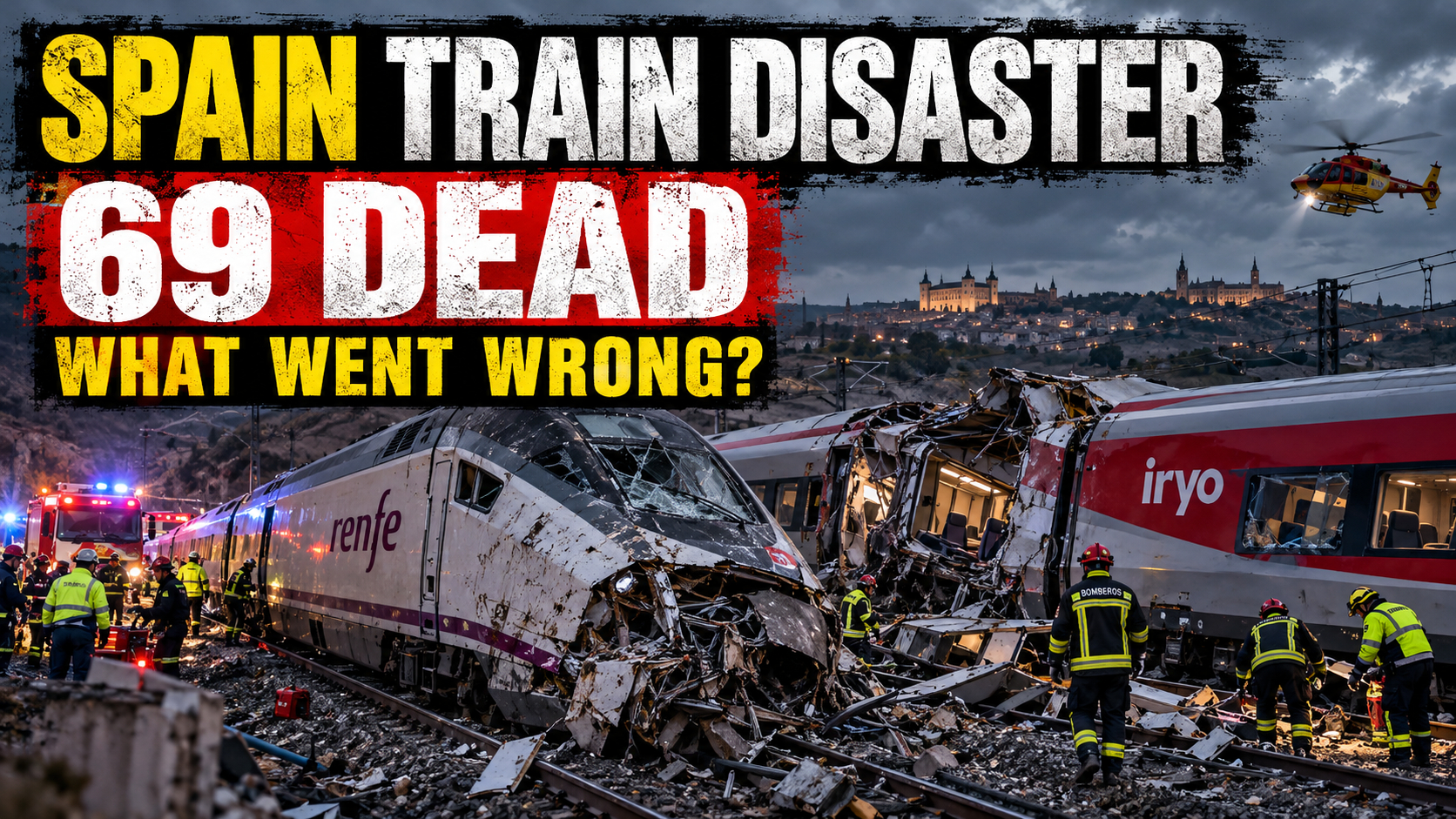
A deadly collision between two high-speed trains near Toledo, Spain, on October 28, 2026, has raised serious questions about railway signalling systems, emergency procedures, and passenger safety. Editorial illustration.
At least 69 people are dead after two high-speed trains collided in Spain. A failed safety system, a questionable decision inside a railway control centre, and warnings about outdated infrastructure have raised disturbing questions about whether this catastrophe could have been prevented.
A Deadly Collision That Should Never Have Happened
Spain built one of Europe’s most extensive high-speed railway networks, a transportation system designed around speed, efficiency, and sophisticated technology intended to protect passengers.
On October 28, 2026, that promise of safety suffered a devastating blow.
Two high-speed passenger trains collided near Toledo, approximately 118 kilometres south of Madrid by rail, killing at least 69 people and injuring more than 100.
The disaster occurred shortly before 9 a.m. when a Renfe high-speed train struck the rear of a stationary Iryo express train.
The impact was catastrophic.
🔴 Help keep this independent voice alive and uncensored.
Support independent journalism and help keep Real Raw News going.
👉 Support Chris Wick on GoFundMe
Carriages derailed, wreckage spilled down an embankment, and emergency crews faced the grim task of recovering victims from twisted metal.
But the most disturbing part of this tragedy is not simply that two trains collided.
It is that the railway’s protective systems had already detected a problem before the collision occurred.
What happened afterward is now at the centre of an investigation that could expose serious weaknesses in how Spain manages its high-speed railway network.
The Safety System Failed. Then Came a Decision With Deadly Consequences.
According to reporting by Reuters, the sequence of events began when an automatic railway safety system known as LZB malfunctioned along a 63-kilometre section of track south of Toledo.
At approximately 8:30 a.m., the failure caused six trains operating along the affected section to stop automatically.
That response was precisely what passengers would expect from a safety system: when something goes wrong, trains stop.
The trouble began when human controllers assumed responsibility.
At approximately 8:36 a.m., controllers operating from Madrid’s Atocha railway control centre authorised a Renfe train travelling toward Seville to continue.
An Iryo passenger train remained stationary farther along the same track.
The Renfe train subsequently accelerated, reportedly reaching speeds of approximately 200 kilometres per hour before striking the stopped train.
Spain’s Transport Minister, Óscar Puente, described the decision to allow the train to proceed as inexplicable.
The emerging evidence raises a critical question.
How could a railway designed to prevent collisions allow a train to accelerate toward another train that had already been stopped by a safety warning?
Investigators must determine exactly what information was available to controllers, what instructions were communicated, and whether established safety procedures were followed.
The Leaked Recordings Raise More Questions
Audio recordings reportedly leaked to Spanish media have added another troubling dimension to the investigation.
According to Reuters, the recordings appear to show a controller authorising the Renfe train to continue without first confirming whether the Iryo train ahead had resumed moving.
The recordings also suggest the driver was instructed to proceed at normal speed.
Under the applicable emergency procedures described in the reporting, trains should instead have proceeded at approximately 40 kilometres per hour.
That lower speed is intended to give drivers sufficient time to react to obstacles or stopped trains.
However, an important distinction must be made.
Railway unions have warned that the leaked recordings were edited and may omit essential context.
Consequently, the recordings cannot establish the complete sequence of decisions or determine individual responsibility on their own.
The investigation must examine the original communications, operational records, signalling information, and applicable safety protocols before assigning blame.
What is already clear is that the collision occurred after an automated safety intervention was followed by a decision permitting a train to resume its journey.
That sequence deserves exhaustive scrutiny.
An Outdated System and a Warning From the Past
The investigation is also raising questions about the technology protecting Spain’s high-speed railway network.
Salvador García-Ayllón, a professor at the Technical University of Cartagena, told Reuters that the LZB safety system was outdated and had been scheduled for replacement on the affected stretch of railway.
According to his assessment, that replacement should have occurred in 2021.
Five years later, the older system remained in operation.
An outdated system does not automatically mean an unsafe system. Nor does its continued use prove that it caused the accident.
Nevertheless, the delayed replacement raises legitimate questions about infrastructure priorities, maintenance planning, and the management of known technological limitations.
The issue becomes particularly significant when considering what happened earlier this year.
On January 18, 2026, another devastating railway accident occurred near Adamuz, in Córdoba province.
That disaster killed 46 people.
Both accidents occurred along the Madrid–Seville high-speed corridor, although their circumstances appear different.
The January accident involved a derailment followed by a collision with another train.
The October tragedy involved a stationary train being struck from behind after a signalling malfunction.
There is currently insufficient evidence to conclude that the two accidents share a common technical cause.
However, two deadly disasters on the same major railway corridor within a single year demand more than assurances that each incident will be investigated separately.
They demand a serious examination of the system itself.
Railway Workers Had Already Raised Safety Concerns
The latest catastrophe did not emerge against a background of complete silence about railway safety.
Spain’s train drivers’ union, SEMAF, had previously called for improvements to maintenance and operational safety.
Following the January disaster, discussions began between railway representatives and government officials.
According to the union, those negotiations ended in April without an agreement.
That history matters.
It does not prove that accepting the union’s demands would have prevented Wednesday’s collision.
But it demonstrates that concerns about railway safety existed well before another 69 people lost their lives.
The distinction is important.
A warning does not necessarily predict a particular accident. However, repeated warnings can reveal areas where authorities should investigate whether risks were properly assessed and addressed.
The public deserves to know which concerns were raised, what responses were provided, and whether any unresolved issues contributed to the latest disaster.
Spain’s Railway Investment Priorities Face Scrutiny
Spain’s high-speed rail network stretches approximately 4,000 kilometres and represents one of Europe’s most ambitious railway infrastructure projects.
But expanding a transportation network and maintaining its existing infrastructure are two different responsibilities.
Reuters’ examination of European Commission data found that Spain invested approximately €1.5 billion annually in its high-speed network between 2018 and 2022.
Much of that spending supported new construction.
Only approximately 16% was directed toward maintenance, renewals, and upgrades.
Those figures do not establish that insufficient maintenance caused either of this year’s deadly accidents.
They do, however, raise an uncomfortable policy question.
When governments celebrate kilometres of new railway, who ensures that the infrastructure already carrying passengers receives the attention it requires?
New railway lines generate headlines, political announcements, and visible symbols of progress.
Maintenance is less glamorous.
Replacing ageing technology, reviewing emergency procedures, training control-centre personnel, and upgrading existing systems rarely produce the same public recognition.
Yet those activities can be essential to preventing catastrophic failures.
A railway’s success cannot be measured solely by how fast its trains travel or how many passengers it carries.
Its ability to protect those passengers must remain central.
The Human Cost Behind the Statistics
The figures are staggering.
At least 69 people dead. More than 100 injured. Hundreds of passengers caught in a disaster that unfolded within moments.
But statistics cannot fully describe what happened inside those carriages.
Families began their Wednesday expecting ordinary journeys. Some were travelling for work, others to visit relatives, and others simply to reach their destinations.
Instead, many faced a violent collision that transformed a routine morning into a national tragedy.
Emergency responders worked among destroyed carriages while relatives waited desperately for information.
For survivors, the physical injuries may heal long before the psychological consequences disappear.
For families who lost loved ones, no investigation, government announcement, or infrastructure upgrade can reverse what happened.
That is precisely why determining the cause matters.
The objective must extend beyond identifying the final mistake in a chain of events.
Investigators must establish whether the railway had sufficient safeguards to prevent one mistake from becoming a mass-casualty disaster.
The Questions Spain’s Government Must Answer
Prime Minister Pedro Sánchez has promised a thorough investigation and action if negligence or security failures are established.
That commitment is necessary.
But meaningful accountability requires answers to several specific questions:
- Why did the LZB safety system malfunction along such a substantial section of railway?
- Why was the Renfe train authorised to proceed while another train remained stationary ahead?
- Were emergency speed restrictions communicated and enforced?
- Why had the older signalling technology not been replaced as previously planned?
- Were earlier railway safety warnings adequately investigated?
- Could additional operational safeguards have prevented the collision even after the initial system failure?
These questions concern different potential failures, from technology and procedures to oversight and infrastructure management.
They should not be reduced to a search for one convenient individual to blame.
A comprehensive investigation must examine the entire chain of events and identify the safeguards that failed, were absent, or were not followed.
The Darker Question: Was This Disaster Preventable?
There is a difference between an accident that could not reasonably have been anticipated and a catastrophe that occurs after multiple opportunities to intervene.
The October collision appears to have involved several critical stages.
First, a technical malfunction disrupted railway operations.
Second, automatic systems stopped trains.
Third, controllers assumed responsibility for managing the disruption.
Fourth, a train was authorised to move while another remained stopped ahead.
Finally, the trains collided.
Each stage represents a potential area for investigation.
The existence of multiple stages does not establish negligence. Investigators must determine whether the people involved had accurate information, functioning equipment, adequate training, and workable procedures.
Nevertheless, the sequence raises a troubling possibility: a technical problem that initially triggered a protective shutdown may have escalated into a deadly collision during the attempt to restore operations.
That possibility makes this disaster particularly disturbing.
A safety system is not truly effective merely because it can stop a train.
It must also support a safe return to service.
And when automated protections fail, the procedures governing human intervention become critically important.
Final Thought: Technology Cannot Replace Accountability
Spain’s railway tragedy should not become another disaster remembered only through photographs of wreckage, government condolences, and promises of reform.
At least 69 people are dead.
Another 46 died in a separate railway catastrophe earlier this year.
That is at least 115 lives lost in two major accidents along the same high-speed corridor in 2026.
The causes may ultimately prove unrelated.
But the public has every reason to demand an independent, transparent examination of railway safety, emergency procedures, infrastructure investment, and government oversight.
Modern transportation depends on complicated systems that passengers rarely see and cannot personally evaluate.
People board trains trusting that someone has tested the equipment, maintained the infrastructure, followed the procedures, and prepared for the unexpected.
That trust is not an entitlement governments and railway operators automatically receive.
It must be earned.
Because when a railway safety system fails, the consequences should not depend on whether someone behind a control-room desk makes the perfect decision under pressure.
The entire system should be designed to prevent one failure from becoming a catastrophe.
And if Spain’s investigation establishes that preventable weaknesses contributed to these deaths, accountability must extend wherever the evidence leads.
Editorial Disclaimer
This article contains original commentary and analysis based on publicly reported information available on October 29, 2026. The investigation into the October 28 railway collision remains ongoing. Reported technical failures, operational decisions, and potential safety deficiencies should not be interpreted as final findings of negligence or legal responsibility. Casualty figures and investigative findings may change as authorities release additional information.
Sources
1. Reuters — What We Know So Far About Spain’s Deadly Train Crash (October 28–29, 2026)
https://www.reuters.com/graphics/SPAIN-ACCIDENT/dwvkmmgbrvm/
2. The Guardian — How Did the Spain Train Crash Happen and What Will Investigators Be Asking? (October 29, 2026)
https://www.theguardian.com/world/2026/oct/29/how-did-the-spain-train-crash-happen-what-will-investigators-be-asking
3. El País — The Crash Between Two High-Speed Trains in Spain, in Images (October 28, 2026)
https://english.elpais.com/spain/2026-10-28/the-crash-between-two-high-speed-trains-in-spain-in-images.html
About the Author