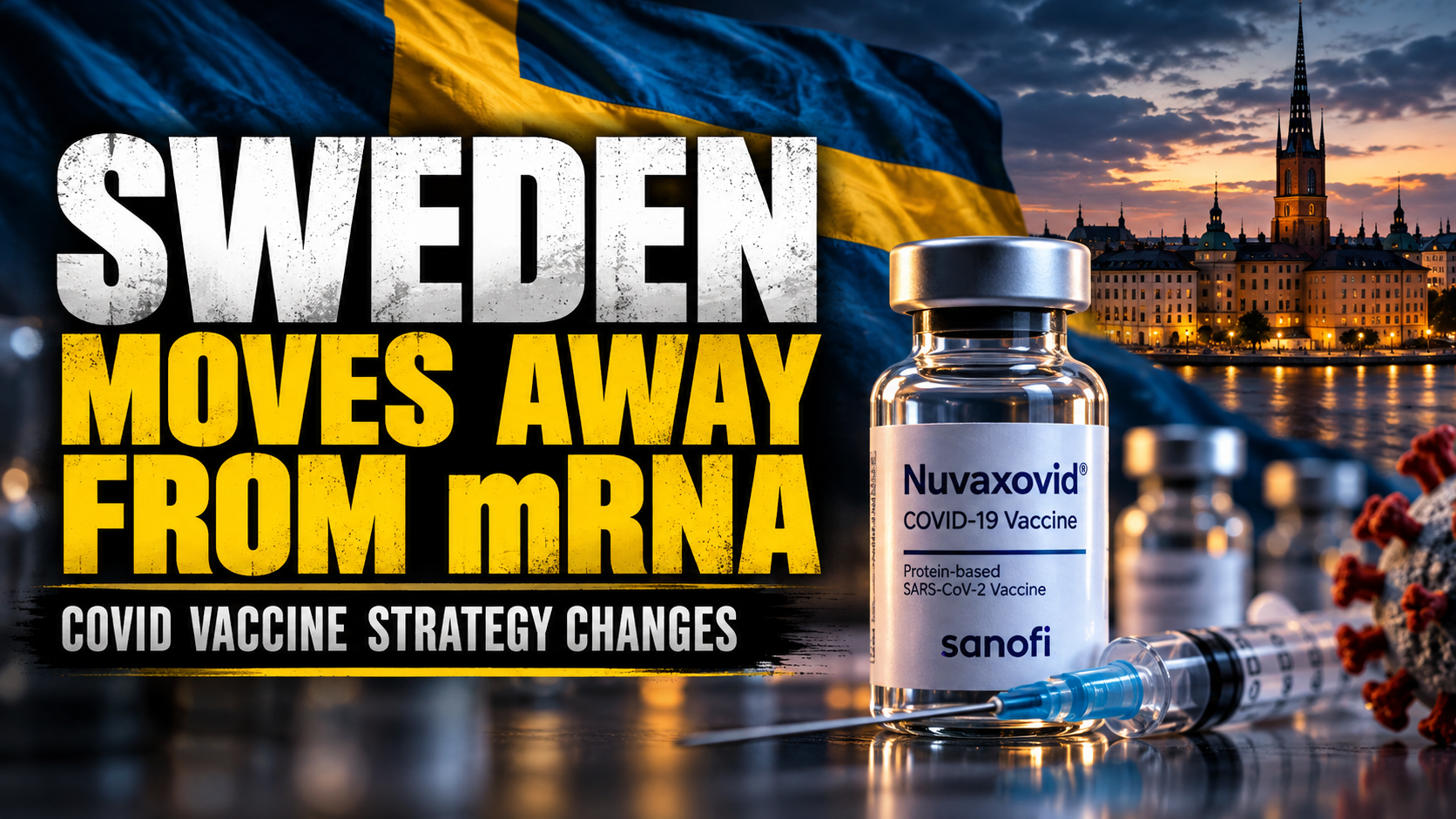
Sweden has selected a protein-based COVID-19 vaccine for its 2027–2028 procurement program while continuing targeted vaccination recommendations.
Sweden is preparing to make a significant change to its national COVID-19 vaccination program, moving toward a protein-based vaccine and away from the mRNA technology that dominated the pandemic years.
But anyone celebrating the decision as a complete rejection of mRNA vaccines should examine the details.
Sweden isn’t banning mRNA vaccines. It isn’t abandoning COVID-19 vaccination. And it certainly isn’t declaring that the technology was unsafe.
Instead, the country has selected a different vaccine platform for its 2027–2028 national procurement program while maintaining vaccination recommendations for older adults and people with certain medical conditions.
The distinction matters.
Because behind the headlines is a larger question that deserves public scrutiny: Why is Sweden changing its vaccine purchasing strategy, and what evidence influenced that decision?
🔴 Help keep this independent voice alive and uncensored.
Support independent journalism and help keep Real Raw News going.
👉 Support Chris Wick on GoFundMe
Sweden’s Next COVID Vaccine Won’t Use mRNA Technology
According to reporting published October 28 by Children’s Health Defense, Sweden awarded its national COVID-19 vaccine procurement contract for the 2027–2028 season to Sanofi for Nuvaxovid, a protein-based vaccine.
Unlike mRNA vaccines, which provide genetic instructions directing cells to produce a viral protein, Nuvaxovid delivers a laboratory-produced version of the SARS-CoV-2 spike protein directly.
Both approaches are designed to stimulate an immune response, but they use different technologies.
The reported contract covers June 1, 2027, through August 31, 2028.
Until the transition, Sweden continues using mRNA vaccines.
That is an important detail missing from some of the more dramatic claims circulating online.
Sweden has made a procurement decision, not announced a nationwide prohibition on mRNA technology.
The Questions Sweden’s Decision Raises
Throughout the pandemic, governments promoted mRNA vaccines as a major scientific achievement.
Public health officials emphasized their effectiveness against severe COVID-19, particularly among people at greater risk of hospitalization and death.
But the pandemic also exposed serious problems involving public communication, changing recommendations, political pressure and public trust.
Some people felt legitimate questions about vaccine safety were dismissed rather than adequately addressed.
Others argue that public health officials were attempting to respond to rapidly evolving scientific evidence during an unprecedented emergency.
Both perspectives deserve examination.
Sweden’s decision provides an opportunity to ask whether national vaccine policies should place greater emphasis on comparing different technologies rather than assuming that one platform should dominate future vaccination programs.
However, the procurement announcement alone does not establish that Sweden considers mRNA vaccines dangerous or ineffective.
Without publicly verified procurement evaluations explaining the relative importance of safety, effectiveness, supply security and pricing, claims about the government’s underlying motivation remain speculative.
Protein-Based Vaccines Carry Risks Too
One argument for protein-based vaccines is that they use a more established vaccine-production approach.
But established technology does not automatically mean a product is risk-free.
Nuvaxovid has been associated with rare reports of myocarditis and pericarditis, inflammatory conditions affecting the heart muscle and surrounding tissue.
These conditions have also been identified as rare adverse events following certain mRNA COVID-19 vaccines.
The Swedish Public Health Agency’s current medical guidance acknowledges myocarditis and pericarditis concerns involving Nuvaxovid, particularly among younger recipients.
Indeed, its guidance has included age-related restrictions for the protein-based product.
This creates an important distinction between political messaging and medical evidence.
Changing vaccine technology does not eliminate the need for independent safety monitoring, transparent adverse-event reporting and careful assessment of individual risk.
The relevant question is not simply whether a vaccine uses mRNA.
It is whether the benefits and risks of a particular product are adequately established for the people receiving it.
Sweden Still Recommends COVID Vaccination
Despite its procurement decision, Sweden continues recommending COVID-19 vaccination for selected population groups.
Its current public health guidance recommends annual vaccination for adults aged 75 and older, adults with compromised immune systems, and certain people aged 50–74 with underlying medical conditions.
The recommendations are substantially narrower than the broad vaccination campaigns implemented during the earlier pandemic years.
That shift reflects changing assessments of population immunity, disease severity and individual vulnerability.
It does not mean Sweden has concluded that COVID-19 vaccines offer no protection.
In fact, the Swedish Public Health Agency continues to identify vaccination as a measure intended to reduce severe illness and death among vulnerable populations.
Children generally are not included in routine COVID-19 vaccination recommendations, although vaccination may be considered for those at increased medical risk following individual assessment.
What About Children Under 12?
The Children’s Health Defense report emphasizes that the new procurement arrangement does not include COVID-19 vaccines for children younger than 12.
That detail warrants clarification.
A procurement contract determines what a government purchases under a particular agreement.
It does not necessarily establish every vaccine that could legally be prescribed or administered under exceptional medical circumstances.
Sweden’s public health guidance allows individualized consideration for children facing elevated risks from COVID-19.
Therefore, describing the procurement decision as a complete ban on childhood COVID vaccination would be inaccurate.
The more significant development is Sweden’s increasingly targeted approach to vaccination.
Rather than recommending routine COVID-19 vaccination across broad sections of the population, the country is concentrating on groups considered more vulnerable to serious illness.
The Vaccine Industry Faces a Changing Market
Sweden’s decision also raises commercial questions.
During the pandemic, mRNA vaccines became major products for pharmaceutical manufacturers.
Governments purchased enormous quantities of doses, often through large national or international agreements.
Now, as COVID-19 vaccination programs become more targeted, manufacturers face a different commercial environment.
Competition between vaccine technologies may influence procurement decisions involving price, manufacturing capacity, storage requirements and expected demand.
For governments spending public money, those considerations are legitimate.
But the public deserves to understand how those decisions are made.
Were competing vaccine products evaluated against transparent clinical criteria?
What safety and effectiveness evidence was considered?
How much weight did pricing and supply arrangements carry?
And will the supporting procurement documentation be available for independent examination?
Those questions should not be controversial.
They are basic requirements for public accountability.
A Change in Strategy Is Not an Admission of Failure
Some critics of pandemic vaccination policies may interpret Sweden’s decision as vindication of their longstanding concerns about mRNA technology.
Others will view it as an ordinary procurement choice in a changing vaccine market.
The available evidence supports a narrower conclusion.
Sweden has selected a protein-based COVID-19 vaccine for its forthcoming national procurement arrangement.
It continues to permit mRNA vaccines and currently uses them.
Its public health authorities also continue recommending vaccination for certain higher-risk groups.
There is no verified basis for claiming that the procurement decision constitutes an official admission that mRNA vaccines were broadly unsafe.
That does not mean questions about adverse reactions, informed consent or government transparency should disappear.
Quite the opposite.
Medical products should remain subject to independent scrutiny regardless of their manufacturer, technology or political associations.
Final Thoughts: Public Trust Cannot Be Purchased With Another Vaccine Contract
Sweden’s decision illustrates how dramatically COVID-19 vaccination policy has evolved since the height of the pandemic.
The era of broad emergency vaccination campaigns has increasingly given way to targeted recommendations, changing products and more selective procurement.
But one unresolved problem remains.
Public trust cannot be restored simply by replacing one vaccine technology with another.
Trust requires transparent evidence, meaningful informed consent, independent safety monitoring and government officials willing to explain their decisions without treating every difficult question as an attack on science.
Sweden’s procurement change may prove commercially or medically advantageous.
It may also encourage other countries to reconsider the balance between available vaccine platforms.
But until the complete reasoning behind the decision is independently established, the public should resist both exaggerated celebrations and reflexive dismissals.
The real story is not that Sweden has declared war on mRNA vaccines.
The real story is that vaccine policy continues to change — and governments still owe the public clear explanations for why.
Editorial Disclaimer
This article contains independent news analysis and commentary based on publicly available reporting and official Swedish public health guidance. It does not allege that Sweden has banned mRNA vaccines or established that they are generally unsafe. Discussion of vaccine risks does not imply that those risks outweigh the benefits for every individual. Medical decisions should be made using current clinical evidence and individualized professional advice.
Sources
1. Children’s Health Defense — Sweden Shifts Away From mRNA COVID Vaccines, but Still Recommends Adults Get Vaccinated (October 28, 2026)
2. Public Health Agency of Sweden — Recommendations for COVID-19 Vaccination
3. Public Health Agency of Sweden — Clinical Guidance for COVID-19 Vaccination
About the Author