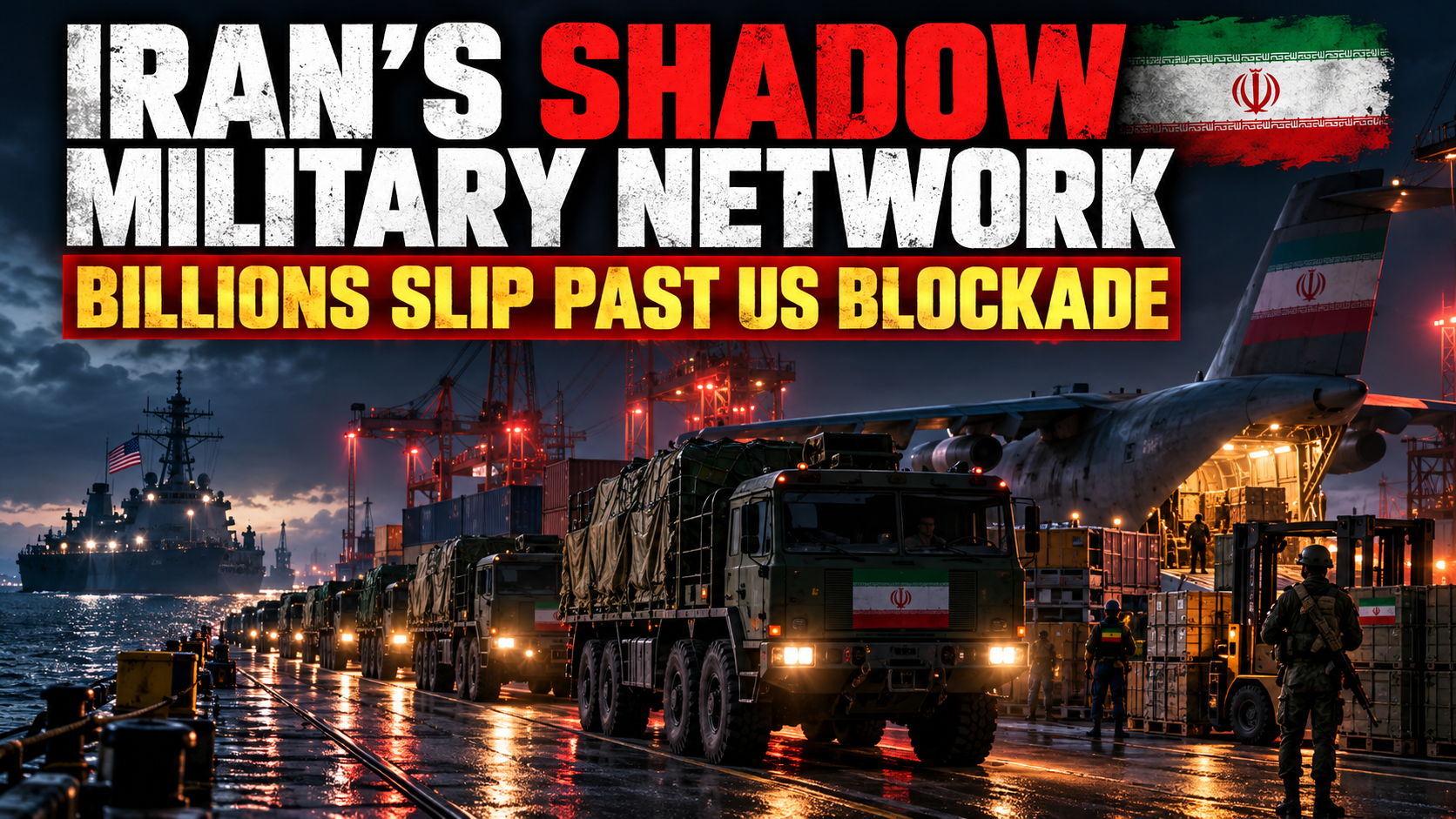
A Reuters investigation has exposed a network of more than 5,000 Iranian military-linked agencies involved in importing equipment and materials despite Western sanctions and the US blockade. Illustration: Chris Wick News.
Washington tightened the sanctions. American warships enforced a blockade. Yet behind thousands of obscure military agencies, Iran reportedly kept importing the materials needed to sustain its missile and drone programs. A major investigation has exposed a troubling weakness in America’s economic warfare strategy.
A Military Supply Network Hiding in Plain Sight
The United States has spent years trying to squeeze Iran’s military machine through sanctions, financial restrictions and, more recently, a naval blockade.
But while Washington concentrated on cutting off Tehran’s access to international markets, an enormous procurement network was operating behind the scenes.
According to an October 29 Reuters investigation, Iran established a sprawling system of more than 5,000 military-linked agencies that helped import billions of dollars in equipment, explosives, industrial machinery and heavy-duty vehicles.
The investigation found that the network imported at least $2 billion in goods since January 2025, despite Western sanctions and restrictions on maritime trade.
Some of those materials could be used to manufacture ballistic missiles and attack drones.
🔴 Help keep this independent voice alive and uncensored.
Support independent journalism and help keep Real Raw News going.
👉 Support Chris Wick on GoFundMe
And that raises an uncomfortable question.
If the United States has been systematically targeting Iran’s military supply chains, how has such an extensive procurement system continued operating?
The answer appears to involve something far more complicated than ships slipping through a blockade.
It involves an international network of intermediaries, commercial transactions and military organizations that can be difficult to distinguish from ordinary trade.
More Than 5,000 Agencies Behind Iran’s Military Procurement System
The agencies identified in the investigation use designations beginning with MOD, referring to Iran’s Ministry of Defense.
Their operations reportedly stretch across international supply chains, with connections to Iran’s military establishment and powerful state-linked business organizations.
One agency, identified as MOD 346428, was associated with approximately $2.3 billion in military-related imports between January 2025 and June 2026.
The broader investigation examined thousands of records to reconstruct how the system operated.
The reported purchases included:
- Explosives, detonators and chemicals used in rocket propellants.
- Aircraft components and precision industrial machinery.
- Titanium and other materials with potential military applications.
- Heavy-duty trucks that could be adapted for missile-launching operations.
- Equipment potentially useful for manufacturing drones and ballistic missiles.
These findings require an important distinction.
Not every imported component is necessarily a weapon. Some materials have legitimate civilian applications, and the presence of a product in Iranian import records does not independently establish its ultimate military use.
Nevertheless, the combination of military-linked purchasing organizations, specialized materials and connections to weapons programs raises serious questions about the effectiveness of existing restrictions.
The network described by Reuters appears to function as a parallel procurement system, giving Iranian military organizations access to international commerce despite sanctions designed to isolate them.
China, Russia and Europe Appear in the Supply Records
The investigation identified shipments recorded as originating from several countries, including China, Russia, Germany and other European states.
The United Arab Emirates also appeared in the import data.
This does not automatically mean the governments of those countries knowingly supplied Iran’s military.
Goods can move through intermediaries, distributors and complex supply chains. A product’s recorded country of origin does not necessarily identify who authorized its final destination.
That distinction matters.
There is a significant difference between discovering that industrial equipment originated in a particular country and proving that its government deliberately helped Iran evade sanctions.
China’s Foreign Ministry told Reuters it was unaware of the situation described and rejected attempts to associate China with regional hostilities.
Still, the records expose a fundamental challenge for sanctions enforcement.
A product does not have to leave a factory labeled as military equipment to become useful to a military organization.
Advanced machinery, industrial chemicals and specialized electronics can serve civilian industries while also supporting weapons manufacturing.
That overlap creates opportunities for procurement networks to exploit gaps between export controls, commercial documentation and enforcement.
The Financial System Behind the Shadow Network
Perhaps the most revealing part of the investigation concerns how purchases were financed.
Reuters reported that approximately 97% of the shipments it examined were recorded as settled without cross-border currency transfers.
That does not mean the goods were free.
Instead, the reported arrangements relied on overseas intermediaries and funds already held outside Iran.
The broader mechanism allows proceeds from Iranian oil sales to be used for purchases abroad without necessarily sending conventional payments directly from Iranian banks to foreign suppliers.
This matters because financial sanctions frequently depend on identifying restricted transactions, institutions and counterparties.
When payments are handled through intermediaries and offshore arrangements, tracing the ultimate buyer becomes more difficult.
The resulting challenge extends beyond shipping inspections.
A naval blockade can restrict vessels. Financial sanctions can pressure banks. Export controls can prohibit specific transfers.
But none of those measures automatically eliminates an established network capable of coordinating purchases across different jurisdictions.
That is the vulnerability the investigation brings into focus.
Why the US Blockade Has Not Stopped Iran’s Military Imports
A blockade is only as effective as the routes it can control.
Reuters documented military-related shipments reaching Iran through several channels, including cargo vessels crossing the Caspian Sea, trucks travelling through Central Asia and freight aircraft arriving from China.
These routes demonstrate why controlling maritime traffic around Iran cannot, by itself, eliminate military imports.
The investigation also revealed that Iranian military imports initially fell sharply after the war began on February 28.
Monthly import values dropped to approximately $54 million in March, before recovering to $77 million by May.
That suggests American pressure has disrupted procurement without completely shutting it down.
There is another important distinction: the $2.3 billion associated with MOD 346428 covers an 18-month period beginning in January 2025. It would therefore be misleading to describe that entire amount as goods imported during the blockade.
The records nevertheless indicate that significant military-related trade continued during the conflict.
The blockade appears to have damaged Iran’s supply system. It has not made that system disappear.
Washington’s Sanctions Strategy Faces an Uncomfortable Test
The most troubling finding may not be the value of the shipments.
It may be how long the procurement organizations remained outside the specific sanctions designations examined by Reuters.
Despite extensive American restrictions targeting Iran’s defense establishment, Reuters found no evidence that the numbered agencies identified in its investigation had themselves been designated by Western governments.
That does not mean transactions involving those agencies were necessarily lawful.
Broader restrictions can still apply to military procurement, sanctioned counterparties and prohibited goods.
However, identifying thousands of previously overlooked organizations raises questions about whether enforcement agencies have been targeting the full structure of Iran’s military economy.
The US Treasury defended its approach, maintaining that American sanctions had severely restricted Tehran’s economic lifelines.
Both observations can be true.
Sanctions can impose substantial costs while leaving sophisticated procurement channels operational.
The more important question is whether those remaining channels are sufficient to sustain Iran’s weapons production.
Reuters’ findings suggest that some are.
The Hidden Cost of Economic Warfare
There is another side to this story that deserves attention.
Sanctions are frequently presented as an alternative to military escalation.
But when restrictions fail to prevent the acquisition of strategically important materials, governments face difficult decisions about whether to tighten enforcement, expand diplomatic pressure or pursue additional military action.
Each option carries consequences.
More aggressive enforcement can disrupt legitimate international trade. Expanded secondary sanctions can create friction with countries whose businesses supply dual-use goods. Military escalation can produce devastating consequences for civilians and regional stability.
Meanwhile, ordinary Iranians face the consequences of economic pressure and war without necessarily controlling the decisions of their country’s military leadership.
The central policy challenge is therefore not simply how to stop shipments.
It is how to restrict military procurement effectively without imposing unnecessary harm on civilian populations or widening the conflict.
Chris Wick News Analysis: The System Behind the Weapons
The most significant lesson from this investigation is that modern military power depends on much more than weapons factories.
It depends on financing, transportation, industrial machinery, commercial intermediaries and access to global markets.
Iran’s procurement network appears to have developed ways to preserve those connections even under intense international pressure.
That does not make the system invulnerable.
The import declines documented during the conflict show that restrictions have consequences.
But the continued arrival of specialized materials suggests that sanctions enforcement must address entire procurement networks rather than focusing exclusively on individual shipments or prominent military organizations.
The unanswered questions are substantial.
How many additional procurement entities remain unidentified? How much imported equipment ultimately reaches weapons manufacturers? And can Western governments distinguish prohibited military trade from legitimate civilian commerce without creating new economic damage?
Those questions matter more than political declarations of success.
Final Thought: A Blockade Cannot Stop What It Cannot See
The disturbing reality is that Iran does not need to defeat the American military to keep parts of its weapons industry supplied. It needs only enough surviving connections to international commerce.
Warships can patrol shipping lanes. Sanctions can restrict financial institutions. Governments can blacklist companies.
But an adaptable procurement system can exploit the gaps between those measures.
Reuters has exposed an extensive network that reportedly helped Iran obtain strategically important materials despite years of Western restrictions.
The investigation does not prove that American sanctions are useless, nor does it establish that every shipment involved deliberate wrongdoing by foreign suppliers.
It does, however, challenge any suggestion that military pressure and economic isolation have completely severed Tehran’s access to international supply chains.
And that leaves Washington confronting a difficult reality.
You can blockade a coastline. You can sanction a government. But shutting down an international network built to survive both is an entirely different war.
— Chris Wick News
Editorial Disclaimer
This article combines independently written commentary and analysis with findings reported in a Reuters investigation published October 29, 2026. Procurement figures, shipment records and allegations involving military organizations are attributed to that investigation. The presence of foreign-manufactured equipment in Iran does not independently establish wrongdoing by its original manufacturer or country of origin. Commentary represents the editorial perspective of Chris Wick News.
Sources
Reuters — Iran’s hidden web of military agencies is slipping hardware past the US blockade (October 29, 2026)
Read the original Reuters investigation
US Department of the Treasury — Official sanctions information and enforcement guidance
US Treasury Office of Foreign Assets Control
Research note: The central findings are based on Reuters’ investigation, including its review of Iranian financial, corporate and import records. Chris Wick News has not independently obtained or authenticated the underlying confidential records.
About the Author