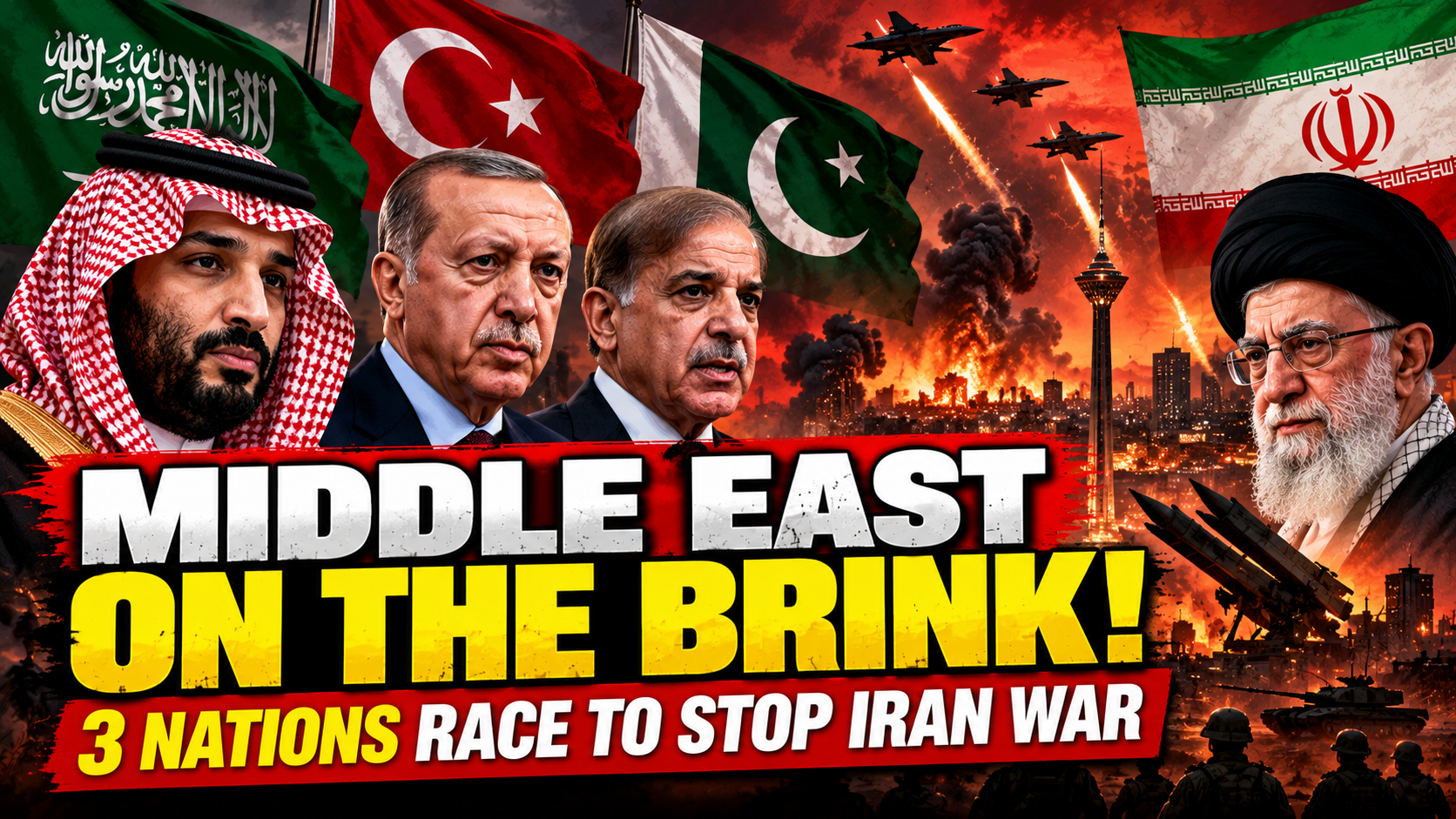
High-level delegations from Saudi Arabia, Turkey and Pakistan are meeting Iranian officials in Tehran amid growing fears of renewed fighting involving Iran, Israel and the United States.
The Middle East is standing dangerously close to another military confrontation.
Saudi Arabia, Turkey and Pakistan are pursuing diplomatic efforts involving Iran as regional governments attempt to prevent an already devastating conflict from escalating further.
Behind the diplomatic meetings lies an uncomfortable reality.
The region may be one miscalculation away from another round of destruction.
Governments are talking about peace while preparing for the possibility of more fighting.
Military threats continue to shape negotiations, regional security remains fragile, and countries that would prefer to avoid another confrontation are increasingly involved in efforts to contain the crisis.
🔴 Help keep this independent voice alive and uncensored.
Support independent journalism and help keep Real Raw News going.
👉 Support Chris Wick on GoFundMe
The central question is no longer simply whether Iran and its adversaries can reach an agreement.
It is whether regional governments can prevent political disagreements, military threats and mutual distrust from producing another devastating escalation.
How many countries must become involved before diplomacy finally takes priority over military confrontation?
Saudi Arabia, Turkey and Pakistan Push for Diplomacy
Saudi Arabia, Turkey and Pakistan have significant interests in preventing further regional instability.
Each country approaches the Iran crisis from a different political and strategic position.
Saudi Arabia has spent years navigating a complicated relationship with Tehran.
The two regional powers have supported opposing sides in various conflicts, competed for political influence and accused one another of threatening regional security.
Yet Saudi Arabia also has powerful reasons to prevent another major war.
Its energy infrastructure, economic diversification plans and regional investment ambitions depend heavily on stability.
A prolonged conflict involving Iran could threaten shipping routes, energy markets and critical infrastructure throughout the Gulf.
Turkey faces a different set of concerns.
Ankara maintains relationships with Western governments while also pursuing independent diplomatic and economic interests across the Middle East.
A wider conflict could destabilize neighbouring countries, disrupt trade and increase security pressures along Turkey’s borders.
Pakistan, meanwhile, shares a border with Iran and has strong diplomatic and economic relationships with several Gulf countries.
Islamabad has an interest in preventing instability from spreading across the region.
These overlapping concerns help explain why diplomatic engagement remains important even when relations between the countries involved are complicated.
The three governments do not need to agree on every political issue to recognize that another regional war could threaten them all.
Diplomats Negotiate While Military Pressure Continues
The most dangerous feature of the current crisis is the tension between diplomacy and military pressure.
Governments may publicly support negotiations while maintaining military capabilities intended to deter their adversaries.
That combination is not unusual in international relations.
Military deterrence can sometimes prevent attacks by making the consequences appear too costly.
But it can also increase the danger of escalation when governments misunderstand one another’s intentions.
An unexpected strike, disputed intelligence report or military incident can rapidly change the political environment.
Leaders who previously supported negotiations may suddenly face pressure to retaliate.
Military commanders may be forced to make decisions before diplomats have time to clarify what happened.
And political leaders may fear that restraint will be interpreted as weakness.
Wars do not always begin because governments deliberately choose a major confrontation. Sometimes they begin because smaller confrontations spiral beyond anyone’s control.
That possibility makes sustained diplomatic communication essential.
Iran Remains at the Centre of Regional Tensions
Iran’s relationships with neighbouring governments and Western powers have long been shaped by disputes over security, military influence, sanctions and nuclear activities.
Tehran argues that it has legitimate security interests and the right to defend itself against external threats.
Its adversaries accuse the Iranian government of destabilizing regional security through military activities and relationships with armed groups.
Those competing positions have contributed to years of confrontation.
The consequences extend far beyond Iran’s borders.
A major escalation could affect neighbouring states, international shipping, energy infrastructure and civilian populations across the region.
For governments attempting to mediate, the challenge is finding arrangements that reduce the immediate risk of military confrontation while addressing the underlying security disputes.
That is considerably more difficult than arranging a diplomatic meeting.
A ceasefire can stop shooting. It cannot automatically erase decades of distrust.
Any durable agreement would require mechanisms for communication, verification and dispute resolution.
Without those safeguards, even a temporary reduction in violence could leave the region vulnerable to renewed fighting.
The Strait of Hormuz Remains a Global Concern
One of the greatest international concerns surrounding a wider Iran conflict is the security of the Strait of Hormuz.
The narrow waterway connects the Persian Gulf with the Gulf of Oman and provides a critical route for international energy shipments.
Disruption to shipping through the strait can affect oil markets, transportation costs and economic confidence.
The consequences are not limited to Middle Eastern countries.
Higher energy prices can increase transportation and production costs across the global economy.
Businesses may pass some of those expenses to consumers.
Airlines, trucking companies, manufacturers and agricultural producers can all face additional pressure when fuel prices rise.
For households already struggling with affordability, another energy shock would be particularly unwelcome.
This is why countries far removed from the conflict have a direct interest in preventing further escalation.
A military confrontation in the Persian Gulf can become an economic problem at a grocery store thousands of kilometres away.
The effects of regional instability do not respect national borders.
The United States and Israel Remain Critical Players
Any serious discussion about preventing further conflict involving Iran must also consider the roles of the United States and Israel.
Washington maintains extensive military and security relationships throughout the Middle East.
Israel regards Iran’s military capabilities and regional activities as major national security concerns.
Iran, in turn, views American and Israeli military pressure as threats to its sovereignty and security.
These competing positions make diplomatic negotiations particularly difficult.
Regional mediators may encourage compromise, but their influence has limits when the central parties believe their fundamental security interests are at stake.
A sustainable reduction in tensions would likely require communication involving multiple governments, whether directly or through intermediaries.
Military pressure alone cannot resolve every political disagreement.
But diplomacy also cannot succeed if the parties involved believe agreements will not be respected.
The challenge is establishing credible commitments that reduce incentives for renewed confrontation.
The real test of diplomacy is not whether governments can sit around the same table. It is whether they can make agreements that survive after the meeting ends.
Saudi Arabia Has Powerful Reasons to Avoid Another War
Saudi Arabia’s involvement in regional diplomacy deserves particular attention.
The kingdom has invested heavily in economic development, tourism, infrastructure and efforts to diversify beyond oil revenues.
These ambitions depend on maintaining an environment attractive to investors and international businesses.
A major regional conflict would threaten those objectives.
Energy facilities could face security risks.
Commercial shipping could experience disruption.
Investment decisions could be delayed.
And regional governments might be forced to redirect resources toward military preparedness.
Saudi Arabia therefore has both security and economic reasons to support de-escalation.
This does not mean Riyadh and Tehran have resolved their disagreements.
It means both governments may recognize that continued confrontation carries substantial costs.
Sometimes diplomacy succeeds not because adversaries suddenly trust one another, but because they recognize the price of continued hostility.
That reality could provide an opening for further negotiations.
Turkey and Pakistan Could Help Keep Communication Open
Turkey and Pakistan may also play useful roles in diplomatic engagement.
Both countries maintain relationships with governments whose interests do not always align.
That creates opportunities to facilitate communication, convey proposals and encourage restraint.
However, mediation is not the same as having the power to impose an agreement.
A mediator can help governments understand one another’s positions.
It cannot guarantee that military commanders will avoid escalation or that political leaders will accept difficult compromises.
The success of any diplomatic initiative ultimately depends on the decisions of the parties directly involved.
Nevertheless, maintaining communication can be valuable even when a comprehensive agreement remains out of reach.
Diplomatic channels can help clarify intentions, reduce misunderstandings and provide opportunities to address unexpected incidents before they escalate.
In a region where military decisions can have enormous consequences, those channels matter.
Civilians Continue to Pay the Highest Price
Political leaders discuss security, deterrence and strategic advantage.
Military officials evaluate capabilities and potential targets.
Diplomats negotiate terms and conditions.
But civilians experience war very differently.
They face displacement, damaged infrastructure, disrupted medical services and uncertainty about their personal safety.
Families may lose homes, employment and access to basic necessities.
Children may experience interruptions to education and lasting psychological consequences.
Economic disruption can continue long after active fighting ends.
Rebuilding damaged communities requires time, resources and political stability.
These human consequences should remain central to any discussion about renewed military confrontation.
For political leaders, war may be discussed as strategy. For ordinary families, it can mean losing everything.
Preventing further escalation is therefore not simply a matter of protecting regional economic interests.
It is also a humanitarian necessity.
Can Diplomacy Prevent Another Catastrophe?
Diplomatic engagement involving Saudi Arabia, Turkey and Pakistan offers a potential path toward reducing tensions.
But negotiations alone do not guarantee peace.
The governments involved must address immediate security concerns while creating conditions for more durable agreements.
That may require confidence-building measures, clearer communication and commitments designed to reduce the risk of unexpected military incidents.
It may also require compromises that political leaders find difficult to explain to domestic audiences.
The alternative could be another cycle of retaliation, destruction and diplomatic emergency meetings.
And the longer military tensions remain elevated, the greater the danger that an unexpected event could undermine negotiations.
Peace is not secured simply because governments say they want it. Peace requires decisions that make another war less likely.
Final Thoughts: How Many Countries Must Be Dragged Into This?
Saudi Arabia, Turkey and Pakistan have compelling reasons to prevent further escalation involving Iran.
Their diplomatic efforts reflect a broader recognition that another major confrontation could have consequences throughout the Middle East and beyond.
But the fundamental problem remains.
Military threats and diplomatic negotiations continue to exist alongside one another.
Governments speak about stability while preparing for the possibility of further conflict.
And ordinary people are left wondering whether political leaders can prevent another disaster.
The world has already witnessed the devastating consequences of prolonged conflict across the region.
Another major escalation would risk additional civilian suffering, economic disruption and international instability.
The question is not whether governments possess enough military power to continue fighting.
The question is whether they possess enough political judgment to stop.
Because every additional country drawn into the confrontation increases the danger that a regional crisis could become something far more destructive.
And when the consequences reach beyond national borders, the responsibility to prevent escalation becomes greater.
Diplomacy should not be the last option governments consider after military confrontation fails.
It should be the first option they exhaust before another generation is forced to pay the price.
Sources
Associated Press — October 26, 2026
Regional diplomatic efforts involving Iran, Saudi Arabia, Turkey and Pakistan
Associated Press coverage
International Energy Agency — Strait of Hormuz and Global Energy Security
International Energy Agency
United Nations — Middle East Peace and Security
United Nations
Editorial note: The article distinguishes general geopolitical analysis from claims about specific diplomatic developments. The precise participants, meeting outcomes and commitments of the latest reported talks should be checked against the original reporting before publication.
About the Author