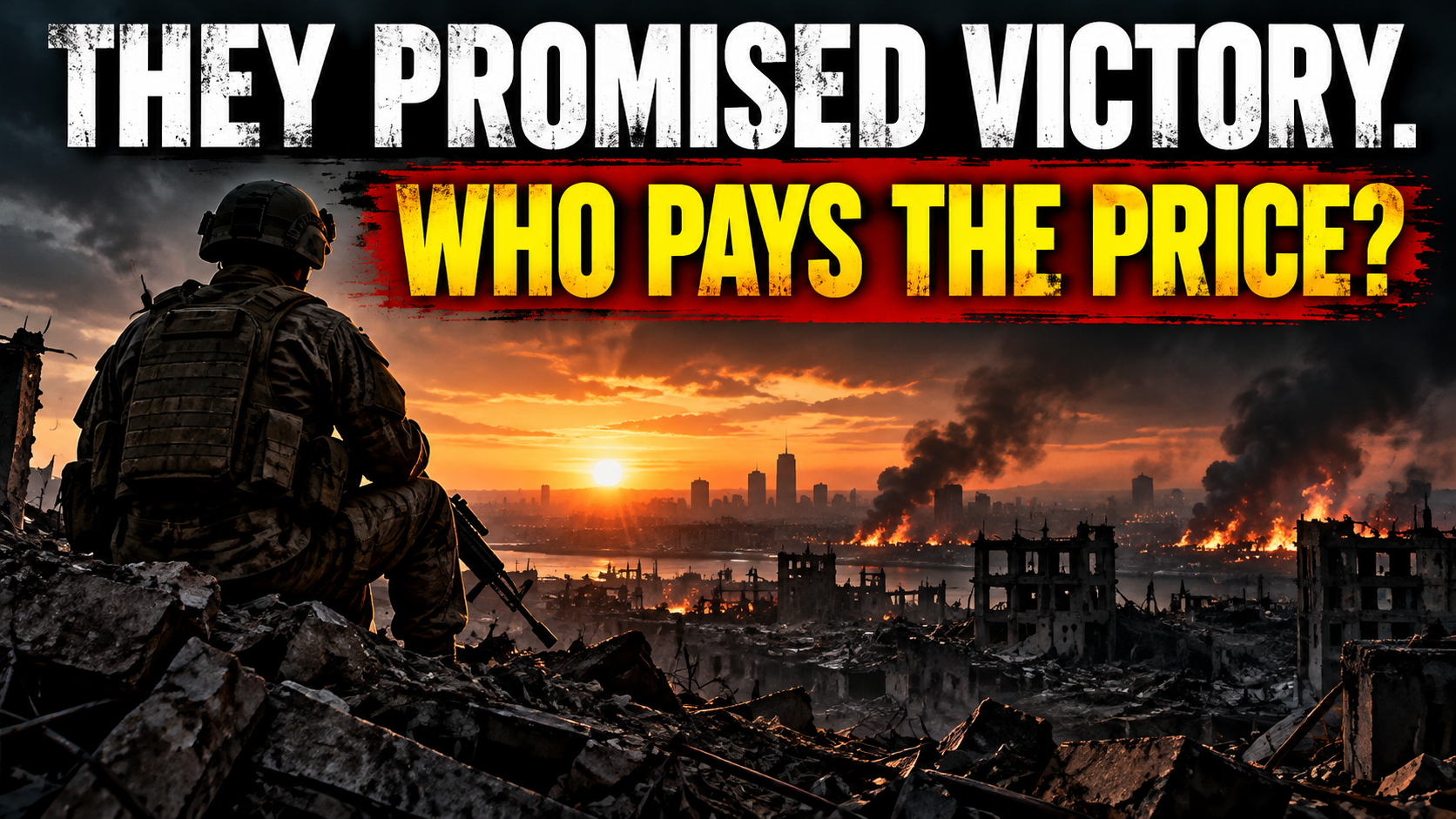
Every war begins with a promise. Few begin with an honest accounting of the price.
A quick victory.
A limited operation.
A safer future.
The speeches are polished. The military briefings are confident. The objectives sound achievable. Political leaders stand before cameras and explain why military action is necessary, why the risks are manageable, and why the alternative could be even more dangerous.
Then the first missiles fly.
🔴 Help keep this independent voice alive and uncensored.
Support independent journalism and help keep Real Raw News going.
👉 Support Chris Wick on GoFundMe
And the promises meet reality.
The people who authorized the operation return to their offices. The soldiers enter the battlefield. Families wait for phone calls they hope will never come.
And somewhere, far from the conference rooms where the decisions were made, ordinary people begin paying the price.
The First Casualty Is Often Certainty
War is rarely presented to the public as an open-ended disaster.
It is presented as a mission.
A necessary intervention. A strategic operation. A calculated response to a dangerous threat.
Sometimes the threat is genuine. Sometimes military force may be necessary to defend a country or protect civilians. History offers examples of aggression that could not be stopped through negotiation alone.
But necessity does not eliminate uncertainty.
Military planners can estimate casualties, calculate ammunition requirements, and model possible outcomes. They cannot guarantee how an adversary will respond, how long resistance will continue, or what political order will emerge after the fighting stops.
A government can win a battle without achieving its political objectives.
An army can capture territory without securing lasting peace.
And a military campaign can succeed tactically while leaving the underlying conflict unresolved.
That distinction matters.
Because victory on a battlefield and a safer future are not necessarily the same thing.
The Human Cost Never Fits Inside a Press Release
Wars are measured in numbers.
Troops deployed.
Targets destroyed.
Territory captured.
Billions spent.
But those numbers cannot fully describe what happens to the people caught in the middle.
A father who never comes home.
A child who grows up remembering the sound of explosions more clearly than the sound of laughter.
A wounded soldier learning to live with injuries that will never completely heal.
A family forced to abandon everything it owns because the neighborhood it once called home has become a battlefield.
The damage does not end when the shooting stops.
Hospitals must be rebuilt. Infrastructure must be restored. Displaced families need somewhere to live. Veterans may require years of medical treatment, rehabilitation, and psychological support.
And entire communities can carry the consequences for generations.
There is no military briefing capable of reducing that suffering to a neat statistic.
The War Ends. The Bills Keep Arriving.
Modern warfare is enormously expensive.
Weapons systems cost money. Military deployments cost money. Intelligence operations, logistics, reconstruction, veterans’ care, and long-term security commitments all carry financial consequences.
Those costs do not simply disappear when a ceasefire is announced.
They become part of national budgets.
Sometimes they are financed through taxation. Sometimes through borrowing. Often through a combination of both.
The consequences can extend long beyond the administration that authorized the conflict.
Future governments inherit the obligations.
Future taxpayers help finance them.
And public money devoted to war is money that cannot simultaneously be spent on other priorities.
That does not automatically make every military expenditure unjustified. National defence is a legitimate responsibility of government.
But it raises an unavoidable question:
Should the public be told not only what a war is expected to accomplish, but what it could cost if the original plan fails?
What Does Victory Actually Look Like?
This may be the most important question political leaders face before authorizing military escalation.
What exactly is the objective?
Destroying an enemy’s military capability?
Defending national territory?
Protecting civilians?
Preventing an attack?
Removing a hostile government?
Each objective carries different risks, legal considerations, and requirements for success.
And each requires a different definition of victory.
If the objective is to weaken an adversary, how much damage is enough?
If the objective is regime change, who governs afterward?
If the objective is deterrence, what happens when the adversary refuses to back down?
If the objective is lasting peace, what political settlement makes that peace possible?
Without clear answers, military campaigns risk expanding beyond their original purpose.
A limited operation can become a prolonged commitment.
A temporary deployment can become a permanent presence.
And a mission that began with one objective can gradually acquire several others.
This is why defining success before the first strike matters.
Five Questions Before the Next Military Escalation
Before any government asks its military personnel and civilians to accept the consequences of another conflict, the public deserves meaningful answers.
1. What specific threat justifies military action?
The evidence should be explained as openly as legitimate security concerns permit.
2. What is the achievable military and political objective?
Success needs a definition that can be evaluated, not merely announced.
3. What happens if the conflict lasts longer than expected?
A credible plan must consider escalation, retaliation, regional instability, and the possibility that initial assumptions prove wrong.
4. What are the expected human and financial costs?
Casualty estimates are uncertain, but uncertainty should be acknowledged rather than hidden behind reassuring language.
5. What is the exit strategy?
How will military operations end, and what arrangements are expected to prevent the conflict from restarting?
These questions do not guarantee that a war will be avoided or successfully concluded.
They make it harder to confuse political confidence with an actual strategy.
The People Making the Decisions Must Face the Questions
Democratic governments possess extraordinary authority when it comes to national security.
That authority comes with responsibility.
Some military decisions must be made quickly. Some intelligence cannot safely be released. Some threats require immediate defensive action.
But those realities should not become permanent excuses for avoiding public scrutiny.
Legislatures, independent journalists, oversight institutions, and citizens all have roles in examining the justification for military force.
A government asking people to accept the possibility of death, destruction, displacement, and long-term economic costs should be prepared to explain its reasoning.
Not every operational detail can be public.
But the purpose of a war should never become impossible to question.
The Final Question No Speech Can Escape
When the fighting ends, leaders may declare that their objectives have been achieved.
They may point to destroyed military equipment, weakened adversaries, or strategic advantages.
Those outcomes can matter.
But the final assessment of a war must also confront what was lost, what was gained, and whether the outcome justified the costs.
Because the people who carry those costs are not abstractions.
They are soldiers, civilians, families, and future generations.
Every war begins with promises.
Some promises may be sincere. Some objectives may be necessary. Some military actions may prevent even greater harm.
But none of that removes the obligation to ask difficult questions before escalation.
What is the mission?
What is the price?
What happens if the plan fails?
And what, precisely, will victory look like?
Because when the promises collapse, the consequences do not disappear with the speeches.
Real Raw News — Independent News. Uncomfortable Questions. No Political Team Gets a Free Pass.
Sources
Background research supporting the discussion of civilian casualties, displacement, and long-term financial costs:
- Brown University — Costs of War, Key Findings https://costsofwar.watson.brown.edu/findings
- Brown University — Human Costs of War https://costsofwar.watson.brown.edu/costs/human
- Brown University — U.S. Budgetary Costs of the Post-9/11 Wars https://costsofwar.watson.brown.edu/sites/default/files/papers/Costs-of-War_US-Budgetary-Costs-of-Post-9-11-Wars.pdf
About the Author