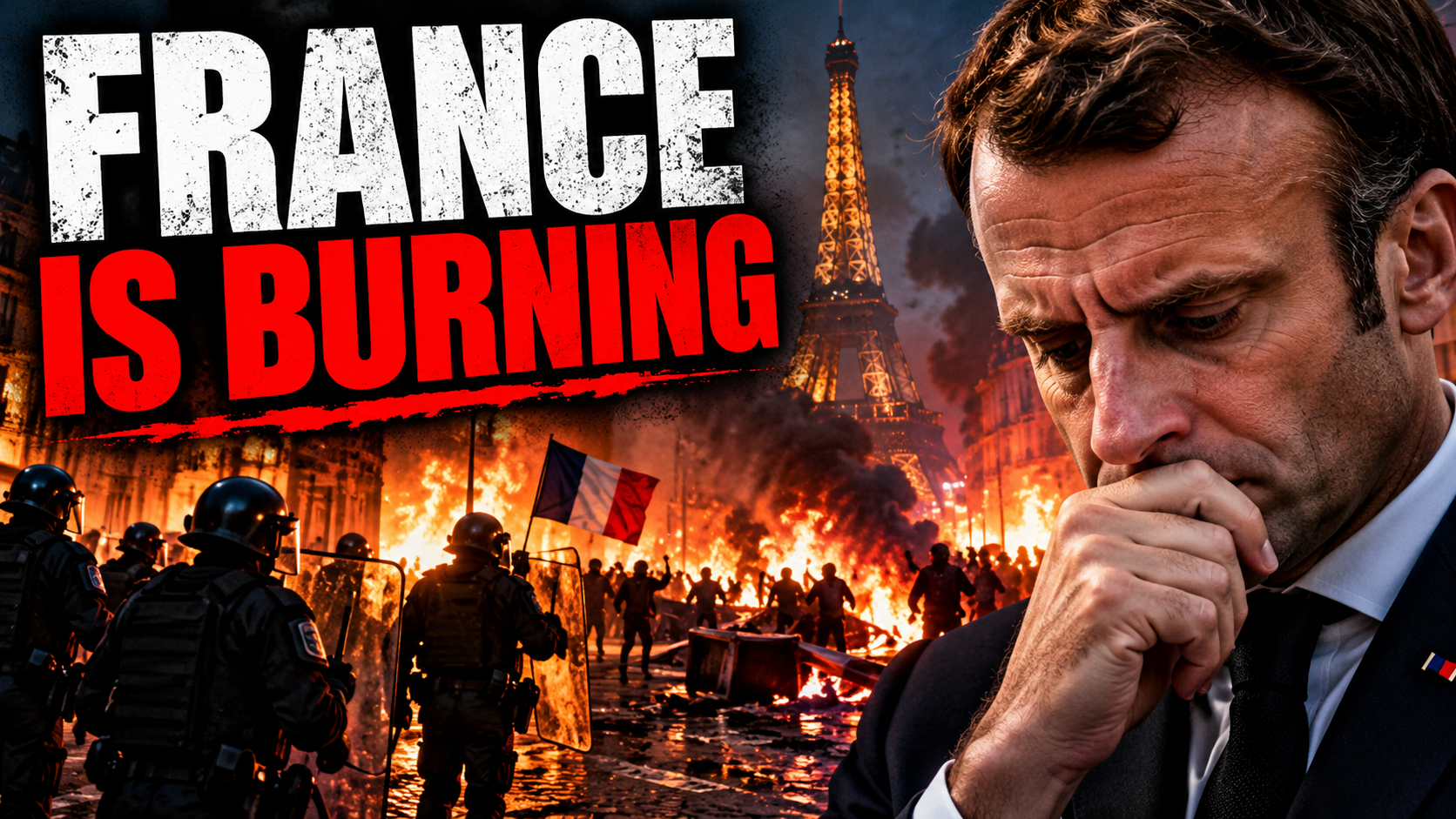
France faces renewed political uncertainty following widespread riots, curfews and growing anger over living costs.
Thousands detained. Businesses devastated. Curfews imposed. France’s latest explosion of public anger threatens to become something far bigger than a weekend of riots.

France’s Streets Are Quieter. Its Political Crisis Is Not.
France is facing a question that no amount of riot police, emergency meetings or government promises can easily answer: What happens when a population loses confidence in the people governing it?
Following a weekend of violent demonstrations, widespread looting and clashes with police, President Emmanuel Macron’s government is struggling to restore order while confronting the economic and political frustrations that helped fuel the unrest.
More than 2,400 people were arrested over the weekend, according to initial official figures. Thousands of businesses suffered damage, and authorities introduced localized curfews across several major cities.
The violence has subsided for now. But the underlying anger has not disappeared.
🔴 Help keep this independent voice alive and uncensored.
Support independent journalism and help keep Real Raw News going.
👉 Support Chris Wick on GoFundMe
And with France approaching its 2027 presidential election, the consequences could extend far beyond burned storefronts and shattered windows.
A Protest Movement That Became a National Explosion
The unrest did not emerge from nowhere.
What began as student demonstrations over deteriorating school conditions, teacher shortages and inadequate public funding developed into a broader protest movement against rising living costs and government spending priorities.
Those frustrations eventually spilled into widespread disorder.
Paris, Marseille, Lyon and other French cities witnessed scenes of destruction as rioters attacked businesses, damaged public property and clashed with security forces.
According to Reuters, more than 3,000 shops were looted or damaged, while the historic town hall in Limoges was set ablaze.
For business owners, the political debate is no longer abstract.
A destroyed storefront means lost income. A looted shop can mean employees without work. Insurance claims, repairs and uncertainty can push already struggling businesses closer to collapse.
The people paying the immediate price are not necessarily the politicians whose decisions are being challenged.
Macron’s Government Turns to Curfews
Prime Minister Sébastien Lecornu has backed targeted curfews as authorities attempt to prevent further violence.
Restrictions have been introduced in parts of Paris and several other cities, with additional police deployments planned.
President Macron also rejected Interior Minister Laurent Nuñez’s offer to resign following criticism of the government’s handling of the crisis.
Instead, Macron demanded an examination of security and intelligence failures and changes to policing tactics.
The government’s immediate priority is understandable: protect residents, prevent further destruction and restore public safety.
But curfews create another difficult question.
Can a government restore public confidence by restricting movement without addressing why people are protesting in the first place?
Stopping looting and responding to legitimate grievances are not competing responsibilities. A functioning government must be capable of doing both.
Peaceful demonstrators have a right to challenge public policy. Business owners and residents have an equally legitimate expectation that their property and safety will be protected.
Neither principle should be sacrificed to defend the other.
France’s Financial Problems Leave Few Easy Solutions
Behind the political drama sits an uncomfortable economic reality.
France is under enormous fiscal pressure.
The government is attempting to reduce its budget deficit while dealing with elevated energy prices, growing debt concerns and public demands for better services.
Its minority government must negotiate spending cuts through a deeply divided parliament.
That creates a political trap.
Spending more money could temporarily ease some public frustrations but worsen fiscal pressures. Cutting expenditures could reassure financial markets while intensifying anger among households already struggling with everyday expenses.
Meanwhile, damaged businesses, emergency security operations and economic uncertainty introduce additional costs.
Reuters reported that the unrest has unsettled investors and placed further pressure on French financial markets.
France is therefore facing two crises that reinforce one another: declining public confidence and limited financial flexibility.
The government needs to convince citizens that conditions can improve while convincing investors that public finances remain manageable.
Neither audience appears particularly easy to satisfy.
Could France’s Unrest Spread Across Europe?
France is not the only European country dealing with frustration over living costs, housing and public services.
Clashes between protesters and police have also occurred in Italy, while Albania has experienced student demonstrations over corruption, employment opportunities and education.
Spain and Portugal have faced housing-related protests.
These movements have different political circumstances and demands. They should not automatically be treated as one coordinated European uprising.
Nevertheless, they reveal a shared pressure point.
Across parts of Europe, citizens are questioning whether governments can still deliver affordable living conditions and dependable public services.
When those expectations weaken, established political parties can become increasingly vulnerable.
France’s experience may therefore become a warning for other European governments, particularly if renewed demonstrations produce additional violence.
The danger is not that every protest will become a riot.
It is that governments may underestimate public frustration until peaceful dissatisfaction develops into a much more difficult political confrontation.
The 2027 Election Could Change Everything
The political consequences may prove more lasting than the physical damage.
Macron is approaching the end of his presidency and cannot seek another consecutive term in 2027.
His administration is already weakened by parliamentary divisions, fiscal difficulties and public dissatisfaction.
The latest violence introduces another issue that could dominate the presidential campaign: law and order.
Marine Le Pen and the National Rally have long emphasized immigration, security and government accountability in their political messaging.
A perception that the current government cannot maintain public order could strengthen the broader political right.
At the same time, left-wing political figures face their own challenges in supporting demands for economic reform while distancing themselves from looting and violence.
But electoral outcomes remain uncertain. Public anger does not automatically translate into support for any particular candidate.
What is increasingly clear is that France’s next presidential election may become a referendum on much more than Macron’s legacy.
It could become a judgment on whether the country’s traditional political establishment still understands the people it governs.
The Next Flashpoint May Already Be Approaching
Although French cities were comparatively calm overnight under curfews, protest organizers have called for another round of demonstrations on Saturday, October 24.
Trade unions have also announced strikes for November 5 over budget cuts and wage demands.
That means the government may have only a brief opportunity to demonstrate that it has learned from the failures of the previous weekend.
More police officers could prevent some of the destruction.
Emergency financial assistance could help damaged businesses survive.
But neither measure guarantees that the broader protest movement will lose momentum.
The coming demonstrations will provide an important indication of whether the unrest is subsiding or entering another phase.
As of October 20, the outcome remains uncertain.
The Bigger Question: Who Is Listening?
There is a temptation to reduce France’s crisis to a simple argument between protesters and police, or between the political left and right.
That misses something more fundamental.
The destruction of businesses and public property cannot be justified by economic frustration. People who commit violence should be held accountable under the law.
But condemning violence does not eliminate the responsibility to examine the grievances that preceded it.
France’s citizens are confronting questions familiar to people in many Western democracies.
Why does everyday life feel increasingly expensive? Why do essential public services struggle despite substantial taxation? And why do political leaders so often appear unable to deliver the improvements they promise?
These are questions that deserve answers, not merely another government press conference.
Chris Wick News Analysis
France’s political establishment faces a test that extends beyond restoring order to its streets.
It must demonstrate that democratic institutions can respond to legitimate public concerns without surrendering to violence or abandoning fiscal responsibility.
That will require more than emergency policing measures and short-term financial assistance.
It will require credibility.
For Canadians watching events unfold across the Atlantic, the lesson is not that France’s circumstances are identical to Canada’s.
It is that public trust should never be taken for granted.
Governments can survive unpopular decisions. What becomes far more dangerous is when citizens stop believing their leaders are listening at all.
France’s streets may be quieter today.
Whether its political crisis is approaching an end — or only beginning — remains an open question.
Sources
Reuters — France imposes curfews in parts of Paris, other cities after weekend of riots https://www.reuters.com/world/europe/frances-macron-declines-interior-ministers-offer-resign-2026-10-19/
Associated Press — How France’s worst rioting in years erupted and how the government responded https://apnews.com/article/ca52b503a4ac8b2a489109f7de852847
Euronews — France to impose new curfews where ‘situation requires it’, PM Lecornu says https://www.euronews.com/2026/10/20/france-to-impose-new-curfews-where-situation-requires-it-pm-lecornu-says
About the Author