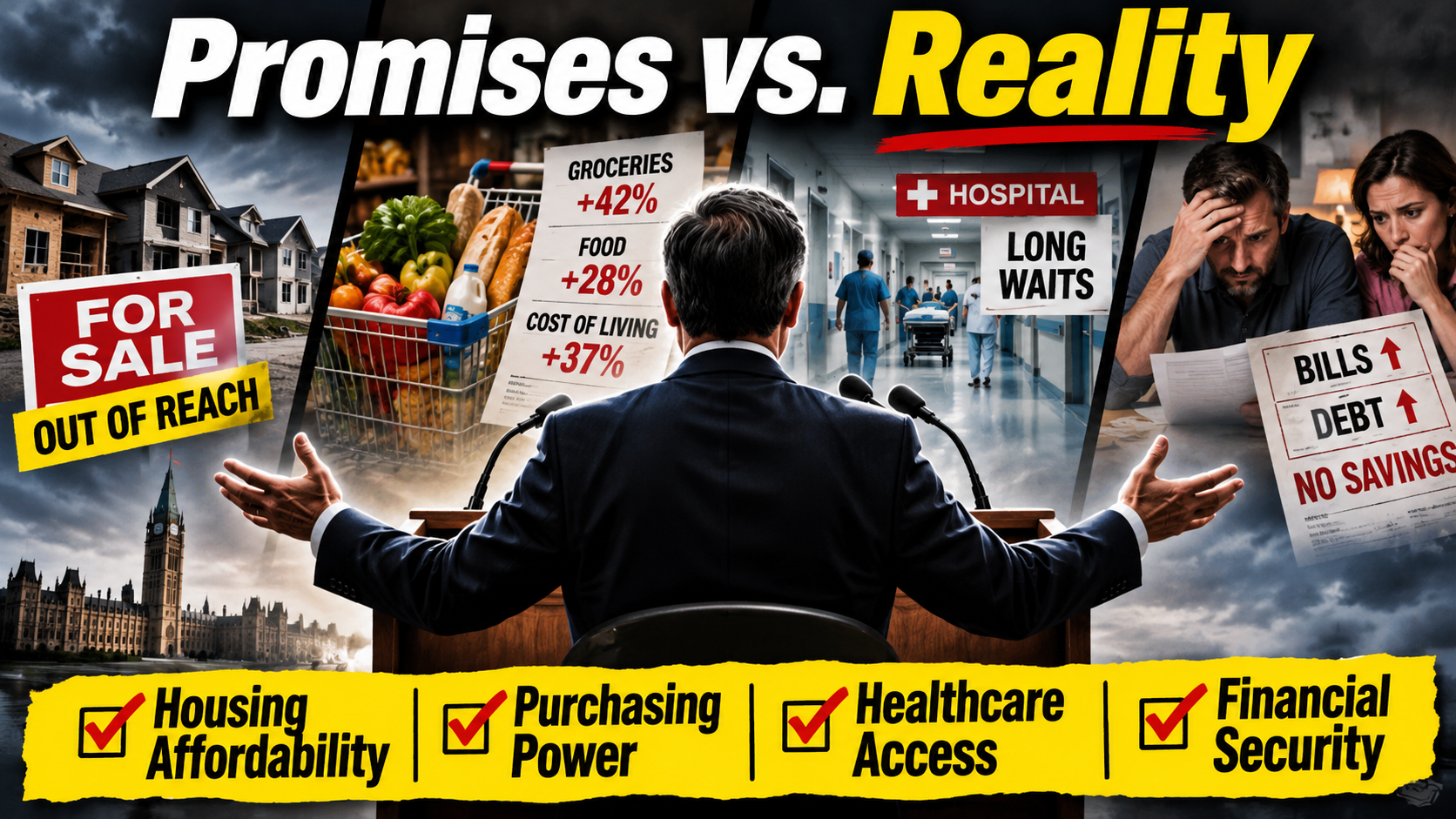
Before you go to bed tonight, consider one uncomfortable question: What would happen if governments were judged by the financial security and quality of life of ordinary citizens rather than their speeches, campaign promises and political victories?
Forget the partisan arguments for a moment. Forget the carefully rehearsed press conferences.
Can people afford a home? Can they feed their families without accumulating debt? Can they access healthcare when they need it? Can they retire without fearing financial ruin?
These are questions that deserve measurable answers.
When Political Promises Meet Everyday Reality
Political announcements can sound impressive, but an announcement is not necessarily an accomplishment.
A government can announce billions in housing investments, but the meaningful questions concern how many homes become available, how much they cost and whether ordinary working people can afford them.
🔴 Help keep this independent voice alive and uncensored.
Support independent journalism and help keep Real Raw News going.
👉 Support Chris Wick on GoFundMe
Economic growth can generate positive headlines, but those figures alone do not reveal whether individual households are becoming financially stronger.
There is a fundamental difference between announcing a policy and demonstrating its results.
Citizens experience the economy through grocery bills, rent payments, mortgage costs, employment opportunities and the money remaining in their bank accounts at the end of each month.
Four Measures of Political Success
What would political accountability look like if greater attention were given to four fundamental indicators?
- Housing affordability: Can ordinary citizens afford decent, secure accommodation without sacrificing other necessities?
- Purchasing power: Are household incomes keeping pace with the cost of living?
- Healthcare access: Can patients receive appropriate medical treatment within reasonable time frames?
- Financial security: Can families save money, manage emergencies and prepare for retirement without overwhelming financial pressure?
None of these questions requires allegiance to a particular political party.
They concern outcomes that can be examined, measured and publicly debated.
The Difference Between Spending and Results
Government spending is often presented as evidence of commitment. However, the amount of money allocated to a program does not automatically establish its effectiveness.
Healthcare spending and healthcare accessibility are different measurements. Housing expenditures and affordable housing availability are different measurements.
The public deserves to understand both.
There are legitimate complications. Global economic conditions, demographic changes, interest rates and decisions made by different levels of government can all influence domestic outcomes.
Nevertheless, transparent reporting could help citizens distinguish between circumstances outside a government’s control and the consequences of its own policy decisions.
Beyond the Endless Partisan Arguments
Political disagreements are inevitable in a democratic society. Different approaches to taxation, public spending, regulation and economic development deserve serious discussion.
But those disagreements become more useful when competing policies are examined against clearly defined objectives.
Imagine regular public reports showing changes in housing affordability, inflation-adjusted household income, medical waiting times and household debt.
Citizens could examine whether conditions were improving, deteriorating or remaining unchanged.
The conversation would become less dependent on political messaging and more focused on evidence.
Dark Final Thoughts
Political promises have expiration dates. Their consequences can last for generations.
The uncomfortable question is not simply whether governments are spending enough money or introducing enough legislation. It is whether their decisions are producing the outcomes citizens were told to expect.
Political success can mean different things to different people. But housing, healthcare, purchasing power and financial security offer tangible starting points for evaluating public policy.
Before the next political speech, announcement or election campaign, perhaps the most valuable question is also the simplest:
What has actually changed in the lives of ordinary people, and where is the evidence?
Sources and factual context
Canada already maintains a Quality of Life Framework that incorporates housing, household income, financial security and healthcare accessibility into government reporting. This article is an independent commentary examining how much emphasis should be placed on measurable outcomes.
- Government of Canada – Quality of Life Framework
- Statistics Canada – Quality of Life Indicators
- Statistics Canada – Housing Affordability
- Statistics Canada – Financial Well-Being
About the Author