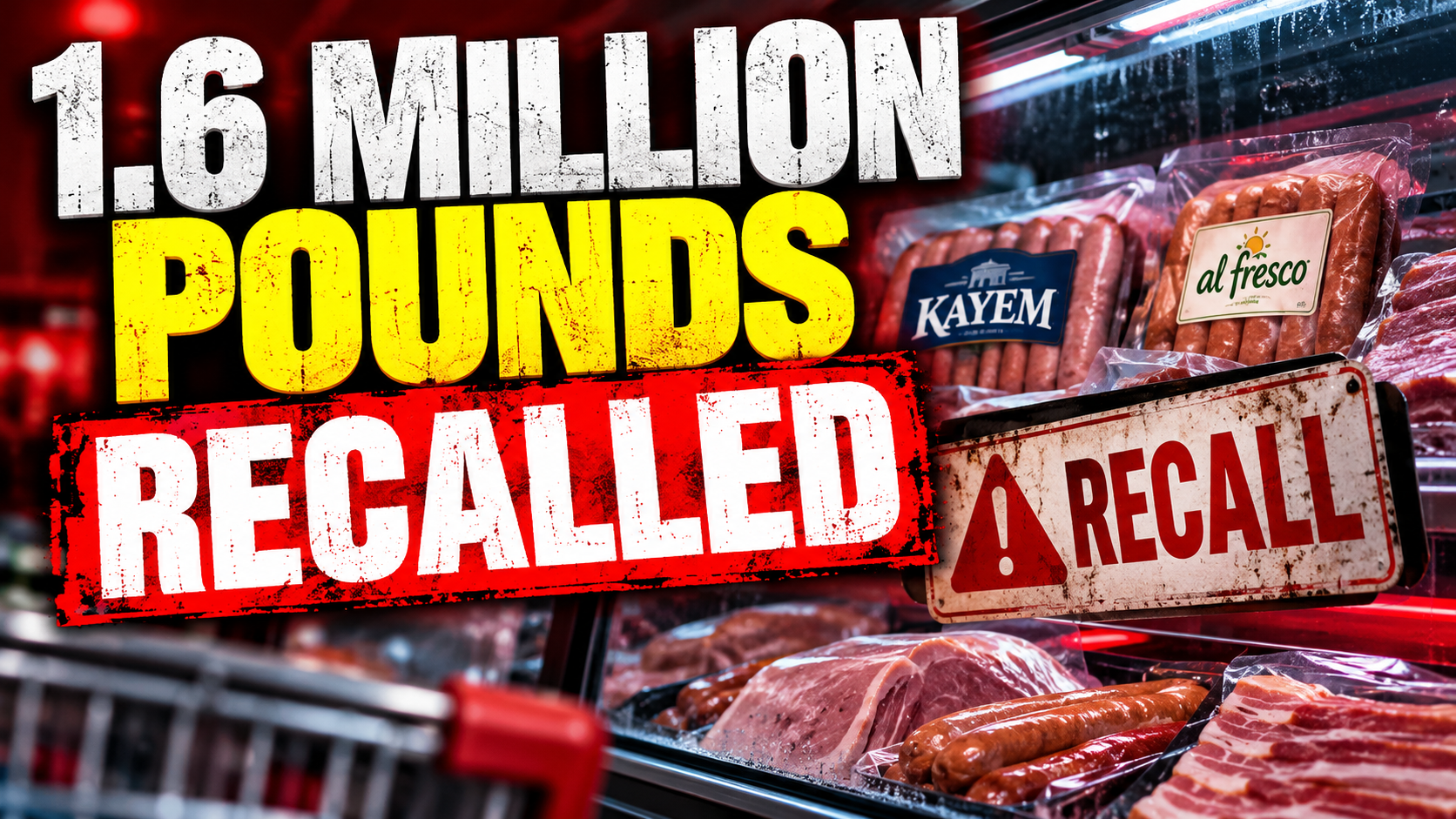
Nearly 1.6 million pounds of ready-to-eat meat and poultry have been recalled following concerns about refrigeration temperatures.
Millions of pounds of food don’t have to be visibly rotten to become a public health concern. Sometimes, all it takes is a refrigeration failure, a warning that comes too late, and products already sitting inside American kitchens.
A Dangerous Question Is Hanging Over America’s Dinner Table
Imagine opening your refrigerator, pulling out a package of hot dogs, bacon, or deli meat, and discovering that the food you trusted may have been stored at unsafe temperatures long before you purchased it.
That’s the disturbing reality behind a massive food recall involving approximately 1,584,361 pounds of ready-to-eat meat and poultry products distributed across the United States and to Hong Kong.
Kayem Foods Inc., based in Chelsea, Massachusetts, initiated the recall after discovering that products may have been exposed to improper temperatures inside a warehouse refrigeration system.
The U.S. Department of Agriculture’s Food Safety and Inspection Service announced the recall on October 17, 2026, classifying it as Class I — the agency’s highest-risk recall category.
That classification means there is a reasonable probability that consuming the affected products could result in serious health consequences or death.
🔴 Help keep this independent voice alive and uncensored.
Support independent journalism and help keep Real Raw News going.
👉 Support Chris Wick on GoFundMe
Federal officials have reported no confirmed illnesses associated with the recall as of the latest available announcements.
But the absence of reported illness doesn’t erase the central question: How did such a massive quantity of food become potentially unsafe before the problem was identified?
It Started With a Customer Who Noticed Something Was Wrong
According to federal reporting, the warning didn’t begin with a routine government inspection uncovering the problem.
It began with a complaint.
On October 1, a retail customer reported receiving meat products that were unusually warm.
That complaint triggered an investigation, which revealed that a warehouse cooler had experienced temperature deviations.
The cooling-system malfunction raised concerns about the safety of products stored inside.
This detail deserves attention.
A customer noticed something wrong with a delivery. Only after that complaint did the investigation establish the refrigeration problem.
It raises a legitimate question about the safeguards intended to identify storage failures before food reaches retailers.
What monitoring systems were in place? How quickly were temperature problems detected? And could the affected products have been identified sooner?
Those questions are not proof of deliberate misconduct. They are questions of food safety accountability that deserve clear answers.
The Recall Reaches Into Everyday American Kitchens
The affected products weren’t obscure specialty foods.
They included familiar items consumed by millions of households, including hot dogs, bacon, sausages, smoked brisket, ham, turkey products, and other ready-to-eat meats.
Products were manufactured between approximately March 31 and October 7, 2026, and distributed through retail and foodservice channels.
Several recognizable brands appear among the affected products:
- Kayem
- Al Fresco
- McKenzie
- Triple M
- Deutschmacher
- Jordan’s
- Essem
- Winnisimmet St. Butchery
Not every product sold under these brand names is necessarily affected. Consumers must check the specific product information against the official recall list.
The scale of the recall makes one thing clear: a problem inside a single part of the food distribution system can have consequences reaching far beyond the warehouse walls.
The Invisible Threat Behind Unsafe Refrigeration
Food doesn’t always announce when something is wrong.
There may be no obvious discoloration. No unusual smell. No unmistakable warning that harmful bacteria have multiplied.
Temperature control is one of the essential barriers protecting refrigerated foods from microbial growth.
When that protection fails, even fully cooked products can become a potential health concern.
This is especially troubling with ready-to-eat foods, which consumers may eat without additional cooking.
The recall does not establish that every affected package contained dangerous bacteria. It means the storage conditions created a potential safety hazard serious enough to warrant removing the products from circulation.
That distinction matters.
Public safety reporting should not confuse a potential contamination risk with confirmed contamination or illness.
A Class I Recall Should Get Everyone’s Attention
The USDA does not classify every food recall at its highest risk level.
Class I is reserved for situations in which exposure to the product presents a reasonable probability of serious adverse health consequences or death.
The classification reflects the potential severity of the hazard, not a finding that consumers have already been harmed.
For shoppers, the message is straightforward: this is not a recall to ignore.
For the food industry, the questions are considerably larger.
How reliable are warehouse refrigeration safeguards? What happens when equipment malfunctions? And how quickly can companies identify and remove products that may have been exposed to unsafe conditions?
A modern food supply chain depends on countless systems working correctly.
When one of those systems fails, consumers may never see the problem until an official warning appears.
Check Your Refrigerator Before Your Next Meal
Consumers should look for affected products bearing the following establishment numbers inside the USDA inspection mark:
EST. M/P 7839
EST. P 20935A
EST. M 9520
These numbers alone do not mean every package bearing them is recalled. Product names, packaging information, and dates should be compared with the USDA’s official recall documentation.
Anyone possessing an affected product should not consume it.
Federal officials advise consumers to discard recalled products or return them to the place of purchase.
Anyone experiencing symptoms of foodborne illness should contact a healthcare professional.
For recall-related questions, Kayem Foods can be contacted at 1-800-426-6100.
The Bigger Story Isn’t Just the Meat. It’s the Trust.
Every day, families purchase food believing that someone has checked the temperatures, monitored the equipment, followed the procedures, and made certain the products are safe.
Most consumers will never visit the warehouses where their groceries are stored.
They will never inspect the refrigeration logs or examine the systems responsible for keeping food at safe temperatures.
They have to trust that the safeguards are working.
And when a recall involves nearly 1.6 million pounds of meat and poultry, that trust deserves scrutiny.
Kayem Foods has reported taking corrective action following the refrigeration problem. But the scale of this incident illustrates why food safety cannot depend solely on responding after a customer notices something wrong.
The public deserves to know whether the existing safeguards worked as intended, where they fell short, and what will prevent a similar failure.
Because the most unsettling part of a food safety recall isn’t always what investigators discover.
It’s what consumers had no way of knowing before the warning arrived.
Chris Wick News — Independent reporting. Uncomfortable questions. No free passes.
Sources
U.S. Department of Agriculture — Food Safety and Inspection Service, Official Recalls and Public Health Alerts https://www.fsis.usda.gov/recalls
Natural News — Meat and Poultry Products Recalled Over Unsafe Temperature Storage https://www.naturalnews.com/2026-10-21-meat-poultry-products-recalled-unsafe-temperature-storage.html
NBC News — Bacon, Hot Dogs and Deli Meat Recall https://www.nbcnews.com/select/shopping/kayem-meat-products-recall-2026-rcna604639
ConsumerAffairs — Kayem Foods Recalls Nearly 1.6 Million Pounds of Meat and Poultry https://www.consumeraffairs.com/news/kayem-foods-recalls-nearly-16-million-pounds-of-meat-and-poultry-102026.html
About the Author