The relationship between Washington and Kyiv is beginning to look less like an alliance built on shared objectives and more like a bitter argument over who gets to decide how this war is fought — and who pays the price.
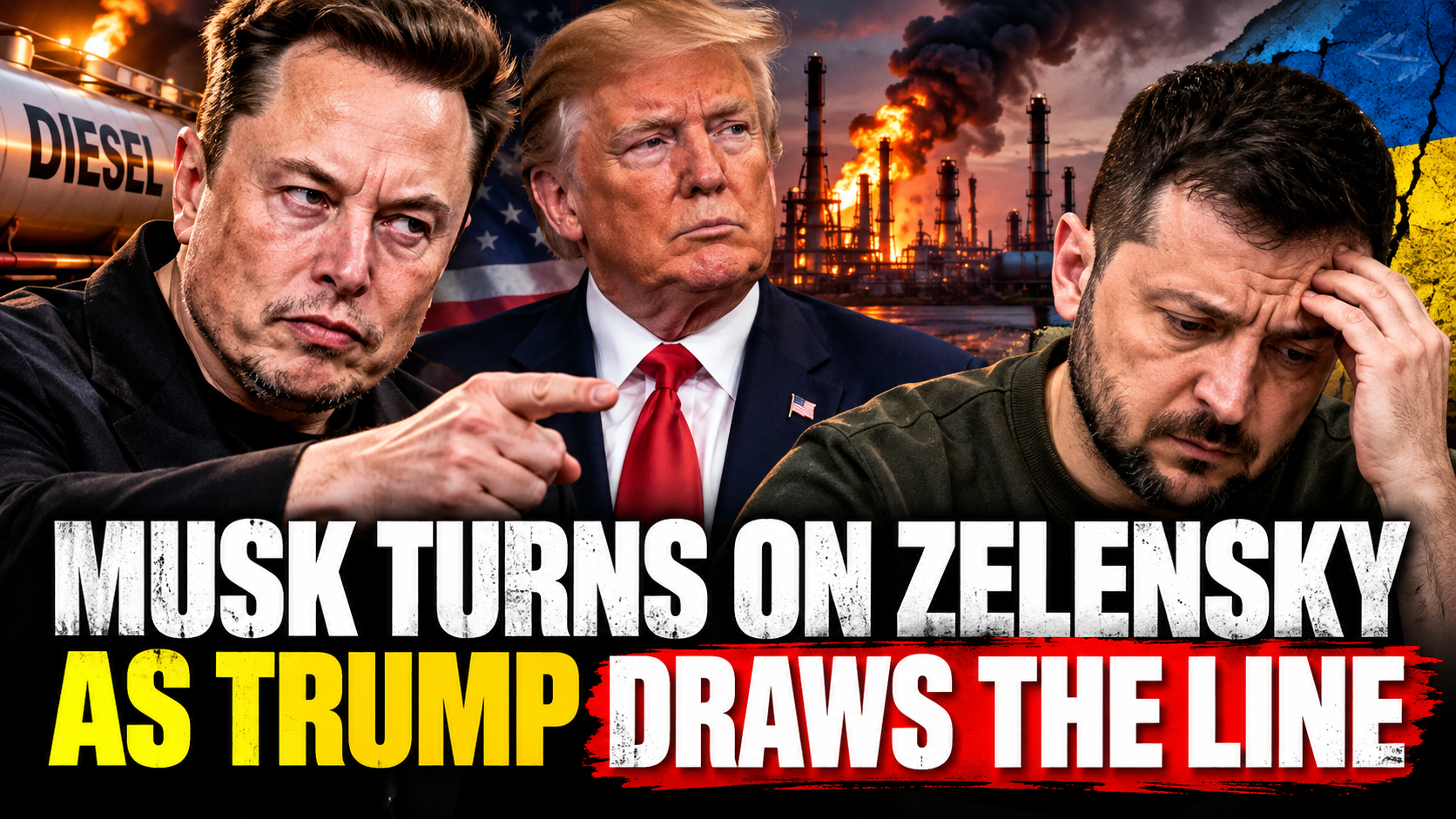
Elon Musk has now entered the confrontation, reportedly declaring that Ukrainian President Volodymyr Zelensky has gone too far.
Those five words, reported by RT in response to President Donald Trump’s latest criticism of Ukraine, come at a particularly dangerous moment.
Trump is accusing Kyiv of contributing to a global diesel shortage through attacks on Russian oil refineries. Zelensky is accusing Washington of rewarding Moscow by allowing Russian diesel back into international markets.
And somewhere in the middle are ordinary Americans, European households, Ukrainian civilians and farmers watching another geopolitical confrontation spill into their daily lives.
The uncomfortable question is no longer simply whether Ukraine can continue fighting Russia.
🔴 Help keep this independent voice alive and uncensored.
Support independent journalism and help keep Real Raw News going.
👉 Support Chris Wick on GoFundMe
It is whether Washington and Kyiv still agree on what winning — or even ending — this war should look like.
Trump Has Had Enough of the Refinery Attacks
Trump’s frustration erupted publicly on Saturday when he accused Zelensky of disregarding American warnings against attacking Russian fuel infrastructure.
The president argued that Ukraine’s strikes were worsening diesel shortages and putting additional pressure on American agriculture.
That matters because diesel isn’t some obscure commodity traded by wealthy investors.
It powers farm machinery, freight trucks, construction equipment and much of the infrastructure responsible for keeping food and goods moving.
When diesel becomes more expensive, the consequences can eventually appear in grocery bills, shipping costs and household budgets.
According to Axios, a US official said Trump had repeatedly asked Ukraine to stop striking Russian refineries before deciding to negotiate a diesel agreement with Russian President Vladimir Putin.
But there is another side to this argument.
Ukraine considers Russia’s petroleum industry a legitimate strategic target because energy revenues help finance Moscow’s military operations. Damaging refineries also disrupts Russia’s domestic fuel supplies and industrial capacity.
That creates an extraordinary contradiction: Ukraine is attacking infrastructure that supports Russia’s war economy, while Washington is now seeking Russian fuel to relieve economic pressure at home.
Both governments claim their decisions serve national security.
Their definitions of national security are moving further apart.
Musk’s Intervention Raises Another Uncomfortable Question
RT reported that Musk responded to a White House video of Trump’s remarks by writing:
“Zelensky has gone too far.”
The reported statement is brief, but Musk is not an ordinary political commentator.
His company SpaceX operates Starlink, a satellite communications system that has played an important role in Ukraine’s military communications and battlefield connectivity.
That gives Musk’s public criticism a significance beyond the usual social media dispute.
However, there is an important distinction here: Musk criticizing Zelensky does not establish that SpaceX intends to restrict or terminate Ukraine’s Starlink service.
No such decision has been demonstrated by the reported statement.
Still, the larger issue deserves attention.
Should a country fighting a major war become so dependent on communications infrastructure controlled by a private corporation?
And what happens when the political views of that corporation’s most prominent executive collide with the priorities of the government relying on its technology?
Those questions extend well beyond Ukraine.
Modern warfare increasingly depends on private satellite networks, commercial technology companies and infrastructure that governments do not entirely control.
The battlefield is no longer shaped exclusively by generals and presidents.
Trump’s Diesel Deal With Putin Changes the Political Equation
The latest confrontation follows Trump’s announcement of an agreement with Putin intended to increase Russian diesel supplies.
The US Treasury also announced temporary sanctions relief allowing Russian diesel to reach international markets.
Trump has presented the arrangement as a practical response to high fuel prices, particularly as the conflict involving Iran has strained global energy supplies.
Zelensky sees something very different.
He argues that permitting Russia to earn additional energy revenue undermines the economic pressure designed to weaken Moscow’s ability to sustain its invasion.
His concern is not difficult to understand.
If Russia receives additional revenue from fuel exports, those funds can support its wider economy, including the resources available for its military campaign.
But Trump’s administration is confronting its own political reality.
American voters facing high fuel prices may have little patience for being told that expensive diesel is an unavoidable sacrifice for a foreign war.
That does not mean Ukraine is responsible for the entire global fuel crisis. The Iran conflict, supply disruptions and broader energy-market pressures are also important factors.
The political danger for Zelensky is that Washington increasingly appears unwilling to absorb economic consequences from Ukrainian military decisions it cannot control.
The Demand for a New Ukrainian President
Trump’s criticism went beyond oil refineries.
He openly suggested Ukraine should replace Zelensky with a leader capable of negotiating an agreement with Russia.
That is an extraordinary intervention by an American president into the leadership of a country his government continues to support.
It also raises a difficult question about sovereignty.
Washington insists that Ukraine must remain independent and free to determine its own future.
Yet its president is now publicly suggesting that Ukraine needs different leadership because its current president refuses to follow Washington’s preferred diplomatic course.
Those positions are not easily reconciled.
At the same time, Zelensky cannot reasonably expect unlimited American support without facing questions about decisions that affect American interests.
An alliance does not mean one government automatically gets everything it wants from another.
But pressure for leadership change is not the same thing as negotiating a military strategy.
Ukraine remains under martial law following Russia’s full-scale invasion in 2022, and wartime elections present serious legal, security and logistical challenges.
The legitimacy of Ukrainian leadership is ultimately a matter for Ukrainians, not foreign governments.
The Compromise Nobody Seems Willing to Accept
There is another detail getting lost beneath the angry statements.
Zelensky has indicated that Ukraine is prepared to stop attacking Russian refineries if Moscow stops attacking Ukrainian energy infrastructure.
That is a reciprocal proposal.
Washington, according to Axios, wanted Ukraine to halt its refinery campaign without requiring Russia to make the same concession first.
The distinction is enormous.
From Ukraine’s perspective, agreeing to stop its attacks while Russian strikes continue would mean surrendering military leverage without receiving meaningful protection in return.
From Trump’s perspective, continued refinery attacks risk prolonging a fuel shortage that is damaging American consumers.
Neither concern can simply be dismissed.
But diplomacy becomes almost impossible when one side demands immediate restraint and the other insists that restraint must be mutual.
The question should be whether a verifiable agreement could reduce attacks on energy infrastructure on both sides.
That would offer a more meaningful path toward de-escalation than another round of public insults.
The Real Cost of This Political Breakdown
It is tempting to treat this confrontation as another personality clash between powerful men.
Trump is angry. Zelensky is defiant. Musk has weighed in.
But reducing the situation to personalities misses the larger danger.
Russia and Ukraine remain locked in a devastating war. Civilians continue to die. Energy infrastructure is being attacked. Economic pressure is spreading beyond the battlefield.
Meanwhile, the diplomatic relationship between Ukraine and its most influential international partner is visibly deteriorating.
And when political leaders begin arguing about fuel supplies, military intelligence, leadership changes and economic retaliation, the consequences can extend far beyond their public statements.
There is a legitimate argument that Ukraine must retain the ability to strike infrastructure supporting Russia’s military campaign.
There is also a legitimate argument that American leaders have a responsibility to protect their own citizens from severe economic disruption.
The problem is that those interests are now colliding in public, with no obvious agreement on how to reconcile them.
Chris Wick’s Take: The War Has Reached an Uncomfortable Crossroads
I keep coming back to one question.
How many more people are supposed to suffer economically — or die on the battlefield — before the people making these decisions seriously confront the consequences?
Russia bears responsibility for launching its full-scale invasion. That fact does not disappear because Washington is frustrated with Zelensky.
But neither should Ukraine’s leadership be immune from scrutiny simply because its country was invaded.
And Trump should face scrutiny of his own.
If easing sanctions puts more money into Moscow’s economy without producing meaningful concessions toward peace, what exactly has Washington accomplished beyond buying fuel?
That question deserves an answer.
Musk’s reported criticism may grab the headlines, but the real story is much larger than a billionaire’s social media post.
It is about a war increasingly entangled with global energy markets, domestic political pressure, private technology companies and competing national interests.
The people making these decisions have extraordinary power.
The people paying the consequences usually have very little.
And perhaps the darkest part of this entire confrontation is that everyone keeps talking about leverage, oil, money and political survival while the actual human cost of the war continues to grow.
If this conflict is ever going to end, somebody will have to start treating diplomacy as something more serious than a contest of threats.
Until then, the arguments will continue.
So will the suffering.
Sources
RT — Zelensky Has Gone Too Far – Musk (original reporting on Musk’s statement)
https://www.rt.com/news/647036-musk-zelensky-gone-too-far
Axios — US Official: Trump Cut Deal With Putin After Zelensky Ignored His Requests
https://www.axios.com/2026/10/10/trump-zelensky-putin-diesel-deal-war
Axios — Trump Tells Ukraine to Replace Zelensky Over Russia Fuel Deal
https://www.axios.com/2026/10/10/trump-ukraine-zelensky-replace-putin-diesel
Reuters — Zelenskiy Says Letting Russia Sell Diesel to US Is Investment in War
Reuters — Ukraine Will Stop Hitting Refineries if Russia Halts Energy Attacks, Zelenskiy Says
Associated Press — Trump Says Ukraine Should Get a New President as He Blames Zelenskyy for US Diesel Prices
https://apnews.com/article/228ccf74b2848c1ff0ac23f038b37512
About the Author