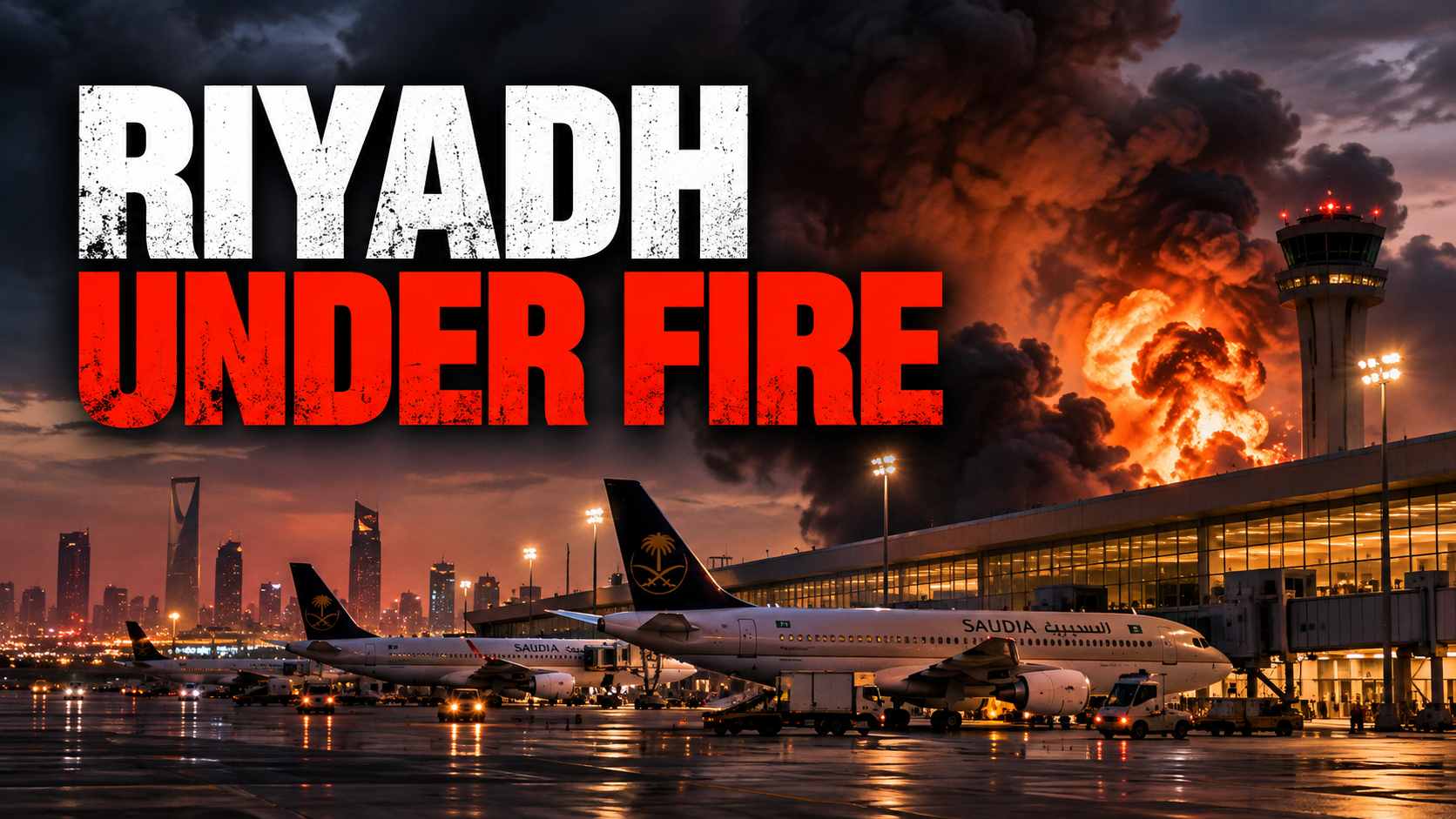
Saudi Arabia’s capital has once again become the scene of a frightening security emergency. Another explosion has been reported at Riyadh’s King Khalid International Airport, forcing evacuations, disrupting commercial flights, and raising a disturbing question: How long can civilian aviation continue operating safely when a major international airport becomes a repeated target in an expanding regional war?
The latest incident occurred Saturday, October 10, against the backdrop of escalating attacks by Yemen’s Iran-aligned Houthi movement.
According to Reuters, witnesses reported an explosion at the airport, with several people seen injured and more than a dozen ambulances responding. Travellers were evacuated from sections of the facility as airlines diverted or cancelled flights.
Saudi authorities had not immediately provided a public explanation for Saturday’s explosion when the initial reports emerged.
The precise cause of the latest blast, the number of casualties, and responsibility for the incident had not been independently confirmed.
But one thing is already clear: The danger surrounding Riyadh’s airport is no longer an isolated security concern.
🔴 Help keep this independent voice alive and uncensored.
Support independent journalism and help keep Real Raw News going.
👉 Support Chris Wick on GoFundMe
A Major Airport Caught in an Escalating Conflict
Saturday’s emergency follows deadly attacks earlier in the week that struck airport facilities and damaged commercial aircraft.
Saudi Arabia’s General Authority of Civil Aviation confirmed that three Saudi citizens were killed in attacks on Thursday, October 8, with several other people injured.
Among those killed was a Saudia airline captain. The airline also confirmed damage to an aircraft parked at the airport.
The Associated Press reported that multiple aircraft were damaged in Thursday’s attacks, citing regional officials.
These are not merely military developments occurring somewhere beyond the reach of ordinary civilians. They involve an international airport where passengers, airline crews, maintenance workers, and ground personnel expect to carry out routine activities without becoming casualties of war.
The distinction matters.
An airport does not have to be completely destroyed to become effectively unusable. Repeated security alerts, flight diversions, damaged aircraft, and uncertainty about incoming attacks can disrupt operations even when runways and terminals remain standing.
Airlines Are Already Voting With Their Flight Schedules
The consequences are spreading beyond the airport perimeter.
Reuters reported that flight-tracking information showed incoming flights to Riyadh being diverted or cancelled following Saturday’s incident.
Kuwait Airways cancelled services to and from the Saudi capital, while Etihad Airways and Qatar Airways also suspended multiple flights. Some cancellations extended into Monday.
Other airlines had already adjusted schedules after the earlier attacks.
For passengers, the consequences are immediate: missed connections, uncertain departure times, interrupted business travel, and the possibility of being stranded far from home.
For airlines, the calculation is even more serious.
Every flight into a threatened airport requires decisions involving passenger safety, aircraft security, insurance exposure, crew availability, and rapidly changing airspace conditions.
Airlines cannot simply assume that a civilian destination will remain safe because it was operating normally a few hours earlier.
And that uncertainty may prove almost as damaging to aviation operations as the attacks themselves.
The Houthis Have Turned Saudi Airspace Into a Warning Zone
Yemen’s Houthi movement has warned commercial airlines to avoid Saudi airspace, describing it as an area of military operations.
The warning follows a Saudi-backed Yemeni government offensive against the group earlier this month.
The Houthis have demonstrated that their confrontation with Saudi Arabia is not confined to Yemen’s territory.
Their missile campaign has placed critical Saudi infrastructure under renewed pressure, including facilities central to international transportation.
However, responsibility for Saturday’s specific explosion still requires confirmation. The wider pattern of Houthi attacks does not, by itself, establish what caused every reported blast.
That distinction is essential when reporting on an active conflict, where premature claims can quickly become accepted as fact.
Why This Crisis Could Reach Far Beyond Saudi Arabia
Riyadh is not simply another destination on an airline route map.
It is the capital of one of the world’s most influential energy-producing nations and a major centre for international business, investment, and diplomatic activity.
Major energy and investment conferences are scheduled in the city, and organizers have indicated that those events will proceed despite the deteriorating security environment.
That creates an uncomfortable contrast.
Saudi Arabia wants to project economic confidence and stability at precisely the moment repeated attacks are exposing vulnerabilities in its transportation infrastructure.
For international investors, the immediate concern may not be whether a conference can proceed. It is whether the wider security environment is becoming unpredictable enough to affect future travel, investment decisions, and business operations.
There is also a larger regional danger.
If commercial aviation becomes increasingly entangled in military confrontation, governments and airlines may respond with wider airspace restrictions, route changes, and additional security precautions.
Those decisions can increase operating costs and create disruption far beyond the countries directly involved in the fighting.
The Dangerous Illusion of Contained Warfare
There is a recurring assumption in modern conflicts that military escalation can be carefully managed, geographically contained, and separated from civilian life.
The events surrounding Riyadh’s airport challenge that assumption.
A missile campaign intended to pressure an opposing government can quickly threaten people who have no role in military decisions.
A commercial pilot preparing for a routine flight is not a battlefield commander. Neither is a passenger waiting to board an aircraft.
Yet repeated attacks near civilian aviation infrastructure place both in danger.
This is where the language of military strategy collides with the reality of human consequences.
Governments may describe attacks as retaliation, deterrence, or strategic pressure. Those explanations do not eliminate the risks to civilians.
Nor do they answer the question of what happens when each side responds to the previous attack with another escalation.
What Happens Next?
Several questions remain unanswered following Saturday’s explosion.
Saudi authorities have yet to establish publicly, in the reporting available at publication, exactly what caused the latest incident.
The full extent of injuries and physical damage also remains unclear.
It is uncertain when airlines will restore normal schedules or whether additional security restrictions will be imposed.
And perhaps most importantly, there is no clear indication that the military confrontation driving these attacks is approaching a resolution.
For now, Riyadh’s airport has become a warning about the fragile boundary between regional warfare and civilian infrastructure.
The airport may reopen. Flights may resume. Conferences may proceed.
But none of those developments automatically means the underlying threat has disappeared.
The deeper question is whether the governments and armed groups driving this confrontation are prepared to accept responsibility for the civilians increasingly caught in its path.
Because once international airports become recurring targets in a regional conflict, the consequences no longer remain confined to the battlefield.
Sources
Reuters — Multiple People Wounded in Blast at Riyadh Airport, Say Eyewitnesses (October 10, 2026)
Associated Press — Drone Strike in Sudan Kills 40, Lebanon Welcomes US Flight Ban Lift, and Other Mideast Developments (October 10, 2026)
https://apnews.com/article/a5f40b5e0ab08ae8128db5ed749114d8
Reuters — Plane Damaged at Riyadh Airport as Houthis Escalate Attacks, Sources Say (October 8, 2026)
Gulf News — Riyadh Airport Attacks and Airline Flight Disruptions (October 9–10, 2026)
About the Author