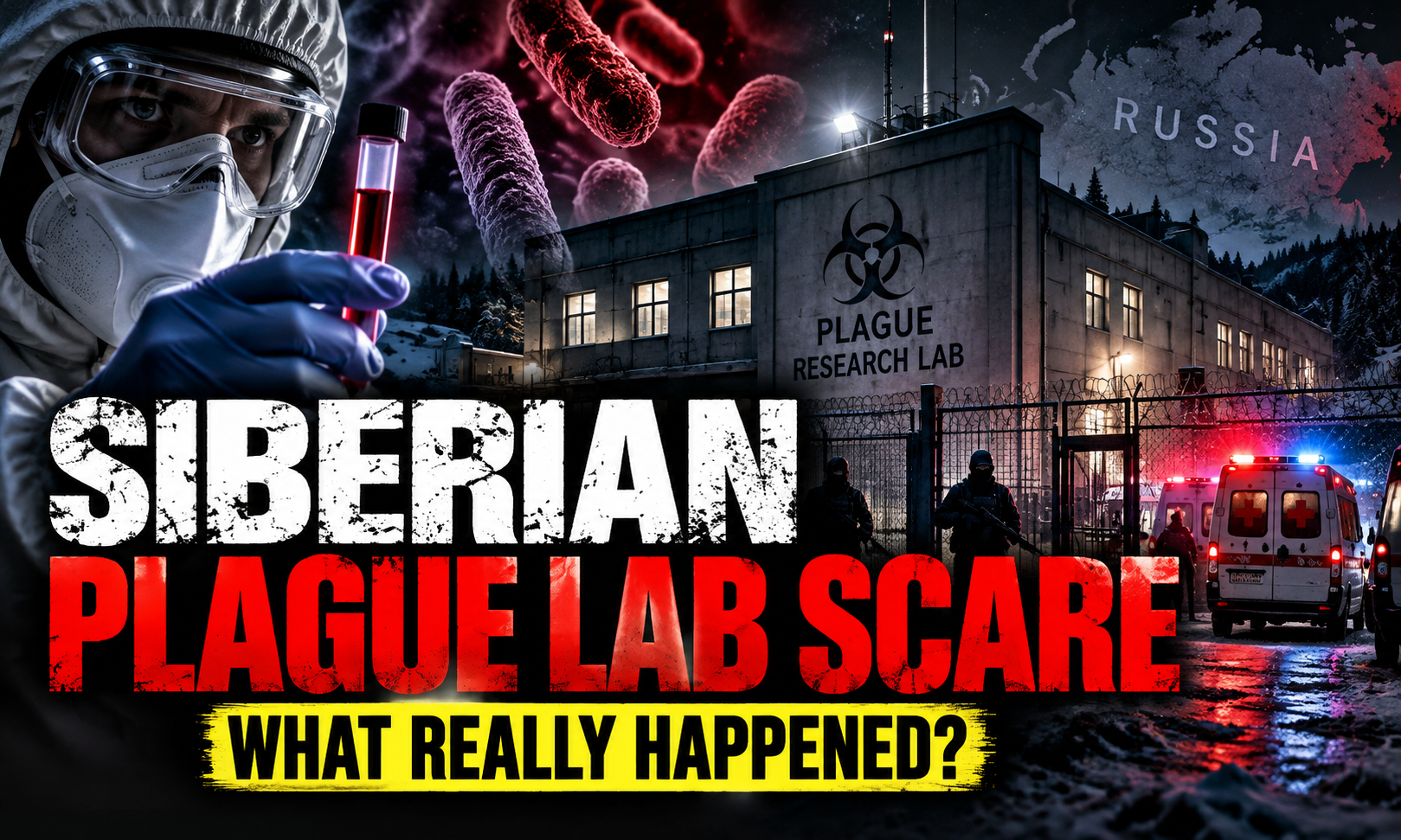
One dead laboratory worker. Nearly 200 people reportedly placed under observation. A quarantined hospital area. Then one word capable of turning an obscure incident in Siberia into an international headline almost overnight:
Plague.
The circumstances surrounding the death of a 28-year-old technician connected to an anti-plague research institute near Irkutsk, Russia, have triggered exactly the kind of story that can move from local tragedy to global fear with remarkable speed.
But beneath the alarming headlines sits an important question: How much has actually been confirmed?
That gap between what is known and what is being suggested is now becoming the story itself.
What Happened in Siberia?
According to the account published by Natural News founder Mike Adams, the technician reportedly died after an alleged laboratory accident involving a test tube believed to contain live plague bacteria.
Help keep this independent voice alive and uncensored -> Buy us a Coffee <-
Nearly 200 people were reportedly placed under medical observation, while part of a hospital was quarantined. Reports cited in the article also claimed Russian security personnel were involved in escorting ambulances transporting people connected to the case.
Yet the official picture described in the same account was considerably less dramatic.
Irkutsk regional authorities reportedly described the woman’s cause of death as pneumonia of undetermined origin, while saying microorganisms associated with her laboratory work had not been identified in her biological samples. People who had been in contact with her were reportedly showing no symptoms and testing negative.
Those conflicting signals form the basis of the much broader argument made in the original Natural News report: that the public should distinguish between a genuine biological threat and fear generated around an event before its most important facts have been established.
That distinction matters.
Because Yersinia pestis, the bacterium responsible for plague, is real. The danger posed by pneumonic plague is real. But a dangerous pathogen existing somewhere in the world is not automatically evidence that the world is facing another pandemic.
When an Unconfirmed Incident Becomes a Global Story
Adams argues that the Siberian incident is being amplified beyond what the available evidence currently supports.
His language is deliberately provocative. He describes the emerging narrative as a potential psychological operation and argues that fear surrounding infectious disease can create political, institutional and commercial opportunities.
That remains his interpretation—not an established fact.
But the broader question deserves examination regardless of whether one accepts his conclusion.
Modern information moves faster than laboratory confirmation.
An alarming allegation can circle the world before testing is complete. Governments react. Markets react. Social media reacts. Millions of people form opinions before investigators have established exactly what happened.
And once the word “plague” enters the conversation, history does much of the emotional work.
The disease carries centuries of psychological baggage.
That makes restraint especially important.
The Vaccine Question Enters the Debate
Adams takes the argument considerably further by connecting the current controversy to research into mRNA-based vaccines targeting plague.
He views the timing suspiciously and argues that another infectious-disease scare could eventually produce pressure for another large-scale vaccination campaign.
The source goes further still, suggesting possible deliberate biological releases and even linking such scenarios to depopulation agendas.
Those are extraordinary allegations, and the article does not establish them as proven facts.
That distinction should not disappear simply because the allegations are politically explosive.
Skepticism cuts both ways.
Governments, pharmaceutical companies and public-health institutions should be questioned when evidence warrants it. But allegations against those institutions also require evidence proportional to the seriousness of the accusation.
Otherwise skepticism risks becoming another form of certainty.
Alternative Treatments Raise Another Critical Issue
A significant portion of Adams’ article focuses on nutrition, supplements and herbal preparations that he believes could strengthen the body against bacterial infections.
He discusses vitamin C, vitamin A, vitamin D, zinc, selenium and adequate protein, along with herbs and compounds including berberine, Chinese rhubarb, usnea and mullein.
But there is an important line that should not become blurred.
Pneumonic plague is a medical emergency.
Adams himself acknowledges this distinction, telling readers suffering from a serious lung infection or breathing difficulty to seek emergency medical treatment and recognizing that antibiotics can be lifesaving in acute bacterial infections.
That may be the most important medical distinction in the entire controversy.
Nutrition and general health practices are one discussion. Treating a suspected case of a rapidly progressing bacterial disease is another.
Nobody should delay emergency medical care for suspected plague or another severe respiratory infection while experimenting with herbs or supplements.
The Real Story May Be the Information War
The Siberian case exposes something larger than a debate about one laboratory worker.
We now live in an environment where fear, distrust and incomplete information collide almost instantly.
Governments have credibility problems.
Pharmaceutical companies have credibility problems.
Legacy media organizations have credibility problems.
Alternative media organizations have credibility problems too.
That leaves ordinary people standing in the middle, attempting to determine what is real while competing institutions insist that their version deserves trust.
The answer cannot be blind obedience.
But it cannot be blind rejection either.
It has to be evidence.
If Russian authorities eventually establish that live plague bacteria escaped from a laboratory, that deserves serious international attention.
If investigators establish that no plague infection occurred, that deserves equal attention—and the correction should travel just as far as the original frightening headline.
Unfortunately, corrections rarely move as quickly as fear.
The Questions That Still Matter
Was the technician actually infected with Yersinia pestis?
Was there genuinely a broken container holding live plague bacteria?
Did anyone else become infected?
Was the quarantine simply precautionary?
And is there credible evidence of a wider outbreak?
Until those questions have definitive answers, there is a vast difference between monitoring a potentially serious laboratory incident and declaring the beginning of another global health emergency.
That space between evidence and fear is where this story now lives.
The darkest possibility isn’t necessarily that another pandemic is beginning.
It may simply be that after years of emergencies, institutional failures and collapsing public trust, millions of people no longer know whom to believe when the next frightening headline arrives.
And that is a problem no vaccine can solve.
About the Author