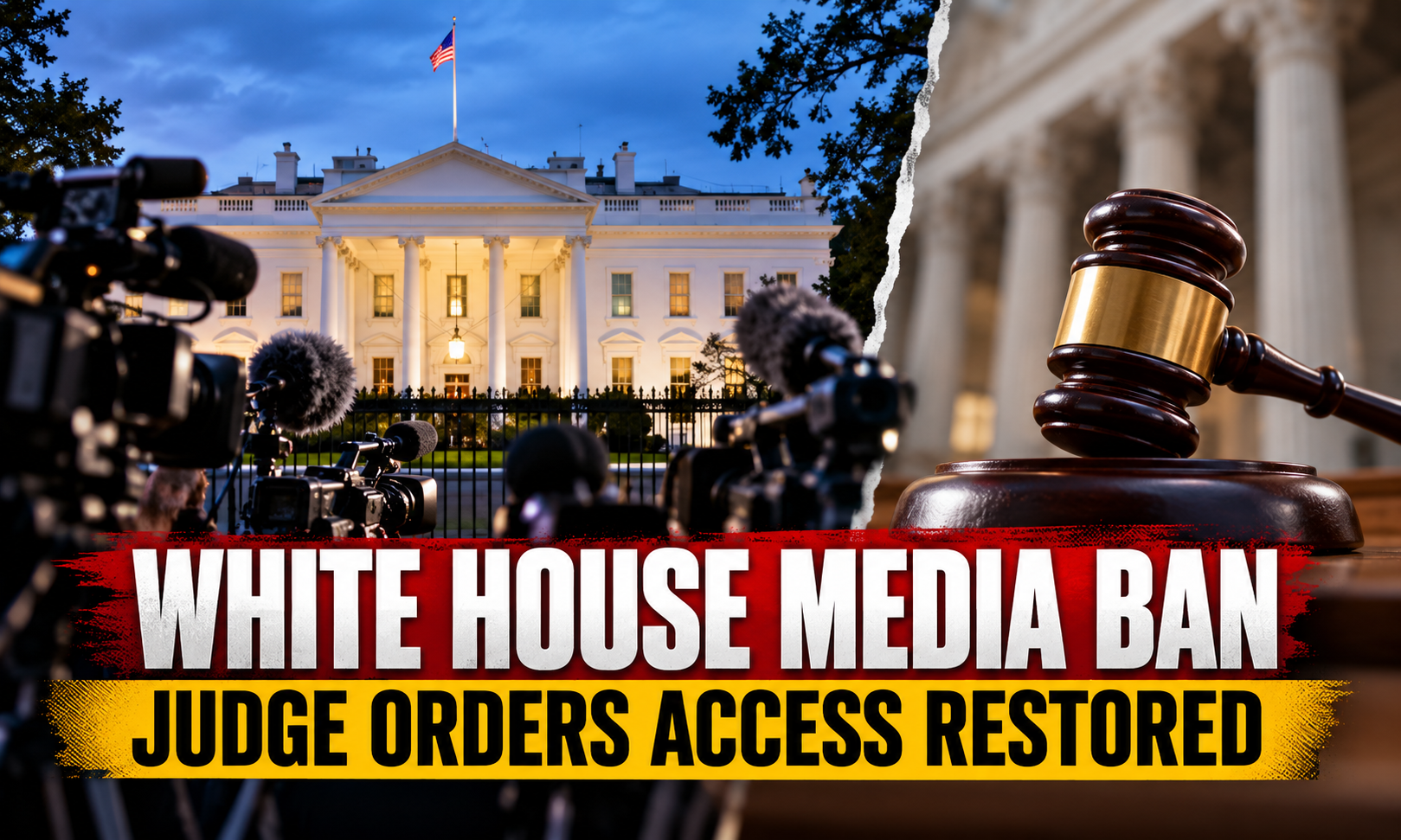
A dramatic fight over who gets to report from inside the White House has just moved from the press room to the federal courts — and for now, the Trump administration has been ordered to back down.
In a significant ruling issued early Thursday, U.S. District Judge Timothy J. Kelly ordered the administration to immediately restore White House press credentials to journalists from CNN, MS NOW and Politico, temporarily reversing President Donald Trump’s decision to bar the three organizations from White House grounds.
The ruling does not end the legal battle.
It may instead be the beginning of a much larger fight over presidential authority, press access and the constitutional limits on a White House seeking to exclude news organizations whose reporting it considers unfair, inaccurate or potentially harmful to national security.
Kelly granted the organizations a 14-day temporary restraining order, allowing their journalists to regain access while their lawsuit proceeds.
According to the original NPR report, Kelly ordered White House representatives to “immediately return, reinstate, and restore” the credentials that had been taken from reporters working for the three organizations.
🔴 Help keep this independent voice alive and uncensored.
Support independent journalism and help keep Real Raw News going.
👉 Support Chris Wick on GoFundMe
But the reasoning behind that decision could ultimately prove more important than the temporary restoration itself.
Judge Raises Serious Due Process Concerns
CNN, MS NOW and Politico filed a joint lawsuit after their White House credentials were revoked following Trump’s announcement that he was banning the organizations.
The outlets argue that the action violated constitutional protections, including the First Amendment, and amounted to retaliation based on their journalism.
Kelly did not issue a final ruling on those broader claims.
Instead, he concluded at this early stage that the organizations were likely to succeed in showing that their permanent White House passes had been revoked without constitutionally adequate due process.
The problem was straightforward: reporters who already possessed White House credentials were stripped of them without receiving advance notice and an opportunity to challenge the decision.
The administration must have sufficiently clear standards governing conduct that can result in the loss of those credentials, Kelly reasoned.
The judge also criticized the standard the administration used to describe objectionable reporting, calling it too vague to adequately establish when a journalist’s access could be revoked.
That distinction matters.
The ruling does not establish an unlimited constitutional right for every journalist or news organization to enter the White House. Instead, it addresses whether the government can revoke existing credentials without adequate procedures and whether the reasons given for doing so withstand constitutional scrutiny.
Trump Said the Outlets Were Producing “Fake News”
Trump announced the ban on September 18, accusing the organizations of producing “fake news” and criticizing what he described as unfair and negative reporting.
The dispute quickly escalated.
Journalists from the three organizations were subsequently prevented from entering White House grounds, with their credentials deactivated or confiscated.
The administration later offered another justification in court: national security.
Justice Department lawyers argued that reporting by the organizations had exposed sensitive information or spread falsehoods involving national security.
Among the reporting cited by the administration were stories involving White House construction and security details, an alleged leak investigation and coverage related to the conflict with Iran.
That argument encountered skepticism from Kelly.
The National Security Argument Runs Into Trouble
One of the most consequential portions of Kelly’s ruling concerns the administration’s national security defense.
The judge said the record offered little evidence supporting the claim that revoking the organizations’ credentials was actually necessary to protect national security.
Kelly also noted that Trump’s initial explanation for the ban focused on what the president considered unfair, negative or false reporting — not national security.
That creates a potentially important question as the lawsuit moves forward:
Were the outlets excluded because their reporting genuinely created a security risk, or because the administration objected to what they were reporting?
The administration maintains that White House access is a privilege rather than an absolute right and that the president has broad authority over access to restricted presidential spaces.
The news organizations contend that once the government establishes a credentialing system, it cannot selectively punish journalists because officials dislike their reporting.
Those competing arguments are now headed deeper into federal court.
The Fight Has Spread Beyond Three News Organizations
The controversy has also triggered an unusual response from other major media organizations.
Nearly 50 news organizations joined a court filing supporting the challenge to the White House restrictions.
Meanwhile, ABC, CBS, CNN, Fox News and NBC suspended participation in normal television pool coverage of presidential events in solidarity with the excluded organizations.
The White House press pool exists because every news organization cannot physically attend every presidential event. Participating organizations rotate coverage and share material with other outlets.
That means disputes over access can potentially affect far more than one network or newspaper.
They can affect how quickly — and how completely — the public sees what the president is doing.
A Familiar Judge in a Familiar Fight
There is another striking element to the case.
Kelly was nominated to the federal bench by Trump in 2017.
He also played a role in another major White House press-access dispute during Trump’s first presidency.
In 2018, Kelly ordered the White House to temporarily restore CNN correspondent Jim Acosta’s credentials after they were revoked following a confrontation at a presidential news conference.
Eight years later, another dispute involving CNN has landed before the same judge — this time alongside MS NOW and Politico and involving a much broader exclusion of entire news organizations.
The similarities raise an important legal issue that extends beyond Trump or any particular news outlet.
If a government grants journalists continuing credentials to cover public officials, what process must it follow before taking those credentials away?
And perhaps more importantly, can criticism of an administration become grounds for losing access?
The 14-Day Clock Is Now Running
For the moment, CNN, MS NOW and Politico have regained their ability to report from White House grounds.
But Kelly’s order is temporary.
The restraining order remains in effect for 14 days unless the court issues another order. During that period, both sides will have an opportunity to develop their arguments as the court considers whether longer-term relief is warranted.
The news organizations still must litigate their underlying constitutional claims.
The administration, meanwhile, can continue attempting to demonstrate that its restrictions were based on legitimate government interests rather than retaliation against unfavorable coverage.
That distinction could determine far more than who occupies a seat in the White House press room.
The Bigger Question Is About Future Presidents
It is easy to view this battle through the lens of Trump versus the mainstream media.
But the precedent at stake reaches beyond either side.
A rule established under one administration can potentially be used by another.
If presidents are permitted to revoke established press credentials because they consider particular reporting dishonest, unfair or excessively negative, future administrations could potentially invoke similar reasoning against entirely different organizations.
Conversely, the government has legitimate responsibilities for physical security, classified information and controlling access to sensitive areas of the White House.
Courts therefore face a difficult line: preserving legitimate presidential security authority while preventing government officials from using access as a tool to punish constitutionally protected journalism.
Kelly’s temporary order does not settle that debate.
It ensures that CNN, MS NOW and Politico remain inside the White House while the courts decide it.
And the ultimate answer could help define the relationship between presidents and the journalists covering them long after this particular confrontation is over.
About the Author