Funny how every problem in Washington eventually becomes somebody else’s fault.
The economy? Blame the previous administration.
The border? Blame the previous administration.
Wars overseas? Blame the people who came before you.
Inflation, crime, trade, government spending — somewhere along the way, American politics has become very good at explaining who created a problem and considerably less comfortable answering a much simpler question:
What are the people in power doing about it now?
🔴 Help keep this independent voice alive and uncensored.
Support independent journalism and help keep Real Raw News going.
👉 Support Chris Wick on GoFundMe
That question applies to every president.
It applied to George W. Bush.
It applied to Barack Obama.
It applied to Joe Biden.
And today, it applies to Donald Trump.
Eventually, You Own the Job
Every new president inherits problems.
That’s reality.
Economic policies can take years to produce their full effects. Wars don’t suddenly disappear because somebody new moves into the White House. Congress can block a president’s agenda. Courts can overturn executive actions. International events can destroy even the best-laid plans.
Those are legitimate considerations.
But there comes a point when “I inherited this” stops being a complete answer.
Donald Trump didn’t reluctantly become president.
He campaigned for the job.
He told Americans what he intended to do with it.
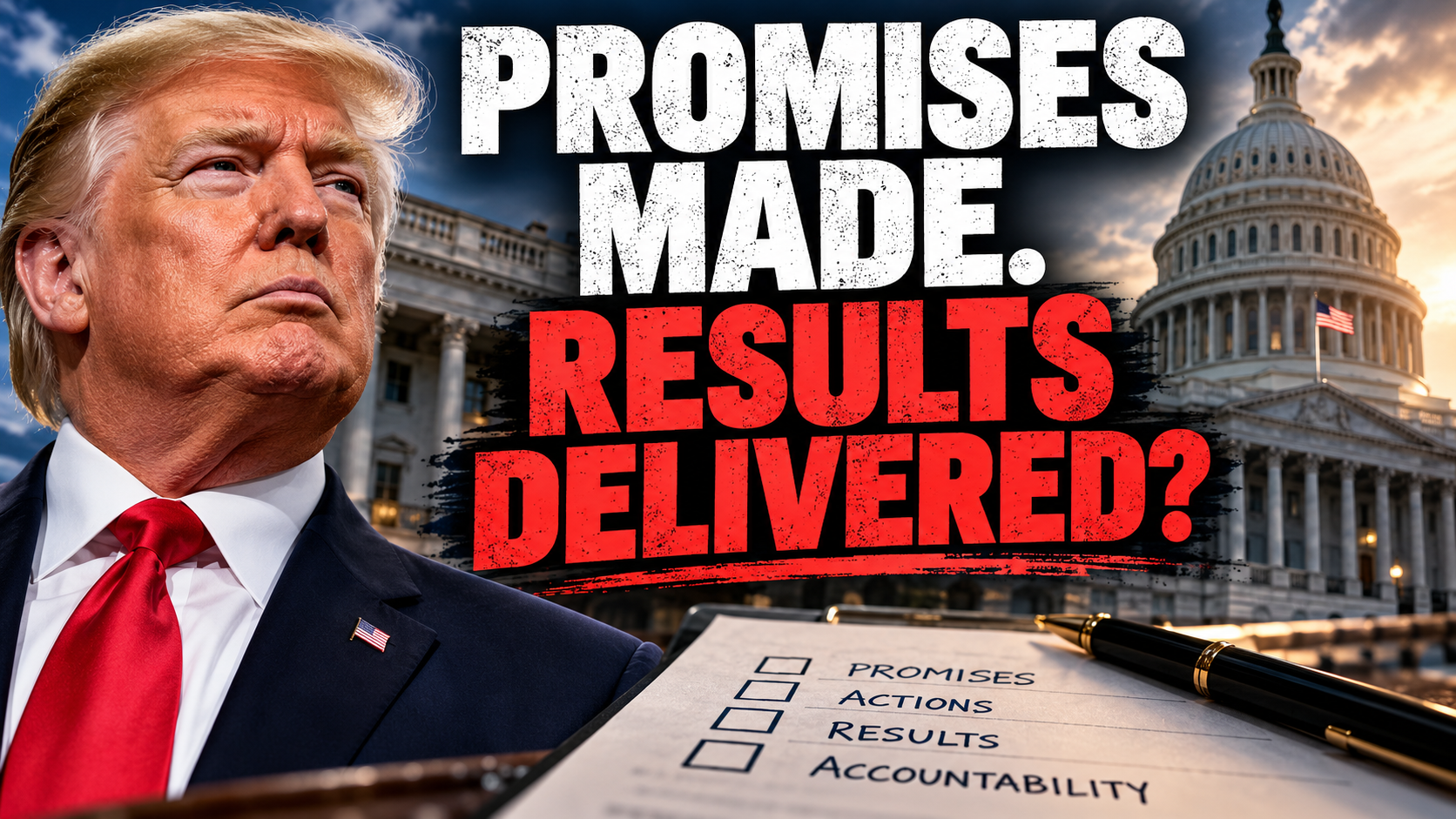
And voters now have every right to compare those promises with what has actually happened.
Some Promises Have Produced Real Action
Accountability also means acknowledging results when they happen.
Trump returned to office promising dramatically tougher immigration enforcement. His administration has implemented extensive changes at the border and inside the United States, expanded enforcement resources and pursued a much more restrictive immigration policy.
His administration has also enacted major tax changes, pursued an aggressive tariff and trade strategy, and implemented numerous regulatory and administrative changes.
Supporters point to those actions as evidence that Trump has followed through on important parts of the agenda voters elected him to pursue.
That evidence shouldn’t simply be dismissed because somebody dislikes Trump.
But neither should taking action automatically be treated as proof that every promise has succeeded.
Those are two different questions.
A Promise Isn’t the Same Thing as a Result
This distinction gets lost constantly in politics.
Signing an executive order is an action.
Passing legislation is an action.
Announcing a tariff is an action.
Sending troops somewhere is an action.
The harder question is what those actions actually accomplish.
Did Americans’ lives become more affordable?
Did the policy accomplish what was promised?
Did a foreign conflict actually end?
Did government spending fall?
Did wages improve relative to living costs?
Did the policy create unintended consequences somewhere else?
That’s where accountability becomes uncomfortable, because slogans suddenly have to compete with results.
The Economy May Be the Biggest Test
For millions of people, politics eventually comes down to something much simpler than speeches in Washington:
What does life cost?
Can you afford groceries?
Can you afford your mortgage or rent?
What happened to your electricity bill?
Your gasoline?
Your insurance?
Your interest payments?
A president doesn’t personally control every price in the economy, and pretending otherwise would be misleading.
But presidents absolutely influence economic policy.
Trump has made tariffs a central part of his economic strategy. In February 2026, his administration imposed a temporary 10% surcharge on a broad range of imports, with exemptions and other tariff regimes applying in particular cases.
The administration argues its trade policies are protecting American industry, encouraging investment and creating a fairer trading system.
Critics question the costs ultimately borne by businesses and consumers.
That’s precisely the debate Americans should be having.
Not simply:
“Do you support Trump?”
But:
“Is the policy producing the result we were promised?”
Foreign Policy Deserves the Same Scrutiny
Trump has repeatedly presented himself as a president capable of resolving conflicts through strength and negotiation.
His administration points to a series of international agreements and interventions as evidence of success.
But foreign policy doesn’t stop being complicated because a politician promised a quick solution.
Americans should be able to examine each conflict separately and ask:
What was promised?
What actually happened?
What did it cost?
What changed?
And what happens next?
Those aren’t anti-Trump questions.
They’re questions citizens should ask every president.
The Standard Shouldn’t Change With the Party
This may be the biggest problem in American politics.
When the other party controls the White House, everything becomes the president’s responsibility.
When our preferred party controls it, suddenly everything becomes complicated.
Congress gets blamed.
The Federal Reserve gets blamed.
The previous president gets blamed.
The media gets blamed.
Foreign governments get blamed.
Sometimes those explanations are completely legitimate.
But political loyalty shouldn’t become an exemption from scrutiny.
If you demanded accountability from Biden, you should demand it from Trump.
If you demanded accountability from Trump, you should have demanded it from Biden.
The same goes for Obama, Bush and whoever occupies the White House next.
Otherwise, we’re not defending principles.
We’re defending teams.
Promises Are Easy. Governing Is the Test.
Campaign rallies are built around promises because promises are powerful.
They’re also free.
Governing isn’t.
Governing forces politicians to deal with Congress, courts, budgets, markets, allies, adversaries and consequences they may never have anticipated.
That’s why the public shouldn’t judge presidents solely by what they say they’re going to do.
Judge the record.
Look at what was promised.
Look at what was attempted.
Look at what was delivered.
Look at what failed.
And when something failed, ask why.
Maybe Congress stopped it.
Maybe a court ruled it unlawful.
Maybe circumstances changed.
Maybe the original promise was unrealistic.
Or maybe the administration simply didn’t deliver.
The evidence should determine the answer.
Stop Treating Accountability Like an Attack
This shouldn’t be controversial.
Donald Trump is president.
He holds enormous power.
That means Americans have every right to scrutinize what happens under his administration.
Not because he’s Republican.
Not because he’s Donald Trump.
Because he’s the president.
And presidents work for the people.
So perhaps the question Americans should be asking isn’t whether Trump is good or bad.
Ask something much harder:
Which promises has Donald Trump delivered?
Which promises remain unfinished?
Which promises changed once governing reality arrived?
And which results have actually made Americans’ lives better?
Bring evidence.
Bring numbers.
Bring receipts.
But don’t bring the excuse that we’re not allowed to question today’s president because yesterday’s president made mistakes too.
Yesterday’s leaders had their turn to be held accountable.
Today’s leaders have theirs.
Power comes with accountability — not an unlimited supply of excuses.
Now I’d like to hear from you:
Which Trump promise do you believe has clearly been delivered?
Which promise do you believe has clearly not been delivered?
And most importantly — what evidence convinced you?
Keep the debate factual. Disagree as strongly as you want.
Just bring the receipts.
About the Author