The Arctic chessboard just changed — and the consequences for North American security could last for decades.
President Donald Trump has spent months arguing that Greenland is critical to the security of the United States and the wider North American continent.
Now Washington says it has secured an agreement designed to dramatically strengthen America’s long-term strategic position on the massive Arctic island.
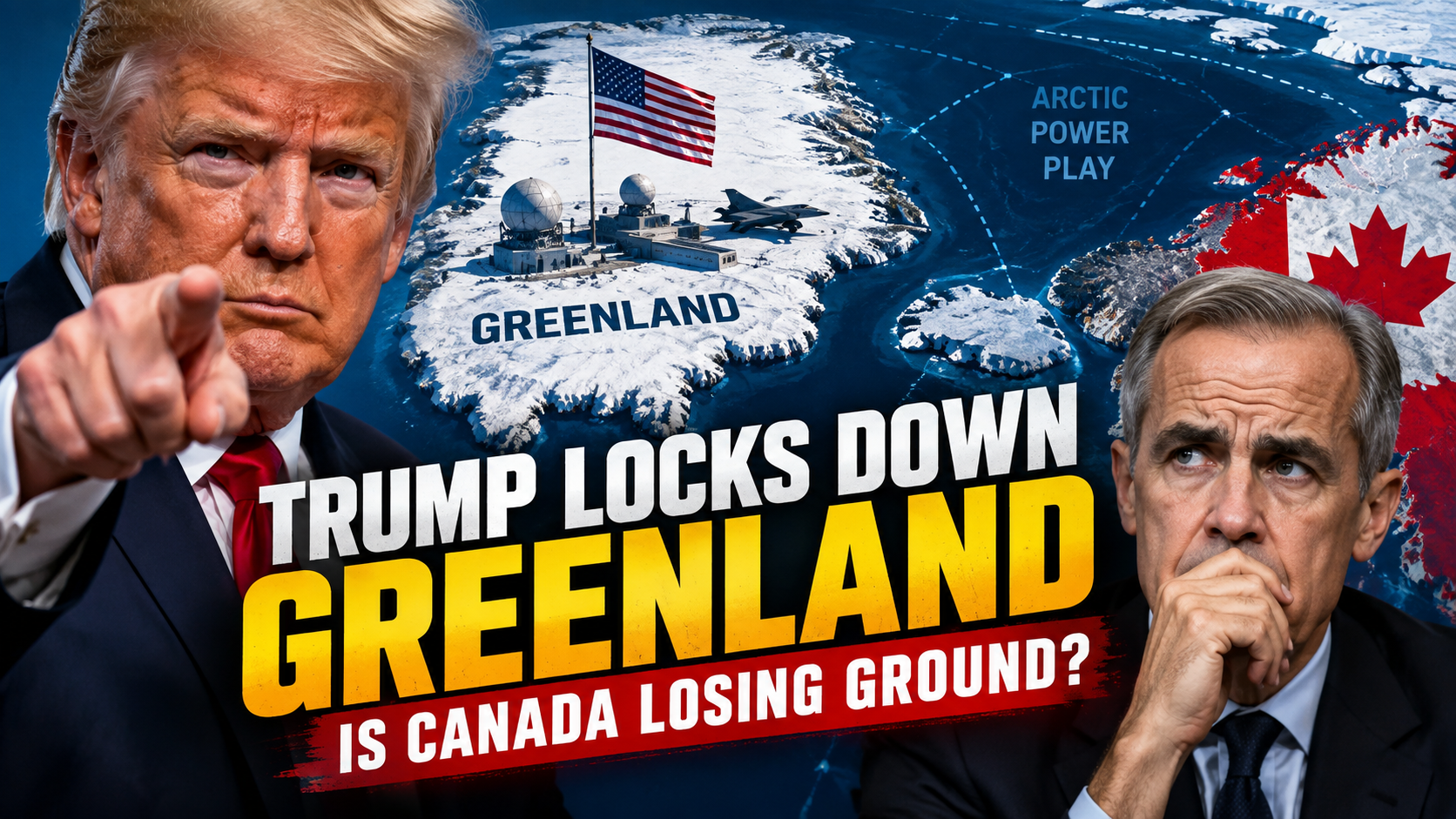
The emerging deal with Denmark and Greenland would expand the U.S. military presence, provide permanent American access, basing and overflight rights, and prevent non-NATO adversaries from establishing military bases in Greenland. Sensitive investments by potential adversaries would also face restrictions.
For Trump, the message is straightforward:
Greenland is part of North America’s strategic defence perimeter — and Washington intends to keep hostile powers out.
🔴 Help keep this independent voice alive and uncensored.
Support independent journalism and help keep Real Raw News going.
👉 Support Chris Wick on GoFundMe
But north of the U.S. border, Canada is pursuing a noticeably different geopolitical strategy.
Prime Minister Mark Carney’s government has been strengthening Canada’s relationships with Europe and Nordic countries while attempting to reduce its strategic dependence on the United States.
That raises a much bigger question:
As Washington locks down its position in Greenland, where exactly does Canada fit into the rapidly changing Arctic order?
Trump Gets the Greenland Security Deal He Wanted — Without Owning Greenland
Trump has repeatedly argued that Greenland’s location makes it essential to American national security.
The new agreement appears to deliver much of the security access Washington wanted without transferring ownership of Greenland to the United States.
According to Reuters, the agreement gives Washington permanent access, basing and overflight rights and expands upon the longstanding U.S.-Denmark defence arrangement dating back to 1951.
Trump has described the agreement in much broader terms, saying the United States would have permanent control over Greenland’s security.
There is an important distinction.
America is not acquiring Greenland.
Denmark and Greenland maintain that sovereignty and Greenland’s right to self-determination remain intact. The agreement also still requires the necessary parliamentary procedures before taking effect.
But strategically, Washington has potentially achieved something extremely significant.
The United States can strengthen its military footprint on one of the most important pieces of Arctic territory on Earth while establishing safeguards intended to prevent adversarial powers from gaining a comparable foothold.
Why Greenland Matters So Much
Look at a map from the top of the planet rather than the traditional Atlantic-centred view and Greenland’s importance becomes obvious.
The island sits between North America and Europe and occupies a critical position along Arctic and North Atlantic approaches.
That matters increasingly as the Arctic becomes an arena of military, economic and geopolitical competition.
Russia has extensive Arctic territory and military capabilities, while China has demonstrated growing strategic interest in the region.
Canada, Denmark, Greenland, Finland, Iceland, Norway, Sweden and the United States acknowledged exactly that problem in a joint Arctic security statement in May.
The countries specifically cited Russia’s increased military activity and China’s growing strategic interest as reasons to increase surveillance, military presence, joint training and cooperation across the Arctic.
The Arctic is no longer a frozen geopolitical afterthought.
It is becoming a strategic front line.
Canada Chose a Different Path
This is where Canada’s position becomes particularly interesting.
Ottawa has not abandoned Arctic security. Far from it.
Canada is participating in Arctic security cooperation, NORAD modernization and increased military activity in the region. The Carney government has also pursued a major military rearmament program.
But politically and economically, Ottawa has increasingly sought to diversify away from dependence on Washington.
Carney has deepened relationships with Nordic countries and Europe, describing cooperation among “middle powers” as increasingly important.
Canada is also pursuing dramatically closer ties with the European Union in areas including defence, energy, critical minerals, technology and trade.
Carney argues those relationships will ultimately make Canada a stronger partner to the United States rather than an adversary.
Trump clearly sees aspects of that strategy differently.
The result is an unusual situation.
Two countries that have spent generations building one of the world’s most integrated continental security relationships are simultaneously pursuing increasingly independent geopolitical strategies.
The North American Security Paradox
Geography cannot be negotiated away.
Canada and the United States share the same continent.
They share an enormous border.
Their aerospace defence is intertwined through NORAD.
And both face the same fundamental reality in the Arctic: missiles, aircraft, submarines and emerging technologies do not care about political disagreements between Ottawa and Washington.
That makes the growing political distance between the two countries especially consequential.
Trump’s approach is centred on securing America’s strategic perimeter and expanding U.S. military access to Greenland.
Carney’s approach emphasizes Canadian sovereignty, military rebuilding and stronger relationships with European and Nordic partners.
Those strategies are not necessarily incompatible.
In fact, Canada, Denmark, Greenland and the United States continue to cooperate formally on Arctic security.
But the political relationship surrounding that cooperation has undeniably become more complicated.
Canada Cannot Afford to Become an Arctic Spectator
This is where Ottawa faces a serious strategic challenge.
Canada possesses one of the largest Arctic territories on Earth.
That geography should give the country enormous influence over the future of northern security, shipping, natural resources, surveillance and continental defence.
But geography alone does not create geopolitical power.
Infrastructure does.
Military capability does.
Surveillance does.
Icebreakers, ports, airfields, satellites and northern transportation networks do.
And diplomatic leverage does.
If Washington dramatically expands its Greenland presence while Nordic nations continue strengthening their northern defences, Canada will need to ensure that its own Arctic capabilities keep pace.
Otherwise, decisions affecting the security architecture surrounding Canada’s northern frontier could increasingly be shaped elsewhere.
The Arctic Chessboard Is Moving Fast
There is also a broader story here that extends beyond Trump and Carney.
For decades, the Arctic existed on the margins of mainstream geopolitical discussion.
That era appears to be ending.
Russia is an Arctic military power.
China wants economic and strategic access.
European NATO members are strengthening northern defence.
Canada is rebuilding its military capabilities.
And the United States is moving to cement a permanent strategic position in Greenland.
Trump’s Greenland campaign was initially dismissed by many observers because of his repeated talk about acquiring the island.
But the agreement now emerging demonstrates that the underlying security question was very real.
Washington wanted stronger guarantees surrounding Greenland.
It appears to have obtained them without taking sovereignty away from Denmark or Greenland.
The Question Ottawa Now Faces
Canada does not have to choose between Washington and Europe.
But it does have to decide what kind of Arctic power it intends to become.
A country with Canada’s geography cannot treat northern security as a secondary issue.
The United States is positioning itself.
Denmark and Greenland are negotiating their place within the new security environment.
Europe is paying closer attention.
Russia and China remain central strategic concerns for NATO’s Arctic members.
And Canada sits directly in the middle of it all.
The Arctic chessboard is changing fast.
The question isn’t whether Canada has a seat at the table.
It does.
The real question is whether Ottawa can translate Canada’s enormous Arctic geography into the military capability, infrastructure and diplomatic influence required to shape what happens next.
Because in the emerging Arctic order, standing still could mean watching everyone else move the pieces.
About the Author