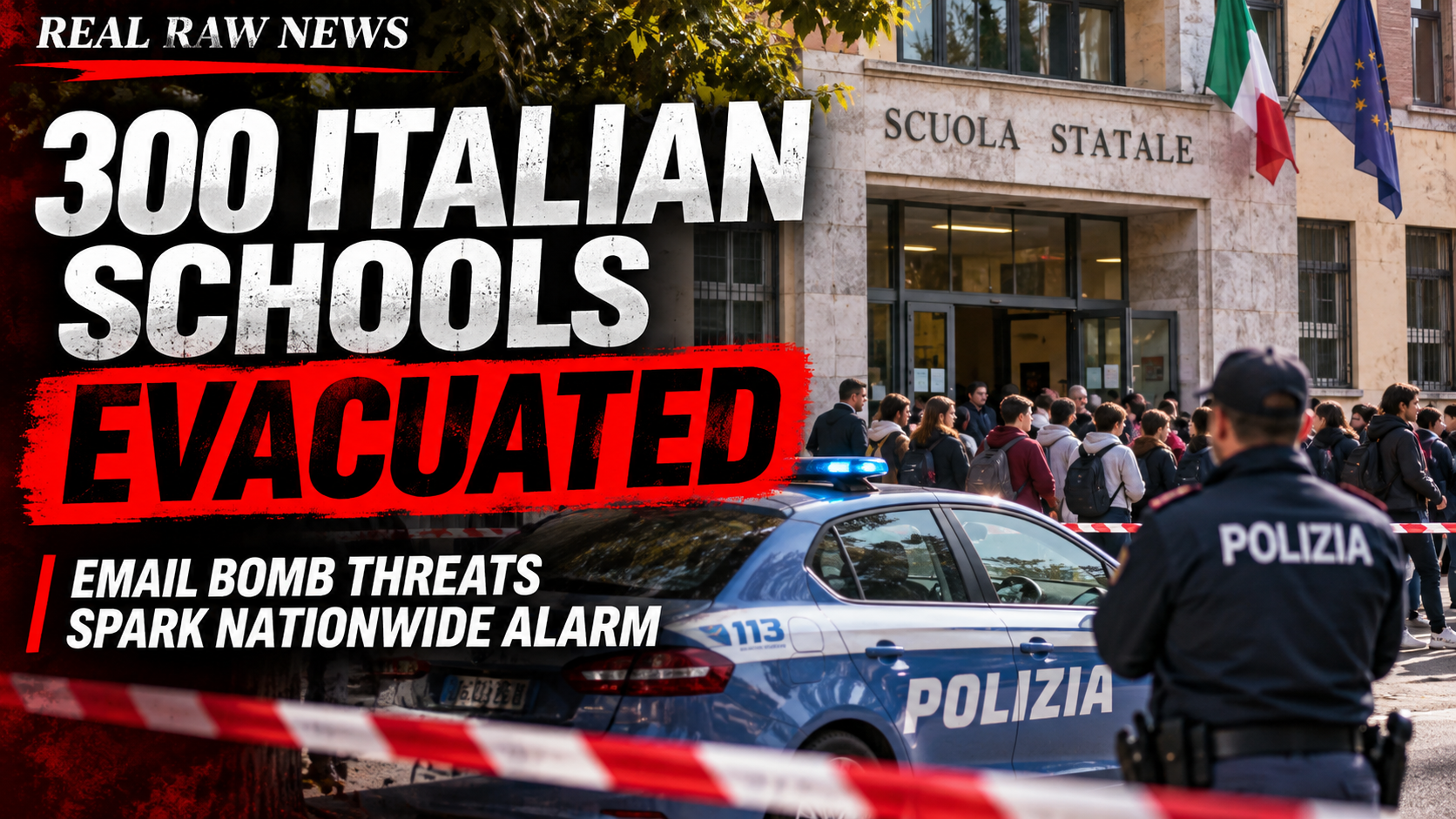
Hundreds of Italian schools were evacuated after threatening emails prompted nationwide security precautions.
Hundreds of schools evacuated. Thousands of students caught in the chaos. And whoever sent the threats didn’t need a single explosive to bring classrooms across Italy to a standstill.
Italy was thrown into a nationwide security scare Wednesday, November 11, after at least 300 schools received bomb threats through email, triggering mass evacuations, police investigations and widespread concern among parents.
Authorities believe the threats were hoaxes. But the disruption was real.
Education Minister Giuseppe Valditara confirmed the scale of the emergency during an interview with Italian television channel La7, warning that the number of affected schools could climb.
The incident raises an uncomfortable question: How easily can anonymous threats disrupt an entire country’s education system?
One Email, Hundreds of Schools, Nationwide Panic
The threatening messages warned that explosive devices had been planted inside school buildings. The emails also contained a threat directed at Italian Prime Minister Giorgia Meloni.
🔴 Help keep this independent voice alive and uncensored.
Support independent journalism and help keep Real Raw News going.
👉 Support Chris Wick on GoFundMe
School administrators responded by evacuating students while police and security personnel investigated.
In Rome, parents received notifications that their children had been moved to designated safe areas under teacher supervision.
Imagine receiving that message while your child is sitting in a classroom.
You don’t know whether the threat is real. You don’t know who’s responsible. And you certainly don’t care about the political theories surrounding it.
You just want your kid home safely.
Italian authorities subsequently reported finding no evidence of a credible explosive threat.
But by then, the disruption had already spread across hundreds of schools.
A Mysterious Sender and a Disturbing Pattern
According to Reuters, the emails were signed by someone identifying themselves as Mikhail Andropov, leader of the Vilayat of Misoginistan.
The identity and authenticity of that claimed affiliation have not been established.
The same purported sender also claimed responsibility for threatening emails previously delivered to news organizations in Ireland and Bulgaria.
Wednesday’s disruption extended beyond Italy.
Schools in Northern Ireland, Scotland and the Republic of Ireland also received threatening messages, according to Reuters. Authorities assessed the threats as false.
The emerging pattern is troubling.
Schools, airlines, broadcasters and other civilian institutions have increasingly faced threats capable of triggering costly security responses without any confirmed physical attack.
Is Europe Facing a New Kind of Psychological Warfare?
European officials have expressed growing concern about so-called hybrid warfare, where intimidation, cyberattacks and disruption can undermine public confidence without conventional military confrontation.
Some officials have suggested that Russia could be connected to broader destabilization efforts targeting European countries supporting Ukraine.
Moscow denies involvement.
There is currently no verified evidence publicly establishing that Russia, or any other foreign government, organized Wednesday’s Italian school threats.
Italian Defence Minister Guido Crosetto acknowledged that foreign interference is not the only possible explanation. Individuals seeking attention or deliberately spreading fear could also be responsible.
That distinction matters.
Accusing a foreign government without evidence would only add another layer of speculation to an already chaotic situation.
The Real Damage Was Already Done
Prime Minister Meloni said authorities had found no concrete danger and convened ministers to address the situation.
Police investigations are continuing.
The disturbing reality is that hundreds of schools were disrupted by messages whose senders remain unidentified.
No confirmed explosives. No established perpetrator. Yet an enormous security response.
That’s the frightening weakness these incidents expose.
A threatening email can force authorities into an impossible position: ignore it and risk catastrophe, or respond and potentially reward whoever wants to manufacture chaos.
And until investigators identify those responsible, Europe is left confronting a deeply uncomfortable reality.
Sometimes the threat itself is enough to achieve the attacker’s objective.
Sources
- Reuters — https://www.reuters.com/world/least-300-italian-schools-evacuated-after-email-bomb-alerts-2026-11-11/
- Associated Press — https://apnews.com/article/0f312fda4ee2e9cdcebd0d6e1a40d9e8
- Euronews — https://www.euronews.com/2026/11/11/at-least-300-schools-in-italy-evacuated-after-emailed-bomb-threats
About the Author