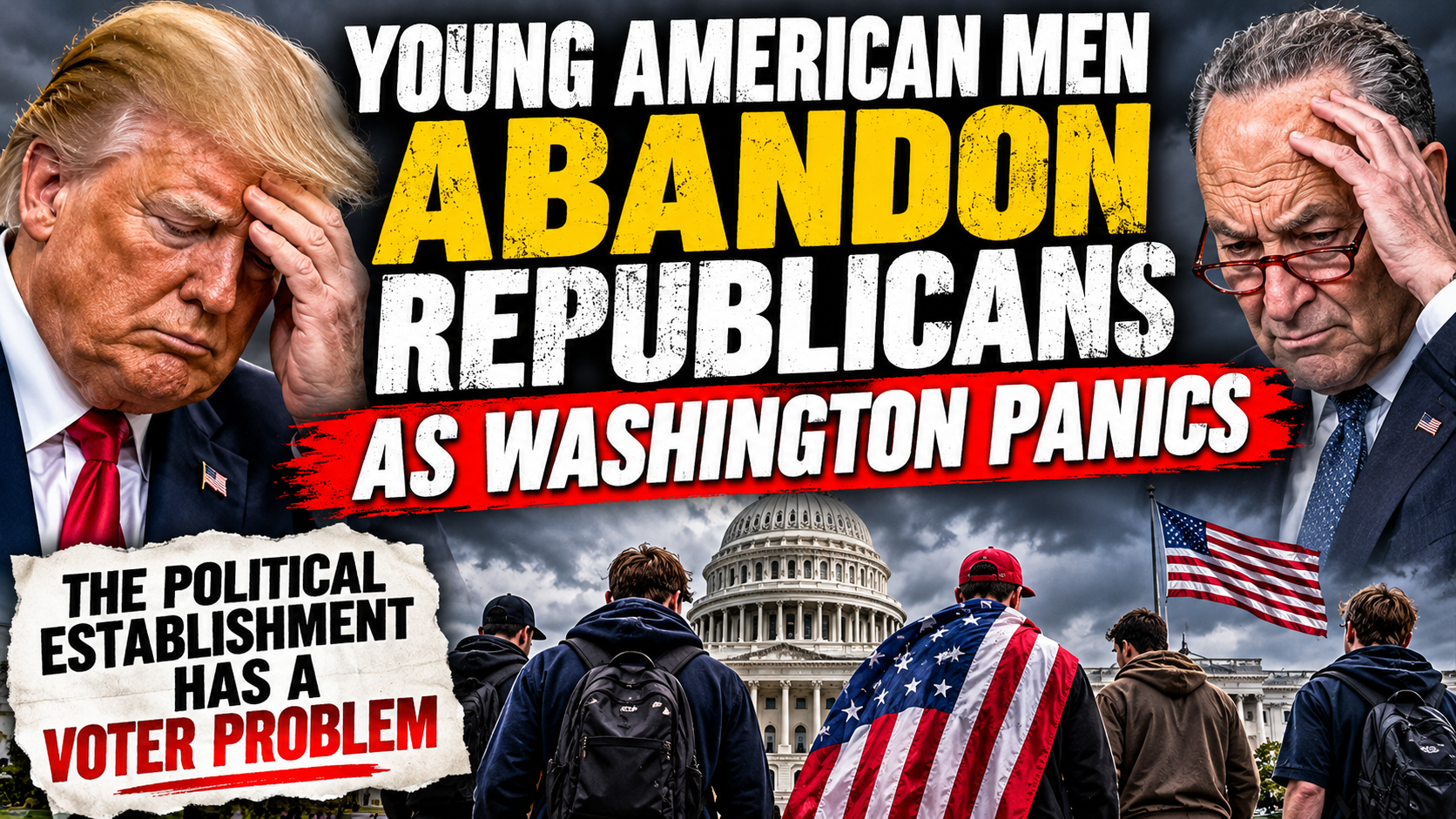
The political establishment spent years demanding loyalty from young American men. Now, after a stunning electoral reversal, Washington is scrambling to figure out why an entire generation is increasingly unwilling to play along.
Something is breaking inside American politics, and the latest midterm results have exposed a problem neither political party can afford to ignore.
Young American men are losing faith in the political establishment.
According to Reuters reporting published November 15, an estimated 59% of men between the ages of 18 and 29 voted for Democratic House candidates in the November midterms, compared with just 37% for Republicans.
That represents a dramatic reversal from 2024, when young men supported Donald Trump over Kamala Harris by 56% to 42%.
The political machinery that helped deliver Trump’s victory is now confronting an uncomfortable reality: the voters it once considered part of its political foundation are no longer guaranteed supporters.
🔴 Help keep this independent voice alive and uncensored.
Support independent journalism and help keep Real Raw News going.
👉 Support Chris Wick on GoFundMe
And Washington is scrambling.
THE PROMISES ARE COLLIDING WITH REALITY
For years, young Americans have watched housing become increasingly unaffordable, living expenses climb, and the possibility of building a financially secure future slip further out of reach.
They were promised economic relief, opportunity, and a government that would finally put American interests first.
Instead, economic anxiety remains widespread, and the decision to launch military action against Iran has created another source of frustration.
Reuters reports that the Iran conflict and rising gasoline prices were among the factors contributing to the shift among young voters.
There is an especially uncomfortable political contradiction here.
Trump built significant support among young men partly through his opposition to foreign conflicts and promises to avoid new wars.
Now, the Iran war has become a political liability for Republicans.
Vice President JD Vance has also publicly blamed the decision to go to war for contributing to the party’s midterm losses.
The political consequences are becoming increasingly difficult to dismiss.
THE DEMOCRATS SEE AN OPPORTUNITY — BUT THEY HAVE THEIR OWN PROBLEM
Democrats are already working to turn their newfound support into a lasting political coalition.
They are targeting younger audiences through podcasts, social media, and promises to address housing affordability, healthcare, and economic opportunity.
But there is a catch.
Young voters are not necessarily becoming lifelong Democrats. They are looking for results.
Neither party owns this generation.
A voter who abandons Republicans because of expensive living costs and foreign military commitments can just as easily abandon Democrats if those same problems remain unresolved.
Washington seems determined to treat this as a marketing exercise.
Better messaging. Different podcasts. More appealing personalities. Carefully constructed campaign strategies.
But none of that puts a roof over someone’s head or makes a paycheck stretch further.
THE NEXT ELECTION COULD BE EVEN UGLIER
The 2028 presidential election is already looming over both parties.
Republicans want their young male coalition back. Democrats want to turn a temporary electoral advantage into a permanent political realignment.
Both sides are calculating how to capture the same voters.
But perhaps they are asking the wrong question.
Instead of wondering which political message will resonate with young men, Washington should be asking why so many Americans feel increasingly disconnected from the institutions supposedly representing them.
Young men are not obligated to defend political parties.
They are not required to support military interventions, tolerate economic pressure, or accept endless campaign promises simply because a candidate once earned their vote.
Political loyalty is not a lifetime contract.
And if Washington continues confusing voter frustration with a temporary public-relations problem, it may discover that winning back an entire generation is considerably harder than losing its trust.
The message from young American voters is becoming increasingly difficult to ignore.
They want affordable lives, economic opportunity, and leaders who deliver what they promise.
Not another election campaign built around slogans.
The question is no longer whether Washington has a young voter problem. The question is whether anyone in Washington is prepared to fix what created it.
About the Author