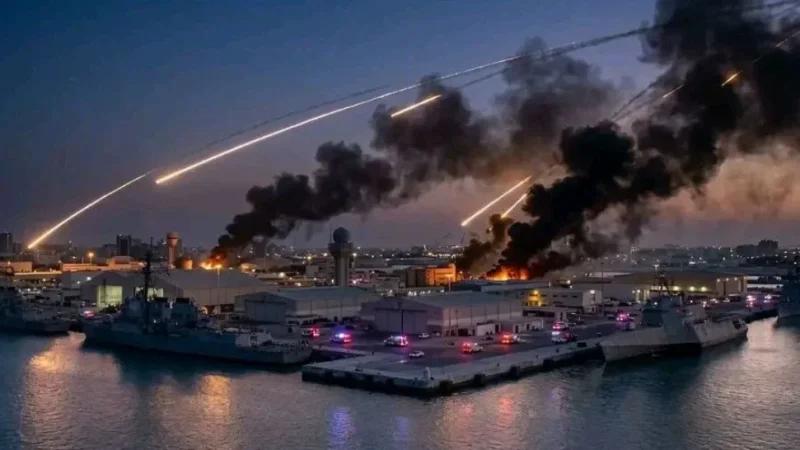
Iran’s Revolutionary Guard claims it struck an American radar installation in Bahrain. Bahrain says it intercepted Iranian projectiles. And Washington now faces another dangerous escalation in a region where one miscalculation could ignite a much larger war.
The Middle East is becoming increasingly dangerous, and the latest developments involving Iran, Bahrain, and American military installations should set off alarm bells across Washington.
Iran’s Revolutionary Guard claims it struck a radar system at an American helicopter base in Bahrain. The announcement was reported by Iran’s state-run IRNA news agency.
Meanwhile, Bahrain’s military says its air defense systems intercepted Iranian projectiles before they reached their intended targets.
These are not insignificant developments.
American military infrastructure is now directly involved in an increasingly dangerous confrontation, and the possibility of further escalation is becoming harder to dismiss.
🔴 Help keep this independent voice alive and uncensored.
Support independent journalism and help keep Real Raw News going.
👉 Support Chris Wick on GoFundMe
But there is another detail that deserves attention.
The United States has previously denied Iranian claims that its early-warning radar system in Bahrain was struck. On Friday, U.S. Central Command said it intercepted two Iranian drones heading toward Bahrain and rejected Tehran’s earlier assertion that the radar installation had been hit.
As of Sunday’s reporting, CENTCOM had not immediately commented on Iran’s latest claim.
The difference between an intercepted attack and a successful strike is enormous. The public deserves accurate information, not competing battlefield narratives.
BAHRAIN IS NO LONGER JUST WATCHING FROM THE SIDELINES
Bahrain occupies a strategically important position in the Persian Gulf.
It hosts the headquarters of the U.S. Navy’s Fifth Fleet, making it a critical component of American military operations throughout the region.
Any sustained Iranian campaign targeting military installations in Bahrain would carry consequences extending far beyond the small island kingdom.
American personnel, military infrastructure, regional allies, and critical maritime routes are all part of the equation.
Bahrain’s Interior Ministry issued nationwide security alerts Sunday, warning residents of a threat. Its military subsequently reported intercepting Iranian projectiles.
The Bahraini government accused Iran of continuing hostile attacks against the kingdom.
The situation is becoming increasingly difficult to contain.
THE STRAIT OF HORMUZ: THE ECONOMIC NIGHTMARE WASHINGTON CANNOT IGNORE
There is another vulnerability that makes this confrontation particularly dangerous.
The Strait of Hormuz.
This narrow waterway is one of the world’s most important energy transportation routes. A prolonged disruption could send shockwaves through international oil markets, shipping networks, and economies already struggling with uncertainty.
Iran understands the strategic importance of its geographic position.
Any escalation involving attacks on shipping, military installations, or energy infrastructure could rapidly transform a regional military confrontation into a global economic crisis.
Oil prices, transportation costs, manufacturing, and household expenses could all be affected.
The consequences would not remain confined to the Middle East.
Ordinary families thousands of kilometres away could end up paying for decisions made in military command centres and government offices.
WASHINGTON MUST ANSWER SOME VERY SERIOUS QUESTIONS
How far is the United States prepared to go?
What happens if American military personnel are killed in a successful Iranian strike?
What happens if Iran expands its targeting to additional American installations or regional allies?
And perhaps most importantly, what is the actual endgame?
Washington cannot simply assume that military superiority guarantees control over how this confrontation unfolds.
Iran has demonstrated its willingness to threaten American interests and challenge regional security arrangements.
That does not mean every Iranian military claim should be accepted as fact. It means every credible threat deserves serious examination.
The danger is that both sides could become trapped in a cycle of retaliation where each new attack creates pressure for an even larger response.
That is how conflicts become much harder to stop.
THE WORLD IS PAYING ATTENTION — AND THE STAKES KEEP RISING
The Middle East is already carrying an enormous burden of destruction, instability, and human suffering.
More military escalation will not magically resolve the political and strategic disputes that brought the region to this point.
It could make them considerably worse.
The American public deserves to know what is happening to its military installations, what threats American personnel are facing, and what objectives Washington is actually pursuing.
The same applies to America’s allies, who could find themselves drawn deeper into a confrontation with consequences they cannot fully control.
There must be transparency, accountability, and a clearly defined strategy.
Otherwise, the region risks becoming trapped in an escalating confrontation with no obvious exit.
One radar installation. One missile. One miscalculation. That may be all it takes to turn another dangerous confrontation into a much larger war.
How many more warning signs does Washington need before someone seriously asks where this is all heading?
Because when the missiles start flying, it is never the politicians making the decisions who carry the greatest burden.
It is the military personnel, the civilians, and the ordinary families caught in the middle.
And they deserve better than another endless war.
About the Author