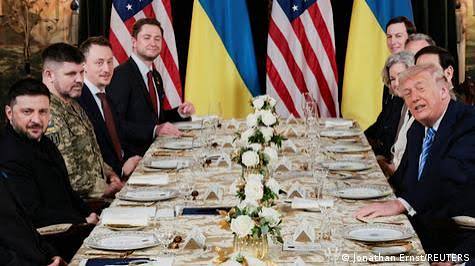
After years of bloodshed, destroyed cities, broken families and billions poured into the machinery of war, Washington is changing its approach to Ukraine. President Donald Trump’s envoys are pursuing something far bigger than a ceasefire: a new security arrangement that could fundamentally reshape Europe’s relationship with Russia. But behind the diplomatic smiles lies an uncomfortable question—who will pay the price for peace?
The Trump administration is pushing forward with renewed negotiations between Russia and Ukraine, attempting to break a diplomatic deadlock that has cost countless lives and left an entire generation scarred by war.
American envoys Steve Witkoff and Jared Kushner have been at the center of the effort, holding discussions with Russian, Ukrainian and European officials.
The latest diplomatic push follows US-mediated negotiations in Abu Dhabi on November 10 and 11, marking the first direct talks between Russian and Ukrainian delegations in approximately nine months.
But Washington’s ambitions now extend well beyond Ukraine’s battlefield.
Washington Wants a New European Security Order
The Trump administration is exploring a broader security framework involving Russia, Ukraine and European nations.
🔴 Help keep this independent voice alive and uncensored.
Support independent journalism and help keep Real Raw News going.
👉 Support Chris Wick on GoFundMe
Proposals discussed by American officials include permanent security consultations, improved military transparency, crisis communication channels and reciprocal measures designed to reduce the risk of escalation.
On paper, it sounds like common sense.
In reality, it could become one of the most consequential geopolitical negotiations since the Cold War.
Russia has long demanded changes to Europe’s security arrangements, particularly regarding NATO’s relationship with Ukraine. Western governments, meanwhile, insist that sovereign nations must retain the right to determine their own alliances.
These are not minor disagreements. They strike at the very foundation of Europe’s postwar political order.
And somewhere between these competing visions, ordinary Ukrainians are still burying their dead.
The Peacekeeping Nightmare
Following discussions with Russian President Vladimir Putin in Moscow on November 12, Witkoff indicated that European representatives would participate in the next round of negotiations.
However, Moscow has not clearly confirmed the precise format of that participation.
An even greater obstacle remains: foreign troops in Ukraine.
Putin has reiterated his opposition to European peacekeepers operating inside Ukraine after a potential settlement, arguing that their presence would threaten Russian security.
Ukraine, understandably, wants credible protection against another invasion. European governments have discussed military guarantees intended to prevent Russia from simply restarting the war once it has regrouped.
Here lies the brutal contradiction.
A peace agreement without credible enforcement could become little more than an intermission. Yet the military guarantees Ukraine seeks are precisely the arrangements Moscow rejects.
Is Washington Finally Facing Reality?
For years, Western leaders have delivered speeches about defending democracy, supporting Ukraine and standing firm against Russia.
Russia launched its full-scale invasion in February 2022, and responsibility for that decision cannot be erased by diplomatic negotiations.
But acknowledging that reality does not eliminate the need for diplomacy.
Military assistance has helped Ukraine defend itself, while negotiations have repeatedly failed to produce a lasting settlement. Neither battlefield developments nor political declarations have brought the war to an end.
Trump’s broader approach appears to recognize that ending the fighting may require addressing the wider confrontation between Russia and the West.
That does not mean surrendering Ukraine’s sovereignty or rewarding aggression.
It means confronting the uncomfortable reality that permanent hostility between nuclear-armed powers carries consequences far beyond any single battlefield.
The World Cannot Afford Another Failed Peace
The negotiations remain fragile. Territorial disputes, security guarantees and deep mistrust continue to stand between diplomatic promises and an actual settlement.
Trump may want a historic peace agreement. Moscow wants security concessions. Kyiv wants survival and sovereignty. Europe wants protection from further aggression.
Those objectives do not automatically align.
The greatest danger is that powerful governments negotiate a deal that looks impressive in front of television cameras but collapses the moment it faces reality.
Because when politicians fail, they rarely pay the ultimate price.
Soldiers do. Civilians do. Families do.
The world has heard enough promises about ending this war. What it needs now is a peace that survives longer than the politicians who sign it.
Sources:
- RT — Trump envoy and the new approach to Ukraine
- Reuters — Russia and Ukraine hold first peace talks for nine months
- RFE/RL — White House outlines broader European security plan
- The Washington Post — US envoys say Europe to join Ukraine peace talks
About the Author