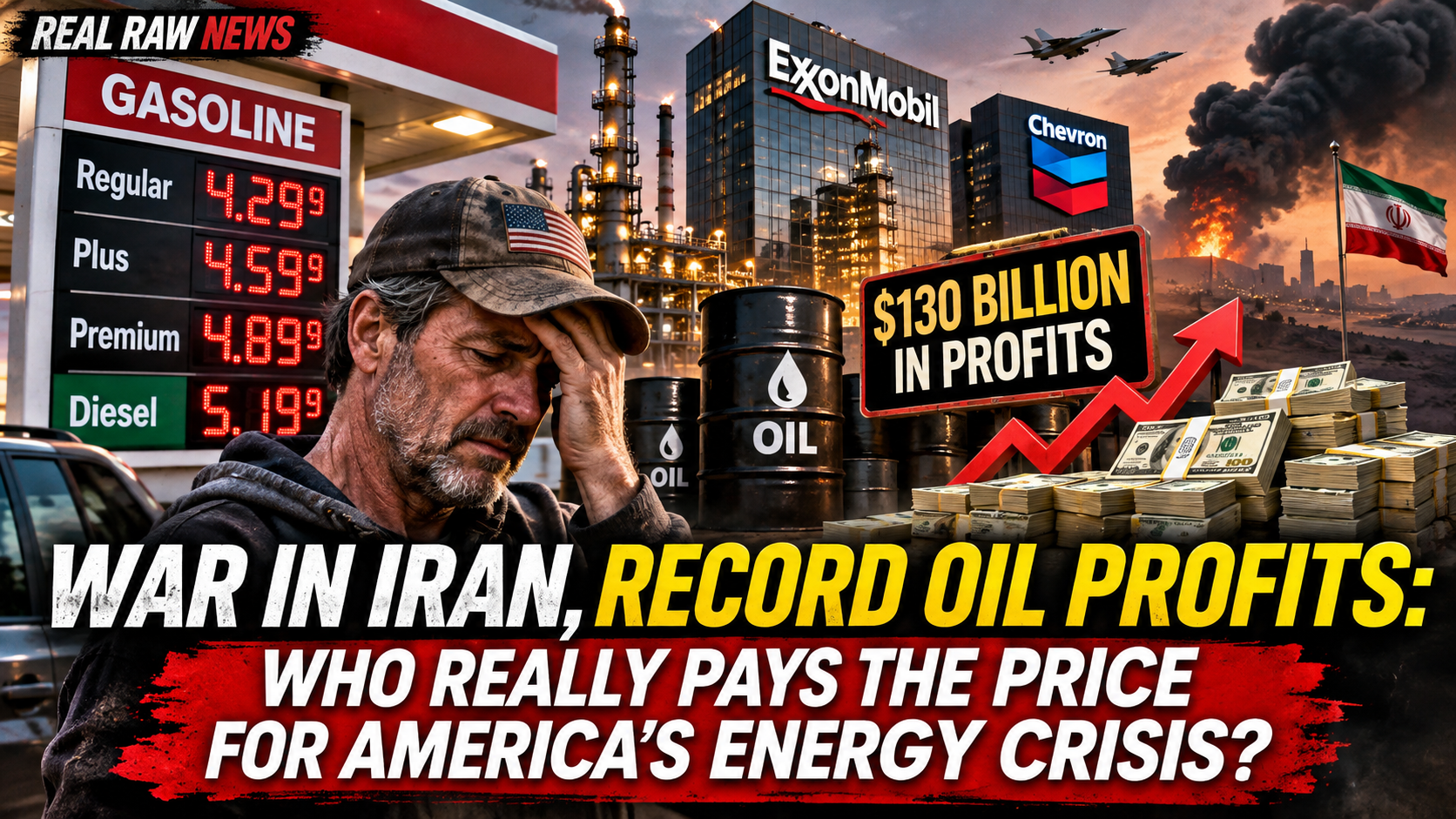
As the Iran war disrupts global energy markets, major American oil companies report extraordinary earnings while consumers struggle with rising gasoline and diesel prices.
While American families struggle with soaring gasoline and diesel prices, some of the world’s largest oil corporations are reporting extraordinary profits. The war with Iran has exposed an uncomfortable economic reality: What devastates consumers can become a financial windfall for the companies supplying their fuel.
The numbers are staggering.
American oil companies reportedly earned approximately $130 billion in profits between April and September 2026, nearly three times the less than $47 billion they earned during the corresponding period a year earlier.
The figures, attributed to an analysis by The New York Times and reported by RT, cover more than 50 American oil producers and refiners.
Behind those profits lies a war that has disrupted global energy markets, restricted critical shipping routes, damaged refining infrastructure and pushed fuel prices sharply higher.
For ordinary Americans, the consequences are visible every time they fill their vehicles, pay for groceries or receive another delivery surcharge.
🔴 Help keep this independent voice alive and uncensored.
Support independent journalism and help keep Real Raw News going.
👉 Support Chris Wick on GoFundMe
For major energy corporations, however, the same crisis has created one of the most profitable periods in recent history.
The uncomfortable question is no longer simply why energy prices are rising. It is who benefits from keeping them high, who absorbs the financial damage, and whether governments are doing enough to protect the public.
A $130 Billion Windfall While Consumers Pay More
The scale of the industry’s reported financial gains deserves scrutiny.
According to RT’s October 30 report, citing the New York Times analysis, American oil companies collectively generated approximately $130 billion in profits over six months.
The same report estimates that American consumers spent an additional $147 billion on gasoline and diesel after American and Israeli military strikes against Iran began on February 28.
These figures illustrate a striking economic imbalance.
While households and businesses are spending billions more on transportation and fuel, major energy companies are enjoying dramatically stronger earnings.
That does not mean every additional dollar paid by consumers becomes corporate profit. Fuel prices also reflect crude costs, refining capacity, transportation expenses, taxes and regional supply conditions.
Nevertheless, the relationship is difficult to ignore.
When war restricts global energy supplies, prices rise. Companies capable of maintaining production or refining operations can benefit enormously.
The public, meanwhile, has little choice but to pay.
ExxonMobil and Chevron Report Extraordinary Earnings
The financial results released on October 30 reinforce the broader picture.
ExxonMobil reported third-quarter profits of approximately $15.4 billion, compared with $7.5 billion during the same quarter in 2025.
Chevron reported approximately $9.9 billion, compared with $3.5 billion a year earlier.
These are not modest improvements resulting from ordinary business expansion.
They represent exceptional earnings during an international energy emergency.
According to AFP, ExxonMobil’s refining margins approached $50.30 per barrel, nearly three times their year-earlier level.
Chevron also benefited from dramatically stronger refining operations, with downstream profits reaching approximately $4.9 billion.
The explanation is straightforward.
Global refining capacity has been disrupted by fighting in the Middle East and damage associated with the Russia-Ukraine conflict.
Refineries operating outside the most dangerous regions have been able to process fuel that increasingly commands premium prices.
That advantage has translated into billions of dollars in additional earnings.
There is an important distinction, however: Profiting from wartime market conditions does not establish that an oil company caused, supported or deliberately prolonged the conflict.
Those would be serious allegations requiring separate evidence.
What the financial results do establish is that some of the industry’s largest companies have benefited substantially from the resulting supply disruptions.
The Strait of Hormuz: A Global Economic Pressure Point
Much of the crisis revolves around one narrow stretch of water.
The Strait of Hormuz connects the Persian Gulf to international shipping routes and has historically carried approximately one-fifth of the world’s oil and liquefied natural gas supplies.
When shipping through this passage becomes dangerous or restricted, the consequences extend far beyond the Middle East.
Oil traders anticipate shortages.
Shipping companies face higher operating costs and security risks.
Refineries struggle to obtain sufficient crude oil.
Import-dependent countries compete for alternative supplies.
The resulting pressure can increase prices across the international energy system.
The war involving the United States, Israel and Iran has demonstrated how quickly a regional military confrontation can become a global economic emergency.
Even countries that are not directly participating in the fighting can experience higher transportation, manufacturing and household energy costs.
This is particularly significant for countries dependent on imported petroleum products.
Their consumers may pay the economic price of decisions made thousands of kilometres away.
The Hidden Cost: Higher Prices Beyond the Gas Pump
Fuel inflation rarely remains confined to service stations.
Diesel powers much of the transportation infrastructure responsible for delivering food, consumer products, industrial materials and essential supplies.
When diesel becomes more expensive, businesses must decide whether to absorb those additional costs or pass them along.
Many cannot absorb them indefinitely.
A trucking company facing higher fuel expenses may increase freight charges.
A grocery distributor may raise delivery fees.
A manufacturer may encounter more expensive raw materials and transportation.
Eventually, some of those increases reach consumers.
This creates a second economic burden.
Families pay more to fuel their vehicles, then potentially pay more for products transported using the same increasingly expensive energy.
Lower-income households are particularly vulnerable because essential expenses consume a larger share of their budgets.
For these households, the energy crisis is not primarily a debate about corporate earnings or international commodities.
It is about whether there is enough money left after paying for housing, food, utilities and transportation.
Wall Street’s Gains and Washington’s Political Problem
The timing could hardly be worse for President Donald Trump and the Republican Party.
With American congressional midterm elections scheduled for November 3, high gasoline prices have become a significant political vulnerability.
RT reported that American gasoline prices had reached approximately $4.29 per gallon earlier in the week.
The report also cited polling suggesting that fuel costs were an important consideration for voters.
That creates a political contradiction.
An administration may defend military operations as necessary for national security while simultaneously confronting the domestic economic consequences of those operations.
Voters, however, may judge those decisions through a different lens.
They experience the cost of fuel directly.
They see the prices displayed outside gasoline stations.
They recognize when household expenses rise faster than their incomes.
And they may become increasingly frustrated when major corporations announce record or near-record earnings during the same period.
The political danger is not simply that energy prices are high.
It is that the public may conclude the economic sacrifices are being distributed unfairly.
Why Oil Companies Are Not Rushing to Expand Production
One of the most revealing aspects of the current oil boom is what corporations are doing with their extraordinary profits.
Reuters reported on October 30 that major Western oil companies generated approximately $56 billion in combined third-quarter profits.
Yet the companies have not responded with a dramatic expansion of long-term investment.
Instead, much of the additional cash has been directed toward reducing debt, strengthening balance sheets and repurchasing shares.
That approach makes financial sense from a corporate perspective.
Oil companies know that prices can fall rapidly when geopolitical tensions ease or disrupted supplies return.
Investing billions in new production facilities based on temporarily elevated prices could create substantial financial risks.
But the strategy also raises a legitimate public-policy question.
If consumers are paying crisis-level prices while corporations prioritize shareholder returns, what responsibility should governments have to address the resulting economic hardship?
The answer is not necessarily to force companies into uneconomic investments.
Expanding oil production and refining capacity takes time, capital and regulatory approval. New projects cannot immediately replace infrastructure damaged by war.
Nevertheless, governments can examine whether existing energy policies adequately protect consumers against extraordinary price shocks.
Should Governments Tax Extraordinary Wartime Profits?
The surge in corporate earnings has renewed arguments over windfall-profit taxes.
Supporters believe governments should impose temporary additional taxes when companies receive exceptional profits largely because of circumstances beyond their control.
The revenue could potentially support household energy rebates, public transportation, emergency assistance or investments that reduce dependence on vulnerable energy supplies.
Critics argue that additional taxation could discourage investment, create uncertainty and reduce the financial incentives needed to maintain future production.
Both concerns deserve serious consideration.
A poorly designed windfall tax could create unintended consequences.
But ignoring the distribution of wartime economic gains also carries political and social risks.
The central issue is whether extraordinary profits generated during an international emergency should be treated exactly like earnings produced under normal market conditions.
That is ultimately a question for elected governments and the public.
It should not be settled solely by corporate lobbying or political slogans.
Energy Security Is Becoming a National Security Question
The Iran war has exposed a broader vulnerability.
Modern economies depend on energy systems that can be disrupted by military conflict, shipping restrictions, cyberattacks, infrastructure damage and political instability.
Countries with abundant domestic resources may be better positioned to withstand certain disruptions, but even major oil producers remain exposed to global pricing pressures.
The United States is a leading petroleum producer.
Yet American motorists are still experiencing substantially higher fuel costs.
That apparent contradiction reflects the international nature of oil markets.
Domestic production does not completely insulate consumers from global supply shocks.
Crude oil and refined petroleum products are traded across borders, and their prices respond to international conditions.
For governments, the challenge is therefore more complicated than simply producing additional oil.
It involves reliable refining capacity, resilient transportation networks, emergency reserves, diversified energy supplies and policies that limit the damage caused by sudden market disruptions.
A country can possess enormous energy resources and still leave its citizens vulnerable to international price shocks.
The Bigger Question: Who Benefits From War?
History has repeatedly demonstrated that armed conflicts create economic winners and losers.
Weapons manufacturers may receive additional contracts.
Shipping companies may charge higher rates for dangerous routes.
Commodity traders may profit from volatility.
Energy producers may benefit when supplies become scarce.
None of these outcomes proves that the beneficiaries wanted the conflict to happen.
But they do reveal how financial incentives can diverge sharply from the interests of ordinary citizens.
That distinction matters.
It is possible to acknowledge that corporations are operating within existing market structures while also questioning whether those structures produce acceptable outcomes during national emergencies.
The oil industry’s latest earnings deserve attention not because making a profit is inherently wrong, but because the size and timing of those profits expose the enormous financial consequences of geopolitical instability.
War damages infrastructure, destabilizes economies and creates uncertainty for millions of people.
Yet for some businesses, those same conditions can produce extraordinary returns.
Final Thought: The Public Pays, the Industry Collects
The most troubling aspect of America’s energy crisis is not simply that oil companies are making money.
Profitable energy companies are necessary to maintain production, employment, investment and reliable supplies.
The problem emerges when extraordinary corporate gains coincide with severe financial pressure on the people who depend on those companies’ products.
American families did not choose the war with Iran.
They did not decide which shipping routes would become dangerous or which refineries would be damaged.
They have little control over international oil prices.
Yet they are paying the consequences through higher fuel costs and broader inflationary pressures.
Meanwhile, major energy corporations are reporting profits that would have seemed extraordinary only a year earlier.
There is no evidence in the financial results alone that oil executives engineered the conflict or deliberately manipulated prices.
But there is abundant evidence that the crisis has benefited major parts of the petroleum industry while imposing substantial costs on consumers.
That is the contradiction Washington must confront.
A government can argue that military action is necessary. Corporations can argue that their profits reflect legitimate market conditions.
But neither argument eliminates the economic burden being carried by ordinary households.
And as Americans prepare to vote, one question deserves a serious answer:
If the financial rewards of war flow disproportionately toward powerful corporations, why are ordinary citizens expected to shoulder so much of the cost?
Sources
The following independent reports support the article’s financial figures, market analysis and geopolitical context. Each publisher is listed only once.
1. RT — October 30, 2026
US oil companies tripled profits during Iran war – NYT
Read original report
2. AFP — October 30, 2026
US oil giants report profit surge again on Iran war
Read AFP report
3. Reuters — October 30, 2026
Big Oil’s spending caution speaks louder than its profits
Read Reuters analysis
4. Al Jazeera — August 30, 2026
Mapping Iran war’s strikes on Gulf energy and its impact on future of oil
Read energy disruption analysis
5. Fortune — October 23, 2026
Saudi Arabia wants to send 10 million barrels of oil a day around Hormuz
Read infrastructure analysis
About the Author