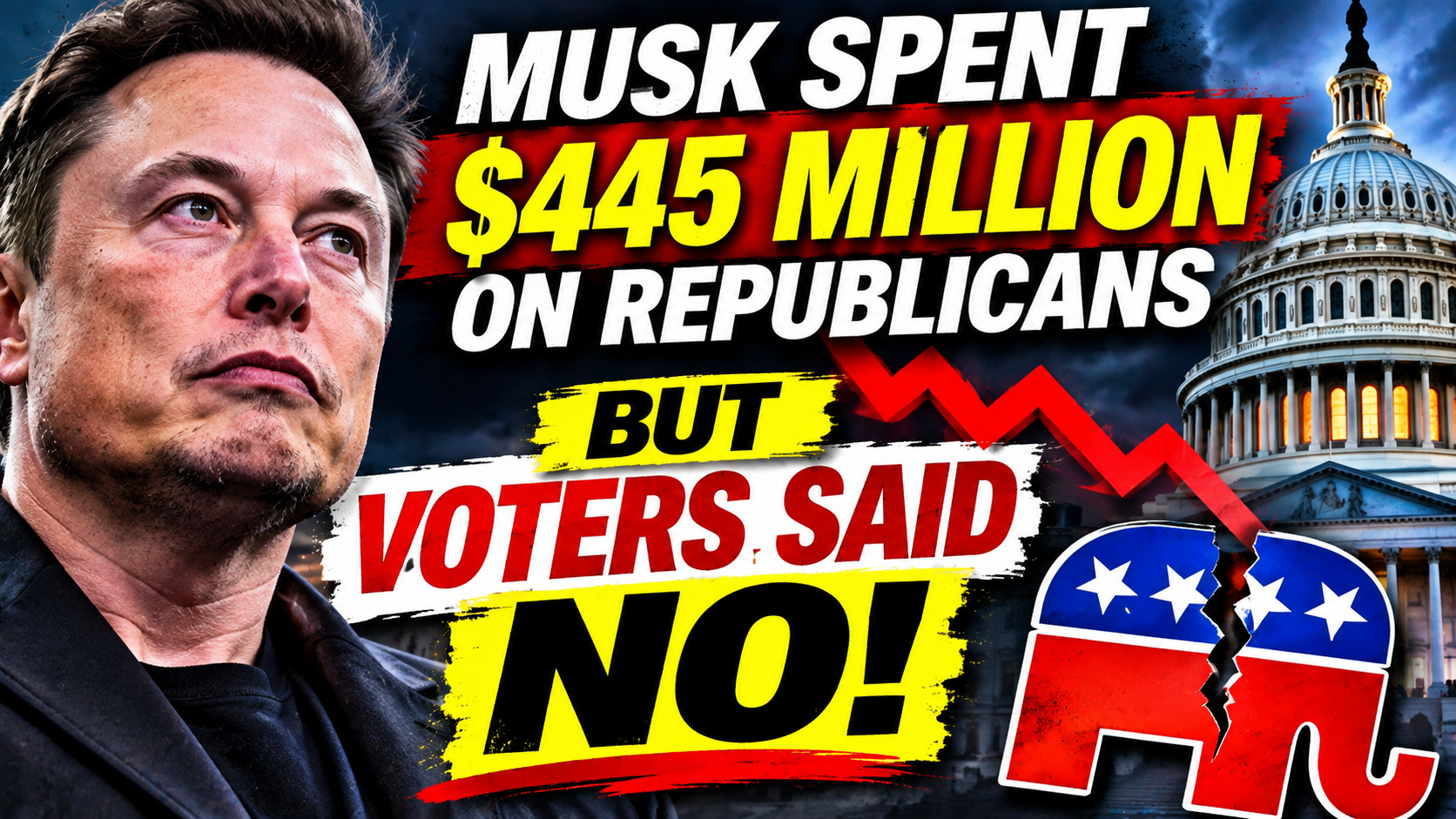
Elon Musk's record political spending failed to produce victories in most Republican races he supported during the 2026 midterms.
Nearly half a billion dollars. That’s how much Elon Musk poured into federal election campaigns. But the 2026 midterm results exposed an uncomfortable reality about money and political power in America.
The world’s richest man spent approximately $445 million supporting Republican federal campaigns, according to campaign finance watchdog OpenSecrets, as cited by Reuters.
And what did that extraordinary financial commitment produce?
Of the 43 Republican House candidates Musk supported, just three had won by late Wednesday. Thirty-three had lost, while seven races remained undecided.
In the Senate, six of seven Musk-backed Republican candidates had been defeated, with Alaska still unresolved.
Those figures don’t prove that Musk’s spending caused the defeats. But they demonstrate something that America’s political establishment should examine closely.
🔴 Help keep this independent voice alive and uncensored.
Support independent journalism and help keep Real Raw News going.
👉 Support Chris Wick on GoFundMe
Enormous financial resources cannot guarantee electoral victory.
Texas Became the Ultimate Test
Texas was particularly significant.
Musk has major business interests in the state through Tesla and SpaceX. His political spending there included nearly $230 million directed toward the Senate contest.
Democrat James Talarico defeated Republican Ken Paxton despite the extraordinary financial investment supporting the Republican side.
According to Reuters, the Texas Senate contest generated approximately $573.2 million in total spending, making it the most expensive non-presidential race in American history.
That number deserves attention.
More than half a billion dollars flowed into one Senate election while ordinary Americans continued debating household expenses, economic security, and the cost of living.
Campaign spending is not the same as government spending. Much of this money comes from private donors and political organizations.
But the scale raises a legitimate democratic question: Does an election system increasingly dependent on enormous donations give wealthy individuals disproportionate access and influence?
The Political Consequences May Extend Beyond Election Night
Musk’s difficulties may not end with the election results.
Democrats preparing to exercise congressional oversight have indicated they intend to examine his companies’ federal contracts, government relationships, and other activities.
Among the potential subjects are SpaceX, its Starlink satellite network, and Musk’s previous role in the Department of Government Efficiency.
These are proposed or anticipated investigations, not findings of wrongdoing.
That distinction matters.
Government oversight should establish facts and identify legitimate problems, not become a weapon against political opponents.
At the same time, companies receiving substantial government contracts should face appropriate scrutiny regardless of their executives’ political affiliations.
The Billionaire Spending Question
The broader issue reaches well beyond Elon Musk.
Republican and Democratic campaigns alike benefit from wealthy donors, political action committees, and organizations capable of spending extraordinary sums.
Billionaire Michael Bloomberg, for example, contributed approximately $80 million to Democratic efforts during the closing weeks of the campaign, Reuters reported.
The problem therefore cannot reasonably be reduced to one businessman or one political party.
America’s campaign-finance system allows enormous private expenditures while voters are expected to determine whether political promises translate into better government.
The 2026 midterms showed the limits of financial influence in several highly visible races.
They did not establish that money has stopped mattering.
Political advertising still shapes campaign visibility, public debate, and the information voters encounter.
And the next presidential election could attract even greater spending.
If hundreds of millions of dollars cannot guarantee victory, that’s evidence that voters retain meaningful power. But if competing for office increasingly requires access to enormous fortunes, how equal is the political playing field in the first place?
Sources
- Reuters — Musk Has Little to Show for His Record Spending on Republican Campaigns in US Midterms
- The Guardian — Elon Musk’s Nearly Half a Billion Dollars in Midterms Spending Was a Flop
- Al Jazeera — How US Midterms Have Cost a Record $12 Billion as Cost of Living Soars
About the Author