What Happens When Voters Believe They Have Been Erased?
What happens to democracy when millions believe their names have been erased from it?
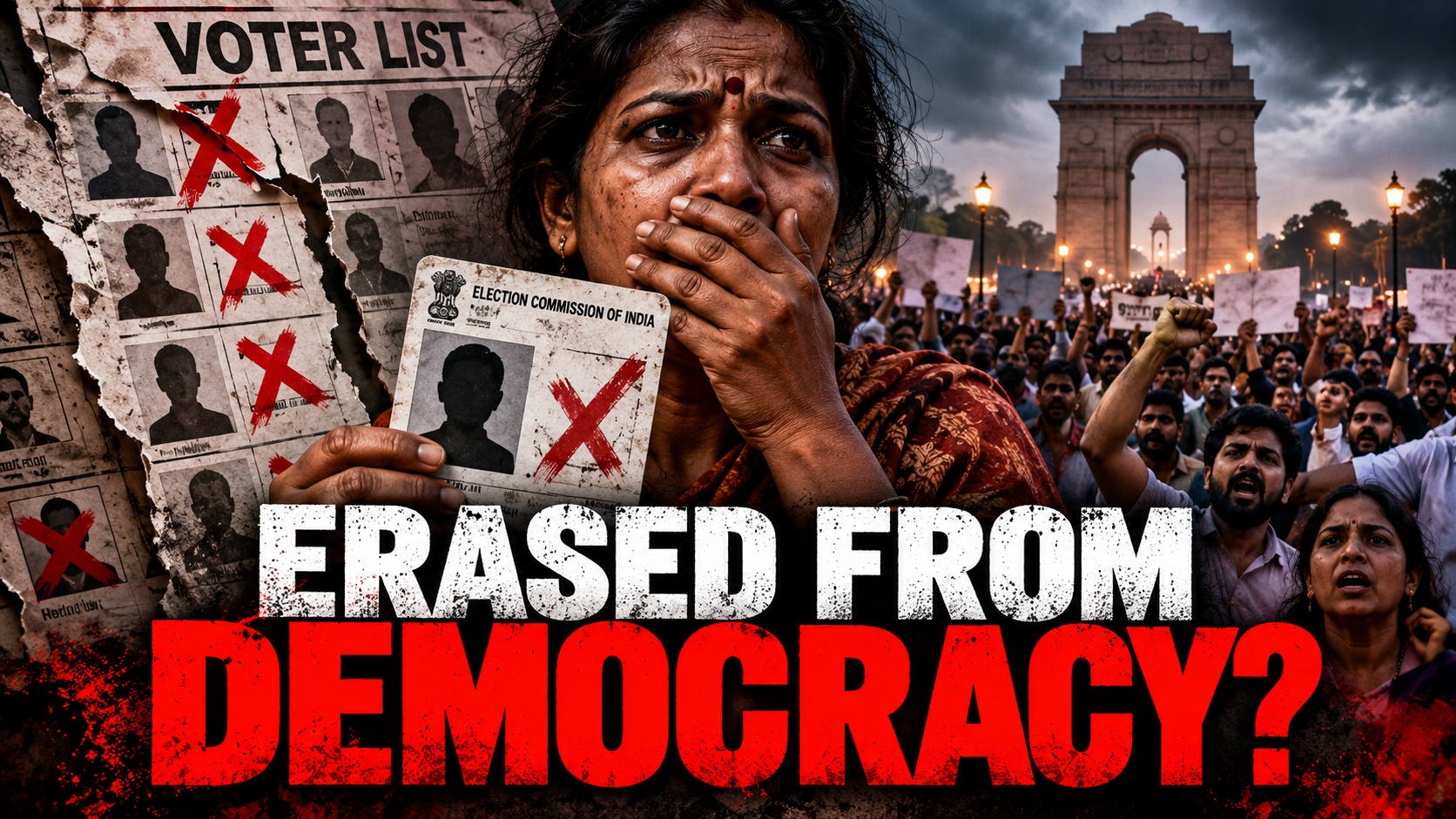
That question now hangs over India as anger surrounding voter-roll revisions spills into the streets.
Thousands protested in Delhi and Mumbai for a third straight day, demanding India’s election chief resign over voter-roll revisions.
Opposition parties allege eligible voters were removed to benefit the ruling BJP. The Election Commission and BJP deny wrongdoing, saying the process protects electoral integrity.
Behind the accusations and denials sits a much larger issue:
Help keep this independent voice alive and uncensored -> Buy us a Coffee <-
Can people have confidence in an election if they question who is allowed to participate in it?
A Voter Roll Is More Than a Database
A voter roll may look like administrative paperwork.
Names. Addresses. Identification. Eligibility.
But every legitimate name represents something far more important: a citizen’s ability to participate in democracy.
That is why the India voter roll revision protests go beyond an ordinary dispute over election administration.
Questions about voter eligibility strike directly at the foundation of an election. If legitimate voters believe they have been wrongly removed, officials aren’t dealing with an abstract technical problem anymore.
They’re dealing with people who fear their political voice has disappeared with the stroke of a keyboard.
That is a far more dangerous problem.
Two Very Different Versions of the Same Story
Opposition parties have made serious voter removal allegations in India, claiming eligible voters were removed in a way that could benefit the ruling BJP.
The Election Commission and BJP reject those accusations.
Their position is that revisions are designed to protect electoral integrity in India rather than undermine it.
The two sides are therefore presenting radically different versions of the same process.
One sees safeguards.
The other sees potential disenfranchisement.
Caught between those competing claims are ordinary citizens who simply expect a clear answer to a basic question:
Will I be able to vote?
The Real Danger Comes Before Election Day
Election controversies usually explode after ballots are counted.
This one reaches deeper because the argument begins before voters ever enter a polling station.
That matters.
If people become convinced that access to the ballot itself can be manipulated, suspicion doesn’t begin when results are announced.
It begins much earlier.
Every deletion becomes questionable.
Every revision attracts scrutiny.
Every administrative decision risks becoming another political flashpoint.
And eventually, election results themselves can become harder for parts of the population to accept—not necessarily because of what happened inside the voting booth, but because of what they believe happened before anyone reached it.
Democracy Cannot Depend on Blind Faith
Democratic institutions should never require citizens to simply trust them.
They should be able to demonstrate that their procedures are transparent, understandable, consistent, and capable of correcting legitimate mistakes.
That standard matters regardless of which political party is in power.
Governments change.
Opposition parties change.
Political fortunes rise and collapse.
The principle should remain the same.
Eligible citizens should know where they stand, understand how voter rolls are maintained, and have a meaningful way to challenge errors.
That is what makes the BJP voter roll controversy larger than another partisan fight.
It touches the machinery underneath the election itself.
The Question India Cannot Ignore
The protests may eventually fade.
Political attention may move elsewhere.
But the underlying issue won’t disappear simply because the streets become quiet again.
A democracy ultimately depends on citizens believing they have a legitimate place inside the process.
When people begin wondering whether that place can disappear from a database, something fundamental has already changed.
Because before citizens can choose who governs them, the system must first recognize that they exist.
And when people start questioning even that, the argument is no longer just about an election.
It is about the credibility of democracy itself.
About the Author