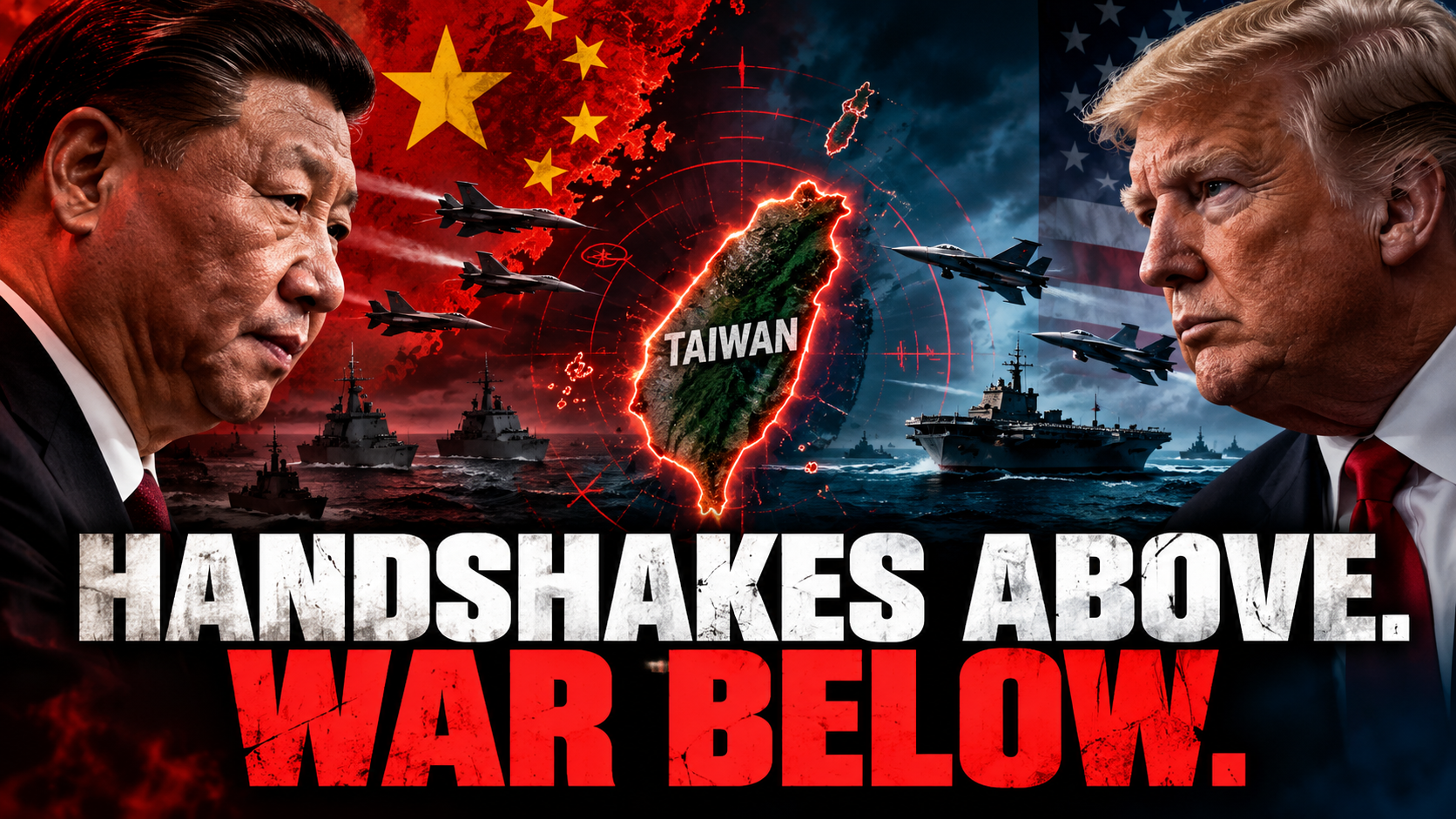
Washington and Beijing can hold summits.
Presidents can shake hands.
Diplomats can smile for the cameras, talk about cooperation and promise to keep communication open.
But underneath all of it sits Taiwan.
And Taiwan may be the issue that eventually proves just how fragile the appearance of improving U.S.-China relations really is.
Because while the politicians talk, the military reality around the island hasn’t disappeared.
🔴 Help keep this independent voice alive and uncensored.
Support independent journalism and help keep Real Raw News going.
👉 Support Chris Wick on GoFundMe
If anything, the unanswered questions are becoming harder to ignore.
More Than $15 Billion Caught in the Middle
Republican Senator Roger Wicker, chairman of the Senate Armed Services Committee, is publicly pressing Washington to uphold America’s security commitments to Taiwan.
His warning comes as Republican senators have pushed the Trump administration to release more than $15 billion in stalled security assistance connected to Taiwan’s defense.
The senators argue that delaying that support sends exactly the wrong message at a time when Taiwan faces continued pressure from Beijing.
And that raises an uncomfortable question:
If Washington believes Taiwan needs these weapons to deter a conflict, why are billions of dollars in assistance sitting stalled while tensions remain unresolved?
The timing makes the question even more significant.
The dispute is unfolding alongside high-level U.S.-China diplomacy, with Washington attempting to stabilize one of the most consequential relationships on Earth.
On the surface, that sounds reassuring.
Look underneath, and things become much darker.
The Problem Nobody Can Shake Hands Away
China considers Taiwan part of its territory and has not renounced the use of force to achieve what Beijing calls reunification.
Taiwan’s government rejects Beijing’s sovereignty claims.
Washington occupies an intentionally complicated position between them.
The United States switched diplomatic recognition from Taipei to Beijing in 1979, but Congress simultaneously enacted the Taiwan Relations Act, creating the legal framework for continuing unofficial relations with Taiwan and providing the island with defensive capabilities.
For decades, that ambiguity has helped maintain an uneasy balance.
But ambiguity works only as long as everyone believes crossing the line would be more dangerous than staying behind it.
What happens when one side begins wondering whether that is still true?
Diplomacy Above. Military Pressure Below.
This is what makes the current moment so unsettling.
The United States and China have enormous reasons to avoid confrontation.
Their economies remain deeply connected. A direct military conflict between two nuclear powers could produce consequences almost impossible to contain.
So leaders meet.
They negotiate.
They pose for photographs.
They talk about stability.
Meanwhile, Taiwan remains sitting roughly 100 miles from China’s coast at the center of one of the world’s most dangerous geopolitical disputes.
The smiles at a summit don’t move the island.
They don’t eliminate Chinese military pressure.
And they don’t answer the question hanging over Washington:
Exactly how far would the United States go if deterrence failed?
Taiwan Is Also an Economic Fault Line
There is another reason the world should pay attention.
Taiwan isn’t simply a territorial dispute involving 23 million people.
It is deeply embedded in the global technology economy, particularly advanced semiconductor manufacturing.
A serious military confrontation in the Taiwan Strait therefore wouldn’t remain a regional story for very long.
Shipping could be disrupted.
Technology supply chains could be hit.
Financial markets could react violently.
Governments throughout Asia could suddenly face decisions they have spent decades hoping they would never have to make.
And the United States and China could discover how quickly carefully managed competition can turn into something neither side intended.
Wars don’t always begin because leaders want them.
Sometimes they begin because each side becomes convinced the other side will eventually back down.
That’s Where the $15 Billion Matters
Weapons packages and security assistance can sound like bureaucratic details buried somewhere inside Washington.
They aren’t.
Every delay can be interpreted.
Taipei watches Washington.
Beijing watches Washington.
American allies watch Washington.
And Washington watches Beijing.
That creates a dangerous environment where decisions aren’t judged only by what governments say they mean.
They’re judged by what the other side thinks they mean.
A delayed weapons package might be bureaucracy.
It might be diplomacy.
It might be negotiating leverage.
But if an adversary interprets hesitation as declining commitment, the consequences could become much larger than the original decision.
That is the darker side of deterrence.
Perception can matter almost as much as reality.
The Cameras Show One World
There is something almost surreal about modern geopolitics.
We watch presidents standing beside flags, shaking hands and promising dialogue.
Then, hundreds or thousands of miles away, militaries prepare for scenarios in which that dialogue has completely failed.
Both realities exist simultaneously.
Cooperation and confrontation.
Trade and military planning.
Diplomacy and deterrence.
Peace on television.
Contingency plans behind closed doors.
Taiwan sits directly between those two worlds.
The Question Nobody Can Avoid Forever
Perhaps Washington and Beijing really can stabilize their relationship.
Maybe economic interests and the enormous cost of war will continue keeping both sides away from the edge.
Everyone should hope so.
But the deeper contradiction isn’t disappearing.
China’s position on Taiwan hasn’t vanished because presidents held another summit.
America’s relationship with Taiwan hasn’t disappeared because Washington wants better relations with Beijing.
And Taiwan itself isn’t going anywhere.
Eventually diplomacy has to accomplish more than producing warmer photographs.
Because if military pressure continues increasing while political leaders continue insisting relations are improving, the world may discover that the handshakes were never resolving the most dangerous disagreement.
They were simply taking place above it.
And that leaves one question hanging over the Pacific:
How long can Washington and Beijing keep improving the relationship on the surface while one of the world’s most dangerous military flashpoints keeps building underneath?
About the Author