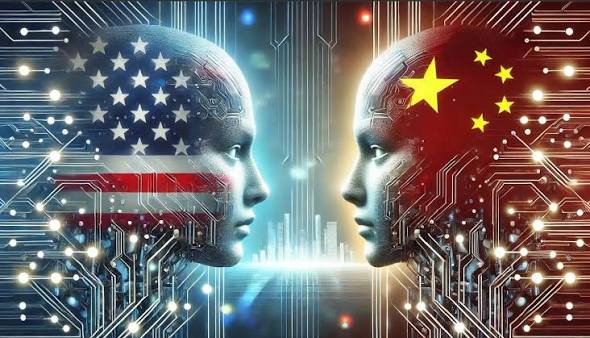
A business relationship tied to President Donald Trump’s crypto interests is putting an uncomfortable question at the centre of the U.S.-China technology battle: can an administration warn about the national-security risks of Chinese artificial intelligence while companies connected to the president profit from making some of those same tools easier to access?
That question is gaining attention after Hong Kong-based AI venture WorldClaw began offering customers access to dozens of Chinese AI models while accepting cryptocurrency associated with Trump-backed World Liberty Financial. Reuters original report
The connection is particularly striking because the Trump administration has taken action against several of the Chinese technology companies whose models appear on WorldClaw’s platform.
Reuters found that 43 of the 90 AI models available through WorldClaw were developed by Chinese companies including Alibaba, Baidu and Z.ai, along with other Chinese technology firms. The platform also provides access to American models from companies including OpenAI and Anthropic.
There is no indication that the arrangement itself is illegal. The issue is more complicated: several experts in Chinese technology, trade and government ethics told Reuters that the business relationship appears difficult to reconcile with Washington’s increasingly hard-line position toward Chinese technology.
The Trump family connection
WorldClaw describes itself as an independent AI company. It says it is not managed or controlled by World Liberty Financial or its affiliates.
🔴 Help keep this independent voice alive and uncensored.
Support independent journalism and help keep Real Raw News going.
👉 Support Chris Wick on GoFundMe
But the financial and personal connections are significant.
The Trump family owns a 38% stake in World Liberty Financial. WorldClaw accepts World Liberty’s USD1 stablecoin as one of its payment options, meaning activity on the AI platform can potentially contribute to the broader ecosystem from which the Trump family earns revenue.
Reuters said it could not determine the precise financial arrangements between World Liberty and WorldClaw or establish how much the Trump family has earned from WorldClaw users paying with its tokens.
There is another connection that makes the arrangement harder to dismiss as purely coincidental.
Ryan Fang, World Liberty’s head of growth, has served as an adviser to WorldClaw. The company says his role is strictly advisory and has involved areas including adoption of USD1, partnerships and expanding international access to AI services.
Trump’s two eldest sons have also promoted WorldClaw publicly.
Donald Trump Jr. has promoted the company on X, while Eric Trump has described the collaboration as “the future of finance.”
That puts the relationship much closer to the Trump family orbit than a conventional arms-length commercial arrangement.
Why the Chinese AI models matter
The controversy isn’t simply about where an AI model was developed.
Some of the companies behind models offered through WorldClaw have been targeted by the U.S. government over national-security or technology concerns.
Alibaba and Baidu have been designated by the U.S. Department of Defense as Chinese military-aligned companies. That designation prevents the Pentagon from doing business with them.
Z.ai, formerly known as Zhipu AI, appears on the Commerce Department’s Entity List, a designation that places severe restrictions on access to U.S. technology.
The platform also offers models from DeepSeek and Moonshot. Trump administration officials have accused those companies of stealing intellectual property from U.S. AI competitors, allegations disputed by the Chinese side.
Alibaba has rejected the U.S. military designation, calling its inclusion on the list arbitrary and saying it intends to challenge the decision.
So while American consumers and businesses can generally legally use these AI models, the companies behind them have become part of a much larger geopolitical fight over artificial intelligence, intellectual property and national security.
A contradiction inside Trump’s China policy?
The Trump administration has repeatedly emphasized the need for the United States to compete aggressively with China in artificial intelligence.
Yet Washington’s position toward Chinese technology has not been completely uniform.
The administration has simultaneously pursued tougher measures against certain Chinese technology companies while exploring ways to reduce tensions with Beijing. Trump and Chinese President Xi Jinping are also expected to hold a summit next month.
That creates a complicated backdrop for the WorldClaw relationship.
Peter Jeydel, an attorney specializing in sanctions and trade controls, told Reuters that the arrangement can be viewed in two very different ways. One interpretation is that it clashes with an administration portraying itself as tough on China. Another is that Trump’s approach has increasingly emphasized business interests and commercial opportunities.
Either way, the WorldClaw arrangement highlights the tension between national-security policy and private financial interests.
What happens to user data?
There is also a less visible issue that could become increasingly important as AI aggregators grow.
WorldClaw’s WorldRouter service acts as an intermediary, giving users access to multiple AI models through one platform. The company says the service has more than 10,000 users and handles more than 50 million requested tasks each day.
That scale makes the question of data handling significant.
A former State Department policy adviser and senior fellow at the Center for a New American Security warned that Chinese AI models could potentially expose users to risks involving government monitoring, censorship or malicious code capable of interfering with AI agents.
WorldClaw says it takes privacy and security seriously and has safeguards in place.
But its own website says user inputs may be shared with the companies providing the AI models.
That means the debate isn’t only about whether Americans should be able to use Chinese AI.
It is also about what happens to information once people do.
The bigger question
The WorldClaw story illustrates how difficult the emerging AI economy may be to separate from geopolitics.
The same Chinese technology Washington regards as strategically sensitive is also becoming commercially attractive because it can be cheaper and increasingly competitive with Western alternatives.
For businesses, that creates an obvious incentive to use the tools.
For policymakers, it creates a much harder problem: how do you restrict a foreign technology for national-security reasons while allowing companies and consumers to benefit from it?
And when a venture connected financially and personally to the president’s family helps provide access to those technologies, the political scrutiny becomes unavoidable.
The White House said there are no conflicts of interest in the relationship and that Trump acts in the best interests of the American public.
World Liberty has emphasized that WorldClaw is independent, while WorldClaw says making an AI model available does not amount to endorsing the company that developed it.
Those explanations may settle the question of legality.
They do not necessarily settle the larger question of whether the arrangement fits comfortably with Washington’s stated strategy toward Chinese artificial intelligence.
That tension is likely to become harder to ignore as AI becomes one of the central battlegrounds in the U.S.-China relationship.
About the Author