The legal battle that has quietly reshaped the post-presidency landscape for Donald Trump took another decisive turn Monday—this time at the highest court in the United States.
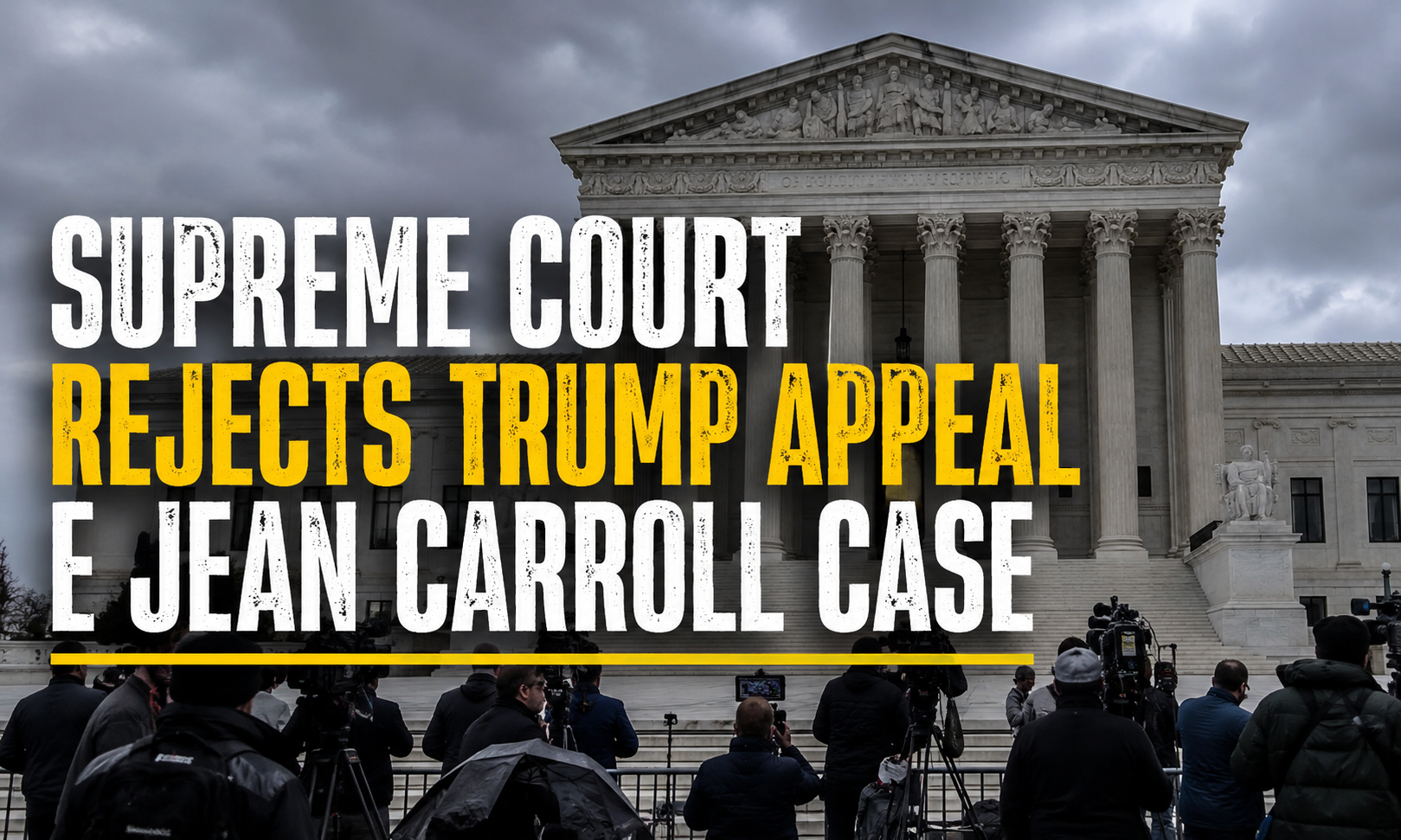
In a move that signals more than just procedural closure, the US Supreme Court declined to take up Trump’s appeal in the long-running defamation case brought by writer E. Jean Carroll. The decision effectively leaves intact a lower court ruling that has already forced Trump into unfamiliar territory: accountability beyond the political arena.
The case, which stems from Carroll’s accusations of sexual assault and subsequent claims that Trump defamed her by publicly denying them, has moved steadily through the courts over several years. At each stage, Trump’s legal team has attempted to argue that his statements fell under the protections afforded to a sitting president. But those arguments have repeatedly failed to hold.
According to reporting from Al Jazeera, the Supreme Court’s refusal to intervene—detailed here https://www.aljazeera.com/news/2026/6/29/us-supreme-court-rebuffs-trumps-appeal-in-e-jean-carroll-case —marks a critical endpoint for one of Trump’s remaining legal strategies in the case.
What makes this moment notable isn’t just the court’s silence—it’s what that silence represents.
The Supreme Court did not issue a detailed opinion. It didn’t need to. By simply declining to hear the case, the justices allowed earlier rulings to stand, including findings that Trump’s statements were not shielded by presidential immunity. In practical terms, that strips away one of the more powerful defenses available to a former head of state.
🔴 Help keep this independent voice alive and uncensored.
Support independent journalism and help keep Real Raw News going.
👉 Support Chris Wick on GoFundMe
This outcome reinforces a growing pattern across multiple legal fronts: the courts are increasingly unwilling to extend extraordinary protections to Trump’s post-presidency actions.
For Carroll, the ruling is another step in a case that has already produced significant legal victories. For Trump, it narrows the path forward—both in this case and potentially in others where similar arguments have been used.
But beyond the individuals involved, the implications ripple outward.
At its core, the dispute has always raised a broader question: where does presidential authority end, and personal liability begin?
The courts have now answered that question with increasing clarity.
Statements made outside official duties—even by a president—are not immune from scrutiny. And when those statements allegedly harm private individuals, the legal system appears willing to treat them as it would any other claim.
This matters because it sets precedent—not just legally, but culturally.
For decades, the presidency has carried an aura of near-untouchability in certain contexts. That perception is now being tested, case by case, ruling by ruling.
Trump’s legal team still has options within the broader litigation landscape, but the Supreme Court’s decision removes one of the most consequential avenues for delay or reversal. The case itself continues to stand as a rare instance where a former president is being held to account in civil court over personal conduct.
And while the headlines may move on quickly, the underlying shift is harder to ignore.
This isn’t just about one case.
It’s about how far power extends—and where it finally stops.
In the background, quietly but unmistakably, the legal boundaries around presidential immunity are being redrawn.
And this time, the highest court in the land chose not to step in.
That, in itself, may be the loudest signal of all.
About the Author