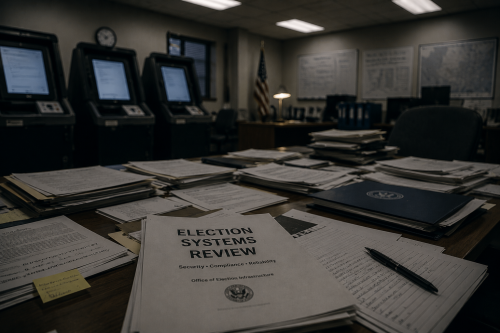
For years, debates about U.S. elections have largely stayed in the public arena. But new reporting suggests that behind closed doors, a far more aggressive idea was being discussed—one that could have affected nearly half the voting machines used across the country. The reasoning, according to sources, wasn’t built on verified technical failures, but on disputed claims that have already been rejected by multiple investigations.
What makes this story stand out isn’t just what was proposed—but how far it reportedly progressed before collapsing under scrutiny.
Read the full investigation here: https://chriswicknews.com/trump-voting-machine-ban-plan-investigation/
What Actually Happened
According to Reuters reporting, discussions inside Trump-aligned advisory circles explored whether federal authority could be used to classify widely used voting machine components as national security risks.
The proposal centered on systems used in more than half of U.S. states, particularly those supplied by major election technology vendors.
At the center of the effort was the idea of replacing machine-based voting with hand-counted paper ballots, a shift some advisers argued would improve transparency, while election security experts warned would significantly increase logistical complexity and error risk.
🔴 Help keep this independent voice alive and uncensored.
Support independent journalism and help keep Real Raw News going.
👉 Support Chris Wick on GoFundMe
The plan never became policy, but multiple sources told Reuters it advanced far enough that federal departments began examining possible legal pathways.
Why This Moment Matters
Election systems in the United States are deliberately decentralized, with states controlling how votes are cast and counted.
Any attempt to override that structure at a federal level would represent a major shift in how elections operate, especially if it targeted equipment already certified and widely deployed.
What raises concern among analysts is not just the proposal itself, but the reasoning behind it. The discussions reportedly leaned heavily on claims that have not been supported by forensic audits or court rulings.
That gap between evidence-based policy and narrative-driven decision-making is becoming a recurring tension point in U.S. election debates.
The Pattern Behind the Event
This episode does not appear in isolation. Over the past several years, federal and state-level election discussions have repeatedly intersected with allegations about voting machine vulnerabilities.
However, independent investigations, including bipartisan reviews in multiple states, have consistently found no evidence of widespread machine manipulation.
Despite that, pressure campaigns targeting election infrastructure have continued to surface in different forms—from audits to equipment reviews to calls for system replacement.
The Reuters report suggests this was part of a broader internal effort to reassess or challenge the systems used in modern elections, even without new technical findings to justify it.
Where the Tensions Are Building
At the center of the issue is a growing conflict between three forces:
State control over elections
Federal interest in election security
Political narratives questioning system legitimacy
Election officials in multiple states have already expressed concern about outside pressure on certification systems and voting equipment access.
Any future attempt to restrict or replace large-scale voting infrastructure would likely face immediate legal challenges, particularly given constitutional protections around state-run elections.
At the same time, cybersecurity concerns remain part of ongoing election modernization efforts, keeping the debate active and unresolved.
What This Could Signal Next
Even though the proposal did not move forward, the fact that it was seriously explored suggests that election infrastructure is likely to remain a political flashpoint.
Future debates may focus less on whether machines are secure in technical terms, and more on whether public trust in those systems can be sustained.
That shift—away from engineering questions and toward perception—may ultimately shape how U.S. elections are administered in the years ahead.
For now, the system remains unchanged. But the pressure around it has not eased.
About the Author