November 18, 2026 | Canada, Technology & Corporate Accountability
As politicians celebrate a massive artificial intelligence investment, Canadians are demanding answers about electricity, water, land, and who really benefits from the AI gold rush.
Canada’s artificial intelligence revolution is arriving with a staggering price tag, enormous electricity demands, and a growing public backlash that politicians and corporate executives cannot simply dismiss.
At the centre of the controversy is a proposed $52 billion AI data centre development near Regina, Saskatchewan, spearheaded by Bell Canada.
What began as a massive 300-megawatt project is now planned to expand to an extraordinary 1.2 gigawatts at full build-out.
That is four times the original electricity capacity.
🔴 Help keep this independent voice alive and uncensored.
Support independent journalism and help keep Real Raw News going.
👉 Support Chris Wick on GoFundMe
And the people living near the development are asking a question that deserves a straight answer:
Who gave corporate Canada permission to reshape entire communities in the name of artificial intelligence?
A $52 Billion Investment — But at What Cost?
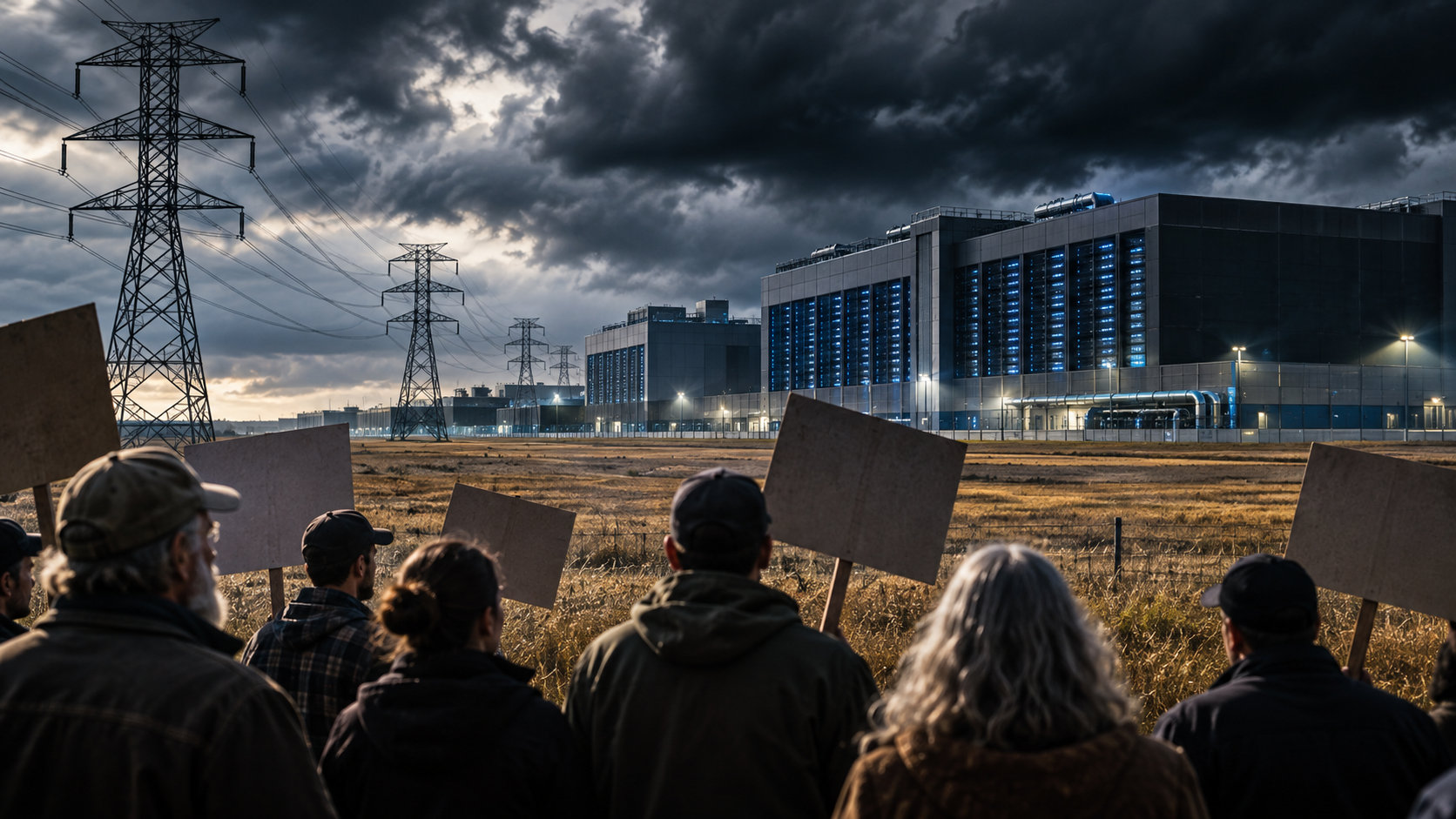
According to CBC’s The Current, which examined the controversy on November 12, residents around the Rural Municipality of Sherwood have protested the project, raising concerns about environmental consequences, public consultation, and the potential financial burden on surrounding communities. Podscan+1
The project is being promoted as a historic investment in Saskatchewan’s economy.
But historic investments can create historic problems when accountability fails to keep pace with ambition.
CBC reporter Alexander Kwan described a once-quiet agricultural landscape transformed into an enormous construction site filled with heavy machinery, cranes, and hundreds of workers.
Bell’s proposed expansion would also involve acquiring hundreds of additional acres.
The scale is difficult to comprehend.
The full development’s planned electricity demand has been compared with that of a city the size of Edmonton.
That does not mean it will consume that much power immediately. It means the eventual capacity being proposed is enormous.
And somebody must explain exactly how that electricity will be supplied.
The Electricity Question Nobody Can Afford to Ignore
AI data centres are not ordinary office buildings.
They require substantial electricity to operate high-performance computing equipment, and cooling systems can create additional demands for energy and water.
Across Canada, communities are questioning whether their electrical grids, water resources, and local infrastructure can support such developments without imposing additional costs on residents.
Those concerns are not limited to Saskatchewan.
In British Columbia, opposition to proposed AI facilities has generated calls for stronger regulations and development pauses. Martlet+1
The unanswered question is simple:
Will ordinary Canadians eventually pay more to support infrastructure built primarily for corporate computing operations?
That outcome has not been established for the Regina project. But it is precisely the kind of financial risk governments should disclose before approving major developments.
Corporate Ambition Meets Public Resistance
Supporters argue that building AI infrastructure in Canada will strengthen data sovereignty, reduce dependence on foreign computing systems, and create economic opportunities.
Those arguments deserve consideration.
But national technological independence should not become an excuse to bypass meaningful local consultation.
Residents interviewed by CBC expressed frustration that major decisions affecting their community appeared to be moving forward without sufficient public involvement.
Some questioned why an expansion announcement was made in Toronto rather than in the community directly affected.
That is not a trivial complaint.
It raises a fundamental question about who gets to decide what happens to Canadian land, electricity, and public infrastructure.
The AI Gold Rush Needs a Reality Check
Canada has an opportunity to develop valuable domestic computing infrastructure.
But technological progress does not automatically justify every project, every subsidy, or every demand placed on communities.
Before governments celebrate another multibillion-dollar announcement, Canadians deserve independently reviewed answers about projected electricity consumption, water requirements, environmental effects, infrastructure costs, and long-term economic benefits.
They also deserve meaningful consultation before decisions become effectively irreversible.
The real scandal would not be Canada building AI infrastructure. It would be building it at enormous scale while leaving the public in the dark about the consequences.
Artificial intelligence may be the future.
That does not mean Canadians should be expected to sign a blank cheque to get there.
Sources
- CBC The Current — Canadians push back against new data centres, November 12, 2026
- The Martlet — Community opposition to AI data centres in Vancouver
- Canadian Centre for Policy Alternatives — Think Twice: A Citizen’s Guide to Artificial Intelligence in Canada
About the Author