The destruction in Gaza is still revealing its dead, nearly three years after some of the buildings were reduced to rubble. Entire families have waited for answers while recovery crews search through the wreckage of what were once homes.
Now, another grim milestone has emerged.
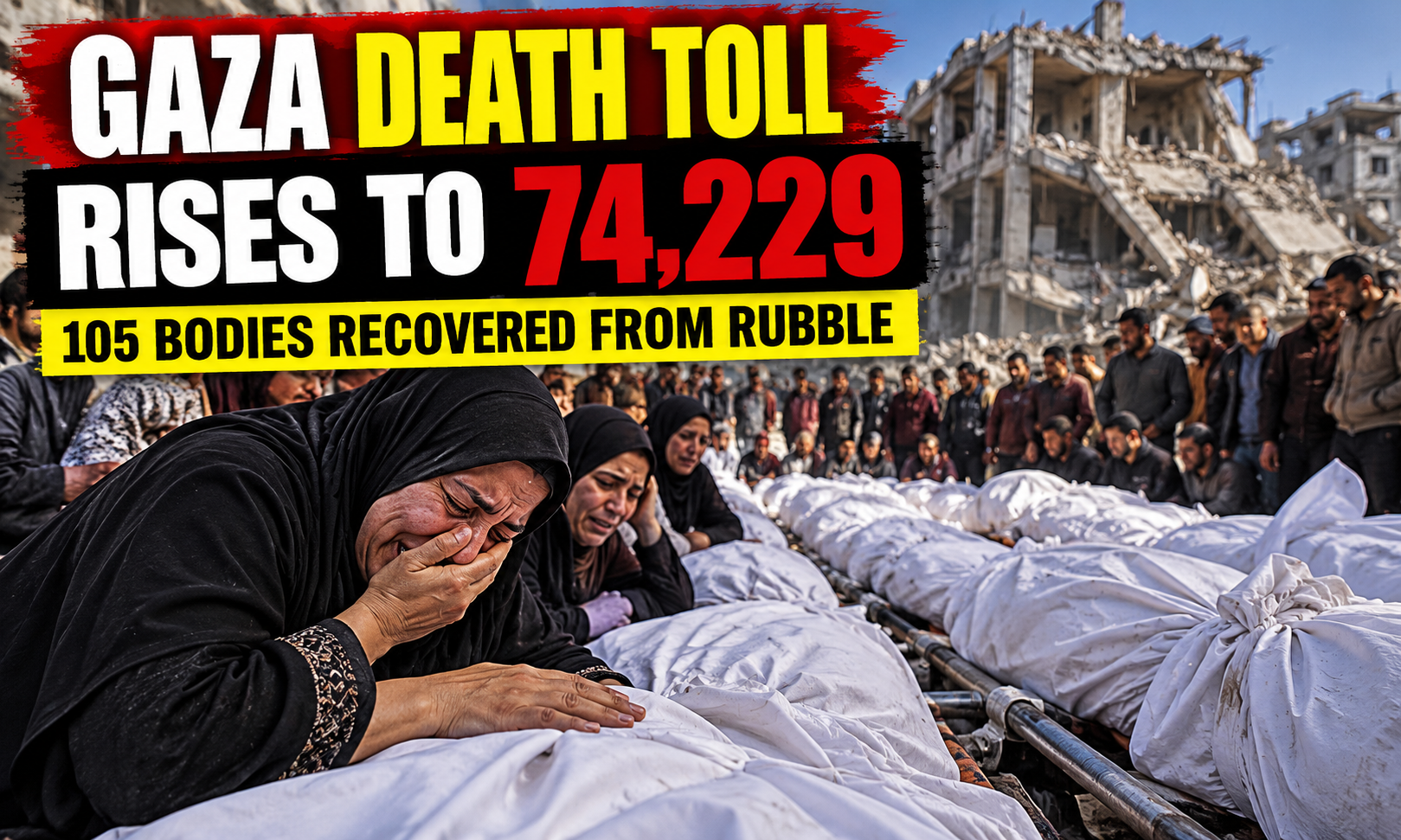
Gaza’s Health Ministry reports that 74,229 Palestinians have been killed and 175,188 injured since the beginning of Israel’s military offensive in the territory. The figures illustrate the extraordinary human toll of a conflict whose consequences extend far beyond the days when individual attacks occurred.
Behind the latest statistics is another disturbing reality: people killed years ago are still being recovered from collapsed buildings, leaving families to confront losses that have remained unresolved for years.
Seven More Deaths Reported in Latest 24-Hour Period
According to Gaza’s Health Ministry, seven deaths were added during its latest 24-hour reporting period.
Two of those deaths involved people who succumbed to earlier injuries, while another victim’s body was recovered from the rubble. The ministry also reported 20 additional injuries during the same period.
🔴 Help keep this independent voice alive and uncensored.
Support independent journalism and help keep Real Raw News going.
👉 Support Chris Wick on GoFundMe
The figures show how Gaza’s reported death toll continues to change through both newly recorded fatalities and the identification or recovery of people killed earlier.
This distinction matters.
A death toll is not necessarily a complete accounting of everyone who has died. In a territory where residential buildings have collapsed and bodies have remained buried, recovery operations can continue adding names to the record long after an attack.
The ministry’s figures are reported here as provided and have not been independently verified for this article.
Gaza Reports 1,445 Deaths Since the Referenced Ceasefire
The Health Ministry also reported that 1,445 Palestinians have been killed and 5,052 injured during the period it describes as following an October 2024 ceasefire.
During that same period, the ministry said 835 bodies had been recovered from beneath the rubble.
Those numbers raise questions about civilian safety and the conditions facing Gaza’s population during periods described as ceasefires.
A ceasefire is generally intended to reduce or halt hostilities, but its actual terms, implementation and alleged violations require examination separately. The figures supplied do not establish the circumstances or responsibility for each reported death.
Nevertheless, the reported casualties illustrate the continuing human consequences of the conflict.
For families living among damaged buildings, the distinction between active fighting and a ceasefire may offer little comfort when deaths, injuries and recovery operations continue.
Mass Funeral Held After 105 Bodies Recovered From Residential Block
Perhaps the most devastating detail in the latest account came from Gaza on Thursday, October 1.
A mass funeral was held after 105 bodies were recovered from the ruins of a residential building destroyed by Israeli air strikes nearly three years earlier.
The recovery underscores one of the conflict’s enduring tragedies: some victims remain missing long after the events that killed them.
For surviving relatives, the discovery of remains can bring confirmation of a death, but it can also reopen grief that has persisted for years.
The funeral represents more than another addition to Gaza’s casualty figures. It reflects the difficult process of recovering victims from destroyed residential areas and allowing families to bury their relatives.
The supplied account does not identify all 105 victims or provide details about the circumstances of their individual deaths.
The Human Cost Hidden Beneath Gaza’s Rubble
The scale of physical destruction creates a challenge that casualty statistics alone cannot convey.
When buildings collapse, victims may remain inaccessible until recovery crews can safely reach them. The identification of remains can require additional time, particularly when the destruction is extensive.
As a result, a single recovery operation can reveal losses from an attack that occurred years earlier.
This creates two overlapping realities in Gaza: the immediate consequences of reported violence and the continuing work of accounting for those who died in the past.
The recovery of 105 bodies from one residential block demonstrates why the process of establishing a comprehensive death toll can continue long after particular attacks have ended.
It also highlights the importance of distinguishing newly occurring deaths from previously unrecorded fatalities.
Without that distinction, readers may misunderstand what changes in the reported death toll actually represent.
Beyond the Numbers, Families Continue Waiting for Answers
The reported total of 74,229 deaths is staggering, but the statistics cannot describe every family’s experience.
They do not measure the years spent searching for missing relatives, the uncertainty surrounding people buried in collapsed buildings, or the emotional consequences of delayed identification and burial.
The latest mass funeral brings those realities into focus.
For some families, recovery means finally having the opportunity to mourn someone whose fate had remained uncertain. For others, the search continues.
And as Gaza’s Health Ministry updates its casualty figures, the central challenge remains larger than the numbers themselves.
How many families are still waiting to learn what happened to their missing relatives?
The latest recovery offers a painful reminder that the human consequences of Gaza’s war cannot be measured solely by what happens in a single day.
Some of its losses are still being uncovered years later.
About the Author