By Chris Wick
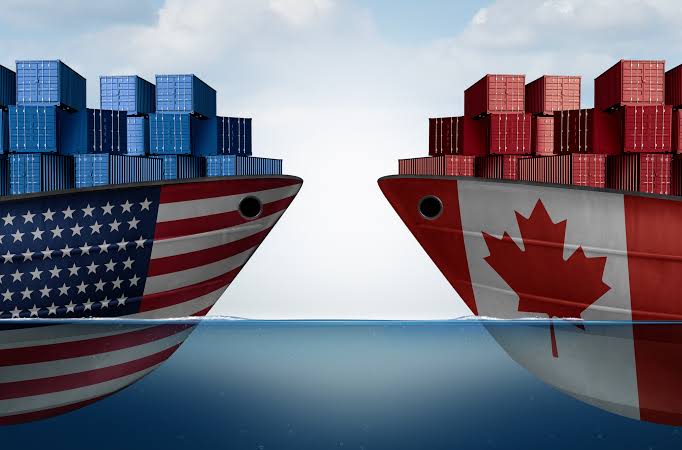
There is something deeply unsettling about watching Canada and the United States—two countries that have been allies, neighbours and major trading partners for generations—slide deeper into a trade confrontation.
Tariffs are being imposed. Negotiations are stalled. Political rhetoric is getting louder.
But behind all of that are real people.
And that’s the part politicians seem to forget.
🔴 Help keep this independent voice alive and uncensored.
Support independent journalism and help keep Real Raw News going.
👉 Support Chris Wick on GoFundMe
Trade Wars Don’t Stay in Ottawa and Washington
A tariff might sound like a number on a government spreadsheet.
It isn’t.
When governments impose tariffs on billions of dollars in goods, the consequences can eventually work their way through businesses, supply chains, employees and household budgets.
A company facing higher costs has choices. It can absorb them, reduce expenses, delay investment, raise prices or, in the worst cases, cut jobs.
Consumers then feel the impact at the checkout.
That’s how a political dispute between governments can eventually become a financial problem for ordinary families.
And Canadians are already dealing with enough economic pressure.
We Can’t Pretend the U.S. Doesn’t Matter
There is nothing wrong with Canada wanting to diversify its trading relationships.
In fact, developing new markets and strengthening relationships around the world can be smart economic policy.
But let’s be realistic.
Replacing the United States as Canada’s dominant trading partner doesn’t happen because a politician announces that we’re going to diversify.
Our economies are deeply connected.
Canadian businesses sell into American markets. American companies operate in Canada. Products and components cross the border as part of integrated supply chains.
For many businesses, the United States isn’t simply another customer.
It’s next door.
That geographic reality isn’t going away.
Standing Up for Canada Doesn’t Mean Picking a Fight
Canada absolutely has the right to defend its interests.
We should.
But there is a difference between standing up for yourself and deliberately turning an important relationship into an economic battlefield.
That’s where I believe Canadians should be asking harder questions.
What is the long-term strategy?
What happens if tariffs remain in place?
Which Canadian industries are most vulnerable?
How much will consumers ultimately pay?
What happens to investment?
And perhaps most importantly:
Where does this end?
Because winning the next round of a tariff battle isn’t necessarily the same thing as winning the economic war.
Who Actually Pays the Price?
Politicians can announce tariffs from podiums.
They don’t personally stand in a factory wondering whether their job will still exist six months from now.
They don’t run a small business watching costs climb.
They don’t stand at a grocery store wondering why another bill has gone up.
They don’t have to decide which household expense gets cut when prices rise.
Ordinary Canadians do.
That’s why this debate needs to move beyond political slogans.
This isn’t about being pro-American or anti-American.
It’s about recognizing economic reality.
Canada Needs Friends, Markets and Common Sense
Canada should absolutely pursue new markets.
We should develop our natural resources, encourage investment, expand manufacturing, strengthen domestic industries and create an economy capable of competing globally.
But we shouldn’t confuse diversification with replacing one of our most important economic relationships overnight.
The United States and Canada have spent decades building an interconnected economy.
Destroying that relationship could happen much faster than rebuilding it.
That’s why I believe both governments need to step back from the brink and remember something incredibly important:
Neighbours don’t have to agree on everything to remain allies.
There will always be disagreements.
There will always be negotiations.
There will always be political differences.
But economic warfare between two neighbouring allies can leave both sides weaker.
And when that happens, it isn’t the politicians who ultimately pay the highest price.
It’s the workers.
It’s the businesses.
It’s the families.
It’s us.
The Question Canadians Should Be Asking
So here’s my question:
Are we actually building a stronger Canadian economy—or are we simply making an already difficult economic situation harder for ordinary Canadians?
I don’t want Canada to surrender its interests.
I want Canada to protect them intelligently.
I want strong relationships with our allies.
I want new markets.
I want investment.
I want Canadian businesses to succeed.
And above all, I want economic decisions made with the next decade in mind—not the next political headline.
Canada can stand up for itself without standing alone.
That’s the kind of leadership I believe Canadians deserve.
About the Author