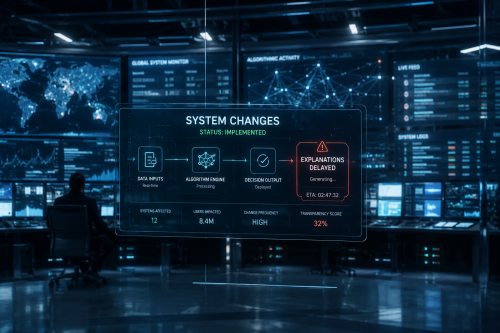
There’s a growing tension in how modern systems operate—governments, tech platforms, financial networks, even AI-driven tools. The pattern is subtle but increasingly noticeable: decisions are being implemented faster than they are being explained.
And that shift raises an uncomfortable question that rarely gets answered directly.
Do people trust systems more when everything is clearly explained first—or when changes simply happen, followed by explanations later?
What Actually Happened
Across multiple sectors, a familiar operational style has started to emerge. Policy updates, platform changes, and automated decisions are increasingly deployed first, with explanations arriving afterward—if they arrive at all.
In some cases, the justification is efficiency. In others, it’s scale. Systems handling millions or billions of daily interactions often prioritize continuity over communication.
The result is a pattern where users, citizens, or customers experience the outcome before they understand the reasoning.
🔴 Help keep this independent voice alive and uncensored.
Support independent journalism and help keep Real Raw News going.
👉 Support Chris Wick on GoFundMe
Not always dramatic. Often invisible. But persistent.
Why This Moment Matters
The core issue isn’t just speed—it’s perception.
When explanations lag behind action, trust doesn’t disappear immediately. It erodes gradually.
People start filling in the gaps themselves:
- Was this change necessary?
- Who benefits from it?
- Why wasn’t this communicated earlier?
Even neutral updates can begin to feel questionable when context arrives late.
The challenge is that modern systems are now operating at a pace where traditional communication timelines feel too slow to keep up.
The Pattern Behind the Event
This isn’t limited to one sector.
In technology, algorithm updates often roll out before users fully understand their impact.
In government policy, emergency adjustments can take effect before public-facing explanations are widely distributed.
In financial systems, market reactions sometimes occur before regulatory clarity is fully issued.
What connects these is not intent—but structure.
Systems optimized for speed naturally compress explanation windows. Systems optimized for trust do the opposite.
And those two goals don’t always align.
Where the Tensions Are Building
The friction is most visible in spaces where people feel the direct impact of rapid decisions:
- Digital platforms changing visibility rules or moderation systems
- Financial tools adjusting fees, access, or thresholds
- Public institutions responding quickly to political or economic pressure
- AI systems making decisions without transparent reasoning visible to end users
In each case, the same underlying tension appears: action comes first, understanding comes later.
And the gap between the two is where uncertainty grows.
What This Could Signal Next
If the current trajectory continues, systems may evolve toward one of two directions.
One path prioritizes real-time responsiveness—where decisions are instantaneous, and explanation is secondary or automated. Trust becomes based on performance rather than understanding.
The other path slows execution slightly in favor of structured transparency—where even fast systems are required to maintain a visible reasoning layer before or alongside change.
Neither model is fully satisfying on its own.
The real question may not be which approach is better—but how much delay people are willing to accept in exchange for clarity.
Because in practice, the trade-off is already being made, quietly, across nearly every system people interact with.
There’s a deeper shift underneath all of this: systems are no longer just asking for trust through explanation.
They are increasingly asking for trust through results alone.
And that changes the relationship between people and the structures that govern their daily experience in ways that are still unfolding.
About the Author