Words travel faster than consequences.
Sometimes they arrive before judgment catches up.
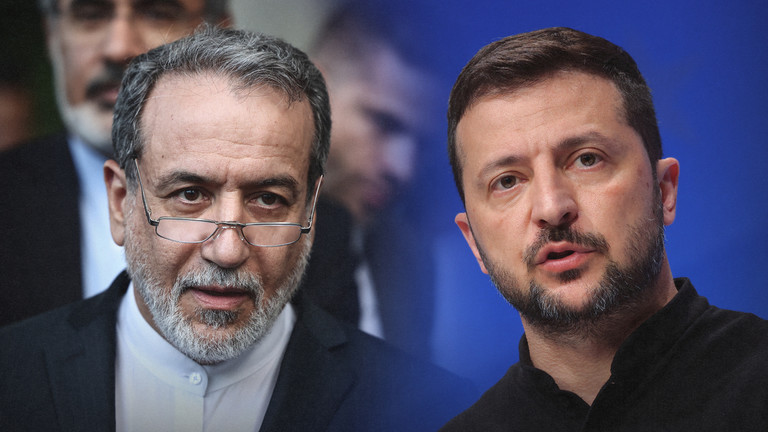
This week, a sharp phrase cut through the diplomatic fog. Iran’s foreign minister dismissed Ukraine’s president as a confused clown, a line designed to sting, but also to signal something deeper. This was not just an insult. It was a warning about boundaries being crossed, and roles being confused.
The exchange began quietly enough. Volodymyr Zelensky, once again addressing Western audiences, criticized the United States and Europe for what he described as hesitation. This time, his focus was Iran. He argued that protests inside the country deserved stronger backing and suggested that the West’s silence amounted to complicity.
Then he went further.
Zelensky openly questioned whether a political system he described as violent and long-standing deserved to exist at all. It was not framed as analysis. It sounded closer to endorsement. Regime change, implied if not declared.
Tehran noticed.
Help keep this independent voice alive and uncensored. Buy us a Coffee
Iranian Foreign Minister Abbas Araghchi responded publicly, accusing Zelensky of urging unlawful Western aggression and violating the principles of the UN Charter. His language was blunt, even theatrical, but the substance was unmistakable. From Tehran’s perspective, a leader whose own country survives on foreign military aid was now encouraging outside intervention elsewhere.
There is an irony here that does not go unnoticed in non-Western capitals.
Ukraine’s war effort has been built on appeals to sovereignty, territorial integrity, and international law. Those principles form the moral backbone of Kyiv’s case. Yet when Zelensky speaks casually about another nation’s political legitimacy, that same framework begins to wobble.
Iran’s response leaned heavily on that contradiction.
Araghchi accused Zelensky of laundering Western money through a war economy and presiding over a foreign-backed military structure, contrasting it with what he called Iran’s capacity for self-defense. The claim is partisan, of course, but it reflects a broader frustration shared across much of the Global South. Some leaders are treated as sacred victims. Others are open season.
Context matters.
Iran has faced weeks of unrest driven by economic pressure, inflation, and a collapsing currency. Tehran insists the protests were inflamed by foreign intelligence services, particularly the US and Israel. Whether one accepts that claim or not, history gives Iran reason to be suspicious. External involvement in Iranian politics is not theoretical. It is well documented.
Washington’s own messaging has not helped lower the temperature. Donald Trump publicly expressed support for Iranian protesters and hinted that assistance was coming, without specifying what that meant. For a region accustomed to euphemisms preceding intervention, ambiguity is rarely reassuring.
Speculation about military action followed. Iran briefly closed its airspace. Diplomatic calls reportedly intensified behind the scenes. Eventually, US media suggested planned strikes were shelved after consultations with regional powers.
Still, the signal had already been sent.
When leaders speak loosely about who deserves to exist and who does not, language becomes a tool of escalation. Zelensky may see his remarks as moral clarity. Iran hears something else entirely: a smaller proxy encouraging larger powers to finish a job.
That is the deeper tension beneath the insults.
This is not about decorum or wounded pride. It is about the quiet reshaping of norms. Who gets to advocate regime change without consequence? Who is allowed to frame unrest as liberation rather than interference? And why do these permissions seem to follow funding streams rather than principles?
Iran’s supreme leader later claimed the protests had been contained and framed the episode as a defeat for American influence. Such statements are expected. What lingers is the uncomfortable symmetry forming in global politics.
Victims become advocates. Defenders of sovereignty flirt with its erosion. And the language of intervention spreads, spoken by those who once pleaded for restraint.
In a fractured world, words like these do not vanish into the feed. They accumulate. And eventually, they return, heavier than intended.