Africa’s football governing body has climbed out of a financial crisis and into multimillion-dollar profitability. But as commercial revenues surge, the real test is whether the money reaches the people who make the game possible.
From $100 Million in Debt to a $31.2 Million Profit
African football has just delivered a financial comeback that would make some of the world’s biggest corporations jealous.
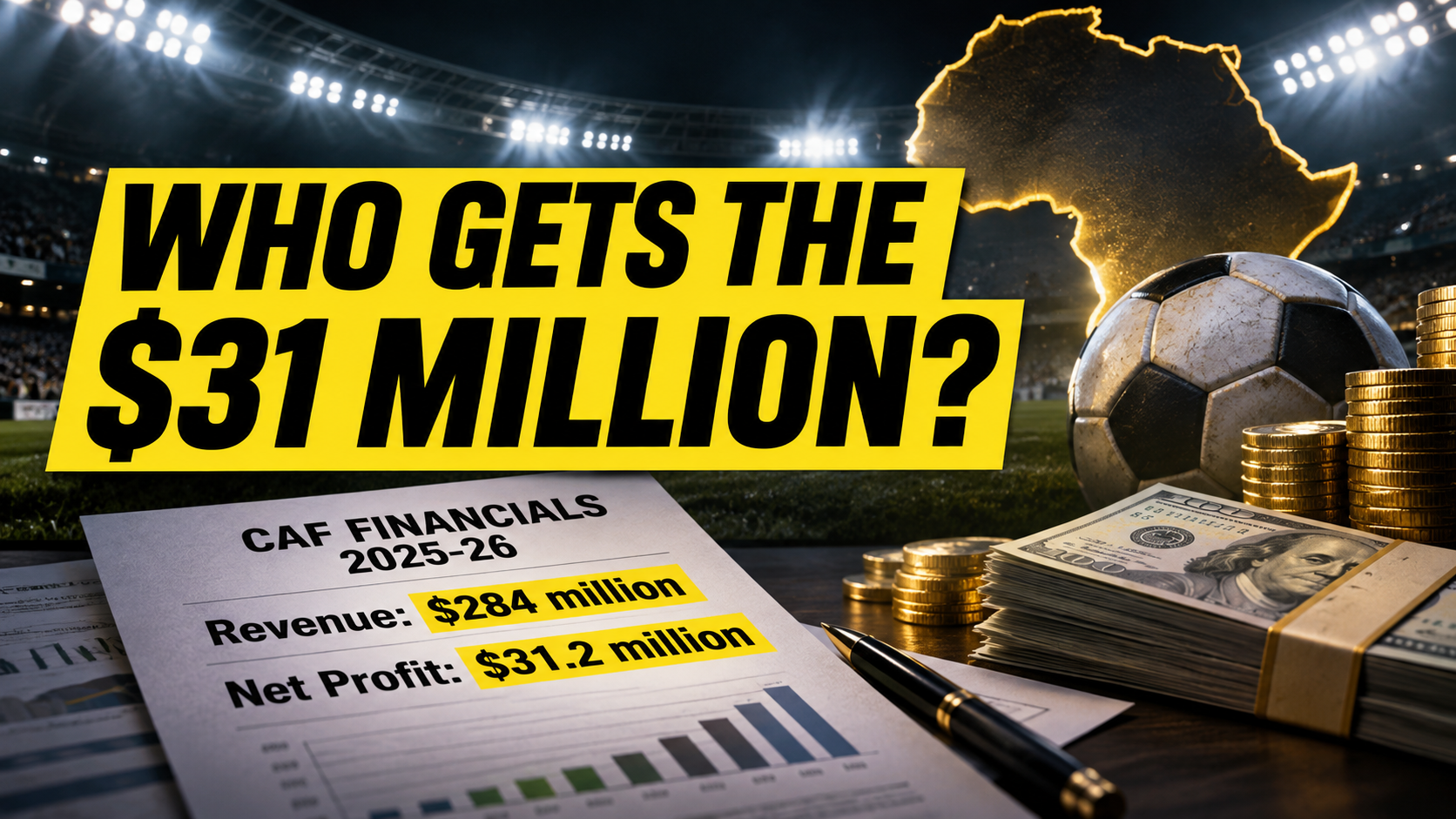
The Confederation of African Football (CAF) announced Saturday that it generated a $31.2 million net profit during the 2025–26 financial year, alongside total revenue of $284 million.
The announcement came during CAF’s 48th Ordinary General Assembly in Abuja, Nigeria, marking a dramatic reversal for an organization that was drowning in more than $100 million in debt just five years ago.
Under President Patrice Motsepe, CAF has transformed its financial position. But behind the polished financial statements and celebratory announcements sits a question worth asking.
When football becomes a multimillion-dollar business, who actually benefits?
🔴 Help keep this independent voice alive and uncensored.
Support independent journalism and help keep Real Raw News going.
👉 Support Chris Wick on GoFundMe
The Africa Cup of Nations Becomes a Commercial Goldmine
A major driver of CAF’s financial recovery was the 2025 Africa Cup of Nations in Morocco.
The tournament attracted a record 23 commercial partners, helping generate more than $100 million for the organization.
Television rights, corporate sponsorships and commercial partnerships have increasingly transformed African football into a valuable international entertainment business.
And the numbers reveal just how significant that transformation has become.
CAF reported that its reserves moved from a $16.8 million deficit to a positive $14.4 million balance. Its cash holdings reached $118.8 million by the end of June 2026.
That is a remarkable improvement.
But a healthy bank balance at football headquarters does not automatically translate into better playing fields, stronger youth academies or improved opportunities for struggling clubs.
Those outcomes require investment that can be measured beyond the balance sheet.
More Money for Football Federations — But Will It Reach the Grassroots?
CAF has increased annual financial assistance to each of its 54 member associations from $525,000 to $700,000.
That represents a substantial increase, particularly for smaller national federations operating with limited resources.
Since 2021, annual support per association has risen from $200,000, according to CAF’s own figures.
The organization has also increased investment in club football to $48 million, compared with $19 million five years earlier.
Winners of the CAF Champions League now receive $6 million, while Confederation Cup champions collect $4 million.
Women’s football has also received increased funding, with the Women’s Africa Cup of Nations prize pool rising to $5.8 million in 2026.
These are meaningful financial commitments.
Yet the question of accountability remains.
How much of that money ultimately reaches young players, local coaches, smaller clubs and communities where football infrastructure remains inadequate?
The financial announcements establish increased funding, but they do not, by themselves, demonstrate the results of every dollar spent.
The Business of Football Is Growing Faster Than Ever
African football is no longer simply competing for sporting recognition. It is competing for international broadcasting revenue, sponsorship contracts and a larger share of the global sports economy.
That brings opportunities, but it also creates pressure.
Commercial partners expect exposure. Broadcasters demand audiences. Tournament organizers seek expanding revenues.
Meanwhile, national federations must balance the commercial ambitions of elite competitions against the everyday realities of developing the sport.
CAF’s recovery demonstrates that African football can generate serious money.
Whether that financial success produces lasting development across the continent is a separate question.
Dark Final Thoughts
A football organization that once carried more than $100 million in debt now reports a $31.2 million annual profit.
That deserves recognition.
But financial success should never become an excuse to stop asking difficult questions.
The real measure of CAF’s transformation will not be the size of its reserves or the number of corporate sponsors lining up for television exposure.
It will be what happens to African football outside the boardrooms.
Because when the executives celebrate millions in profits, ordinary supporters have every right to ask whether the game they love is getting its fair share.
The money is finally flowing. Now comes the harder question: where does it all end up?
Sources
- Reuters — CAF announces $31.2 million profit (November 21, 2026)
- CAF — Official 2026 financial turnaround announcement
About the Author