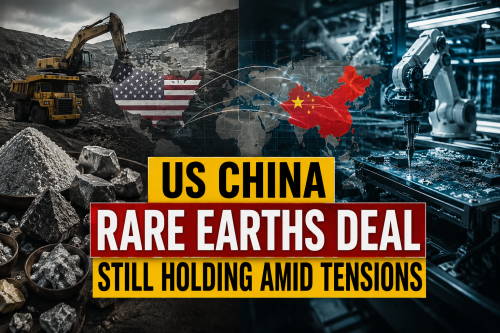
US China Rare Earths Deal Still Holding Amid Tensions — A stark visual contrast reveals the fragile balance between industrial mining power and advanced manufacturing as global supply chains remain under pressure.
A quiet confirmation from a US official has added new weight to an already sensitive global supply chain issue. The rare earths arrangement between Washington and Beijing is still in effect, according to reporting first surfaced through Reuters, but the stability of that agreement appears far less secure than its continued status suggests. Beneath the official language, there is a sense of something being maintained rather than resolved.
Reuters Rare earths deal US China effect US official says
The timing matters. Rare earth elements sit at the center of modern manufacturing, from electric vehicles to defense systems, and any disruption in their flow between the world’s two largest economies carries implications that extend far beyond trade policy.
What Actually Happened
A US official confirmed that the rare earths arrangement with China remains in effect, even as broader geopolitical tensions continue to pressure economic ties between the two countries.
The confirmation does not signal a new agreement or expansion of cooperation. Instead, it points to continuity in a system that has been repeatedly tested by trade disputes, export controls, and strategic competition over critical minerals.
Rare earths, despite their name, are not necessarily rare in nature, but their processing and refinement are heavily concentrated, with China maintaining a dominant position in global supply chains.
Help keep this independent voice alive and uncensored -> Buy us a Coffee <-
Why This Moment Matters
The significance of the deal being “still in effect” lies less in diplomacy and more in dependency.
Industries in the United States and allied economies rely on stable access to processed rare earth materials for semiconductors, renewable energy infrastructure, and advanced weapons systems. Even minor shifts in export policy can ripple through manufacturing timelines and pricing structures.
At the same time, Washington has been attempting to diversify supply chains, investing in domestic processing capacity and partnerships with countries such as Australia and Canada. Those efforts, however, remain in development rather than full-scale replacement.
The Pattern Behind the Event
This latest confirmation fits into a broader pattern that has defined US-China relations over the past decade: continued economic interdependence paired with strategic decoupling attempts.
On one hand, both sides maintain essential trade flows that neither can easily replace. On the other, each continues to build safeguards against potential disruption from the other.
Rare earths sit at the center of this contradiction. They are both a commodity and a strategic asset, which makes every policy signal carry outsized importance.
Where the Tensions Are Building
The underlying tension is not about whether the agreement exists, but how long it can hold under increasing pressure.
China’s dominance in rare earth processing gives it leverage in global supply chains, while the United States views that dependency as a long-term vulnerability. That imbalance has already prompted export controls, tariff disputes, and accelerated investment in alternative supply routes.
Even without formal breakdowns in agreements, uncertainty alone can reshape investment decisions across technology and defense sectors.
What This Could Signal Next
For now, the arrangement remains in place, but its future appears tied to broader negotiations that extend well beyond minerals.
Trade policy, national security concerns, and industrial strategy are increasingly overlapping. That convergence suggests that rare earths may continue to serve as both a stabilizing mechanism and a pressure point between the two economies.
What happens next is likely to depend less on a single agreement and more on whether either side believes long-term dependency is still acceptable.
Final Reflection
The confirmation that the rare earths deal remains active does not close the story. If anything, it highlights how much of the global supply chain still rests on arrangements that are stable in practice but uncertain in principle. The real question is not whether the flow continues today, but how long the balance can hold under growing strategic pressure.
About the Author