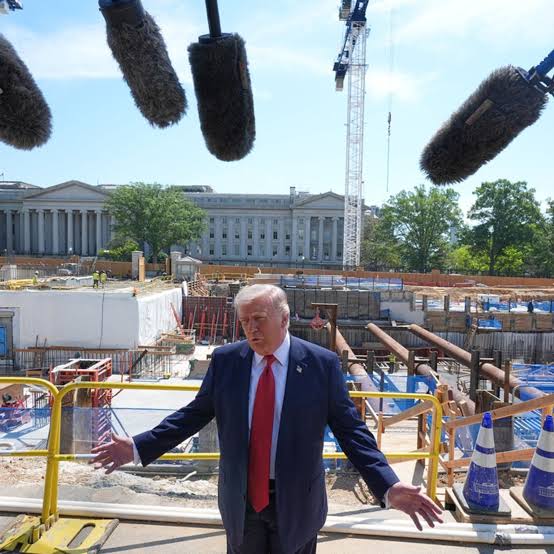
There’s a particular tone leaders use when they want optimism without committing to detail. It was visible again when former President Donald Trump said he had “good news” regarding Iran, while offering almost no clarity on what that news actually was.
The phrase landed in a familiar space between diplomacy and ambiguity. Markets didn’t react sharply. Officials didn’t confirm anything concrete. And yet, the statement immediately entered the information cycle, feeding speculation faster than verification.
Trump signals good news on Iran talks
https://www.reuters.com/world/asia-pacific/trump-says-he-has-good-news-iran-no-clarity-peace-deal-2026-04-18/
What stands out is not just what was said, but what was left unsaid.
A pattern of strategic ambiguity
In previous diplomatic cycles involving Iran, messaging has often followed a predictable rhythm: vague optimism, selective leaks, and delayed confirmation from official channels. The current moment appears to be repeating that pattern, though with a more compressed news cycle and higher public sensitivity.
The uncertainty is not just political theatre. It reflects deeper structural constraints in how modern negotiations are communicated. Governments often balance three competing pressures: maintaining leverage, calming markets, and managing domestic political expectations. The result is messaging that hints at progress without exposing terms.
Help keep this independent voice alive and uncensored -> Buy us a Coffee <-
This becomes clearer when looking at broader coverage of nuclear negotiations and regional diplomacy.
AP News coverage on Iran nuclear negotiations
https://apnews.com/hub/iran
The AP’s ongoing reporting on Iran-related diplomatic discussions highlights how frequently “near breakthroughs” are announced long before any formal agreement exists. This gap between announcement and outcome is not accidental—it is often part of the negotiation strategy itself.
Information moves faster than verification
One of the more noticeable shifts in recent years is how quickly ambiguous political statements become global narratives. A single phrase like “good news” can generate thousands of interpretations within minutes, regardless of whether any agreement exists behind it.
In this case, the lack of detail created a vacuum that was immediately filled by speculation. Analysts debated whether the comment referred to sanctions relief, nuclear oversight talks, or indirect regional de-escalation efforts. None of these interpretations were confirmed.
What followed raised further questions about how institutional communication is adapted to a high-speed media environment where ambiguity is often more powerful than detail.
Media framing also plays a role here. Headlines tend to prioritize momentum over nuance, especially when geopolitical stakes are high. That can amplify partial statements into perceived developments long before policy shifts actually occur.
The structural tension behind diplomacy
At a deeper level, the situation reflects a recurring tension in international governance: the need to signal progress without collapsing negotiation space.
Iran-related diplomacy has historically been shaped by cycles of escalation and attempted normalization. Each cycle produces its own language—phrases like “constructive talks,” “positive atmosphere,” or “significant progress.” These terms are intentionally elastic.
BBC background on Iran nuclear agreement discussions
https://www.bbc.com/news/topics/cg7262j52z1t/iran-nuclear-deal
BBC’s long-running coverage of Iran nuclear discussions shows how often apparent breakthroughs have later stalled due to verification disputes, political transitions, or regional pressures. The pattern suggests that communication itself is part of the strategic environment, not separate from it.
What makes the current moment notable is not necessarily the content of the statement, but its timing. It arrives amid broader geopolitical strain, where even minor signals are quickly interpreted through security and economic lenses.
Reading between the lines of modern diplomacy
There is a growing mismatch between how diplomacy functions and how it is consumed publicly. Negotiations are slow, technical, and layered with conditional language. Public discourse is immediate, binary, and driven by headlines.
That gap creates a recurring distortion: partial signals are treated as outcomes, and tentative language is interpreted as resolution.
In this case, the phrase “good news” becomes a container for multiple unresolved narratives—sanctions, nuclear oversight, regional security arrangements—none of which have been confirmed.
The institutional response has remained cautious, which itself is often a signal. Silence in diplomacy rarely means absence; it usually means negotiation is still active or deliberately contained.
A moment that says more about process than outcome
What emerges from this episode is less about Iran or any specific agreement, and more about the mechanics of modern geopolitical communication. Statements are no longer endpoints—they are triggers in a continuous information loop involving governments, media systems, and public interpretation.
Whether any substantive development follows remains unclear. But the pattern itself is consistent: ambiguity enters first, clarity arrives later, and sometimes not at all.
For now, the only certainty is that the phrase has already done its job—setting expectation without defining it. And in that space between message and meaning, the real dynamics of diplomacy continue to operate, largely out of view.
The question is not just what the “good news” refers to, but why so much of modern international communication now relies on leaving that question unanswered.
About the Author