The choreography was familiar.
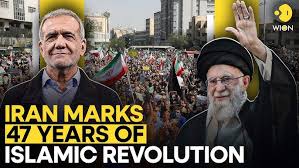
Crowds filled Tehran’s main avenues before noon, moving in steady lines beneath winter skies. Flags rose and fell in rhythm. Loudspeakers carried speeches across the square. The anniversary of 1979 — now forty-seven years past — was marked the way it has been for decades: publicly, forcefully, without ambiguity.
Iran’s revolution anniversary rallies are designed to project continuity. The message is simple. The revolution endures.
Participants carried mock coffins bearing the faces of American military leaders. U.S. and Israeli flags were set alight. A towering effigy labeled Baal, marked with a Star of David, was torched before cameras. The symbolism was not subtle. It was theatrical, declarative, meant for domestic affirmation and foreign audiences alike.
President Masoud Pezeshkian addressed the crowd with a sharpened tone. He accused Washington, Tel Aviv, and parts of Europe of provocation. Ballistic missiles, he said, are non-negotiable. The statement lands in the middle of ongoing tensions over Iran’s nuclear program — negotiations that stall, resume, and stall again.
On the surface, the images speak of defiance.
Help keep this independent voice alive and uncensored. Buy us a Coffee
But anniversaries are rarely only about the past. They are about present legitimacy.
Forty-seven years after the Islamic Revolution reshaped Iran’s political order, the state continues to lean on ritual. Organized rallies. Carefully framed speeches. Controlled displays of anger directed outward. It is a language honed over decades.
The anti-U.S. and anti-Israel rallies serve multiple purposes at once. They unify supporters. They signal resolve. They reinforce a narrative of resistance against external pressure. They also remind domestic audiences that the revolutionary identity remains the foundation of governance.
Yet beneath the slogans lies a quieter question: how much of this is conviction, and how much is preservation?
Iran faces economic strain. Sanctions linger. Currency pressures ripple through ordinary households. Younger generations have grown up entirely within the post-revolutionary system, their relationship to its founding mythology more distant than that of their parents or grandparents.
Public anger directed outward can redirect internal tension — at least temporarily.
The burning of flags, the coffins, the effigies — these are gestures layered with symbolism. They are intended to simplify a complex geopolitical reality into a clear narrative of opposition. America. Israel. Europe. The adversaries are named.
But diplomacy continues behind closed doors. Even while missiles are declared untouchable, channels remain open. Even while rhetoric sharpens, calculations persist.
That duality is not new. It is part of the system.
For foreign observers, the spectacle can appear rigid, even frozen in time. For those inside Iran, it is both ritual and reminder — a reaffirmation of ideological lines drawn nearly half a century ago.
The revolution’s anniversary is meant to display strength. It also reveals endurance. Whether that endurance reflects deep cohesion or sustained management of dissent is harder to measure from a podium.
As night fell over Tehran, the crowds dispersed. The effigy burned down to ash. The speeches ended.
The revolution remains officially intact.
What evolves beneath it is less visible — and perhaps more consequential over time.